


 New York Knicks Logo PNG
Attractive and informative symbols distinguish American basketball teams. The New York Knicks’ logo, established in 1946, reflects the team’s athletic profile, tactical identity, and respect for the city’s founding history.
The New York Knicks’ history dates to 1946, when Ned Irish founded the franchise in the Basketball Association of America at Madison Square Garden. The name referred to early Dutch settlers in New York. After the 1949 merger with the National Basketball League, the Knicks became one of the NBA’s founding teams.
In the early 1950s, the club reached three straight Finals in 1951, 1952, and 1953, losing to the Minneapolis Lakers and the Boston Celtics. The team declined until 1964, when Willis Reed was drafted and later became Rookie of the Year, marking the start of a new phase.
In 1967, coach Red Holzman reshaped the team. Alongside Reed, players like Walt Frazier and Dave DeBusschere formed a balanced core. In 1970, the Knicks won 60 games and defeated the Los Angeles Lakers in the Finals. Reed’s brief appearance in Game 7 became one of the most recognized moments in league history. In 1973, the Knicks again beat the Lakers to win a second title.
After Reed’s retirement in 1974, performance declined. In the 1980s, Bernard King led the offense until injury disrupted his career. In 1985, the team selected Patrick Ewing first overall. For 15 years, Ewing anchored the franchise, but the franchise repeatedly exited the playoffs against the Chicago Bulls. In 1994, the Knicks reached the Finals but lost to the Houston Rockets.
In 1999, the team made another Finals run as an eighth seed, losing to the San Antonio Spurs. After Ewing traded in 2000, the franchise entered a long period of instability. In 2011, Carmelo Anthony joined, but did not deliver deep playoff runs. By 2023–24, the Knicks returned to the Eastern Conference Finals behind Jalen Brunson.
Thus, an Irishman became the owner and led the club, with participation from The Madison Square Garden Company. Initially, they wanted to choose a different nickname, but then they gathered the team members at a meeting to cast their votes in a hat. After counting the votes, the franchise was named the “Knickerbockers.”
The name “Knickerbockers” comes from the pseudonym Washington Irving used in his book “A History of New York.” This name came to be applied to the descendants of the first Dutch settlers in the area that later became New York. This term denotes trousers, such as crop pants or pantaloons, tucked under the knee; they were integral to the image of the New World settlers.
In addition, in 1845, a local baseball organization was called the Knickerbocker Nine. This nickname was suggested once again. The team is most often called the “Knicks.” James Dolan became the team owner in 1999. He still holds shares in Madison Square Garden.
Meaning and History
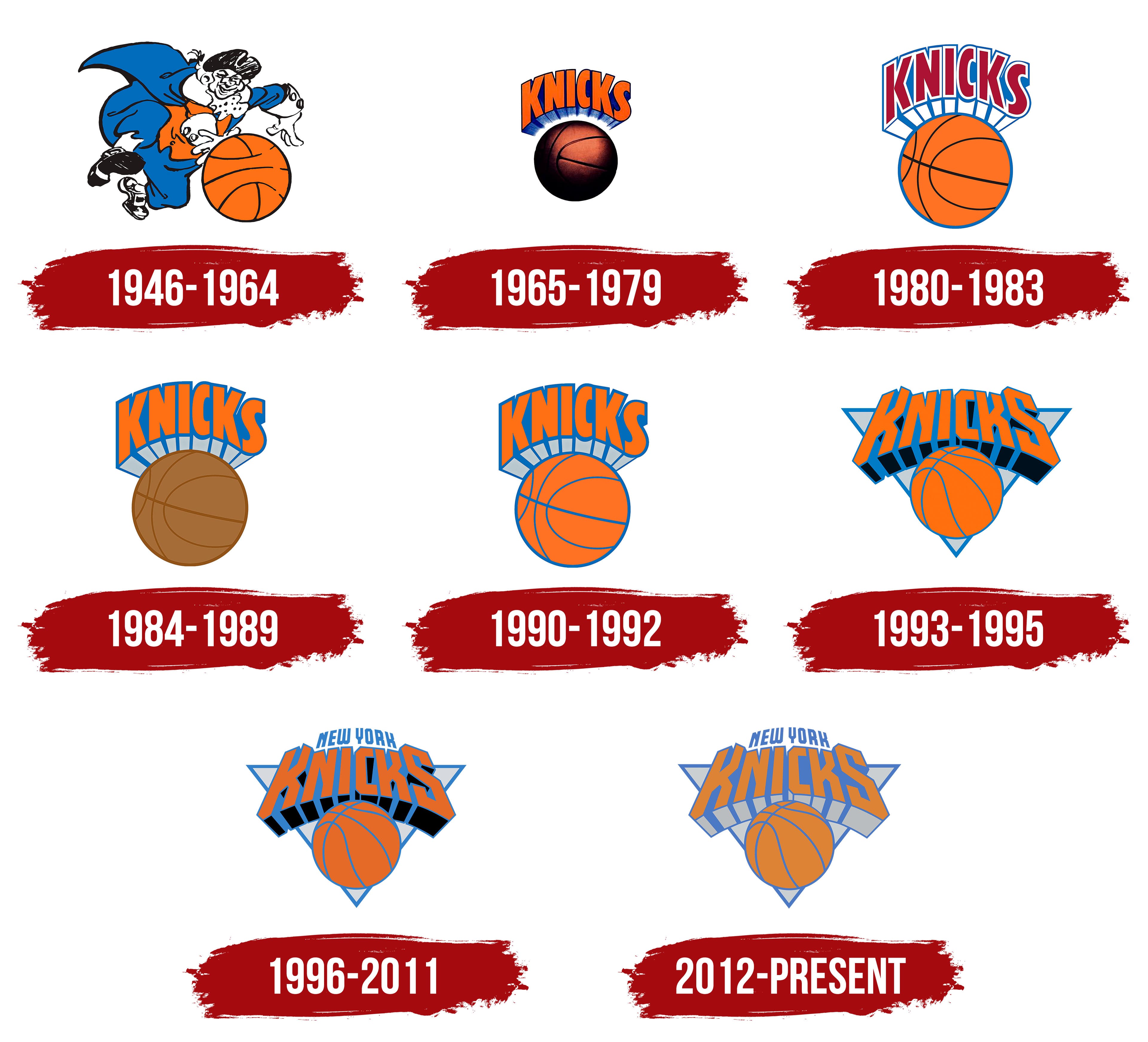
The New York Knicks’ logo was approved in the year the team appeared and fully meets the requirements for a basketball-oriented logo. It features a ball and the name. Moreover, the emblem’s entire history is an evolution from simple to complex. Over the sports club’s history, it has had eight logo variants.
What is the New York Knicks?
The New York Knicks are an abbreviation of New York Knickerbockers, a sports franchise of the National Basketball Association. The team has existed since 1946 and plays its home games at Madison Square Garden. Madison Square Garden Sports Corp. owns the team.
1946 – 1964
The club’s very first logo was “Knickerbockers,” derived from the Dutch settlers who arrived in the New World. Most of them settled in the area now known as New York. Specifically, this refers to the style of trousers worn by settlers. Pants rolled below the knee came to be called “breeches” or “pantaloons.” Now, this word is mostly forgotten, and the team name is shortened to “Knicks” in 100% of cases.
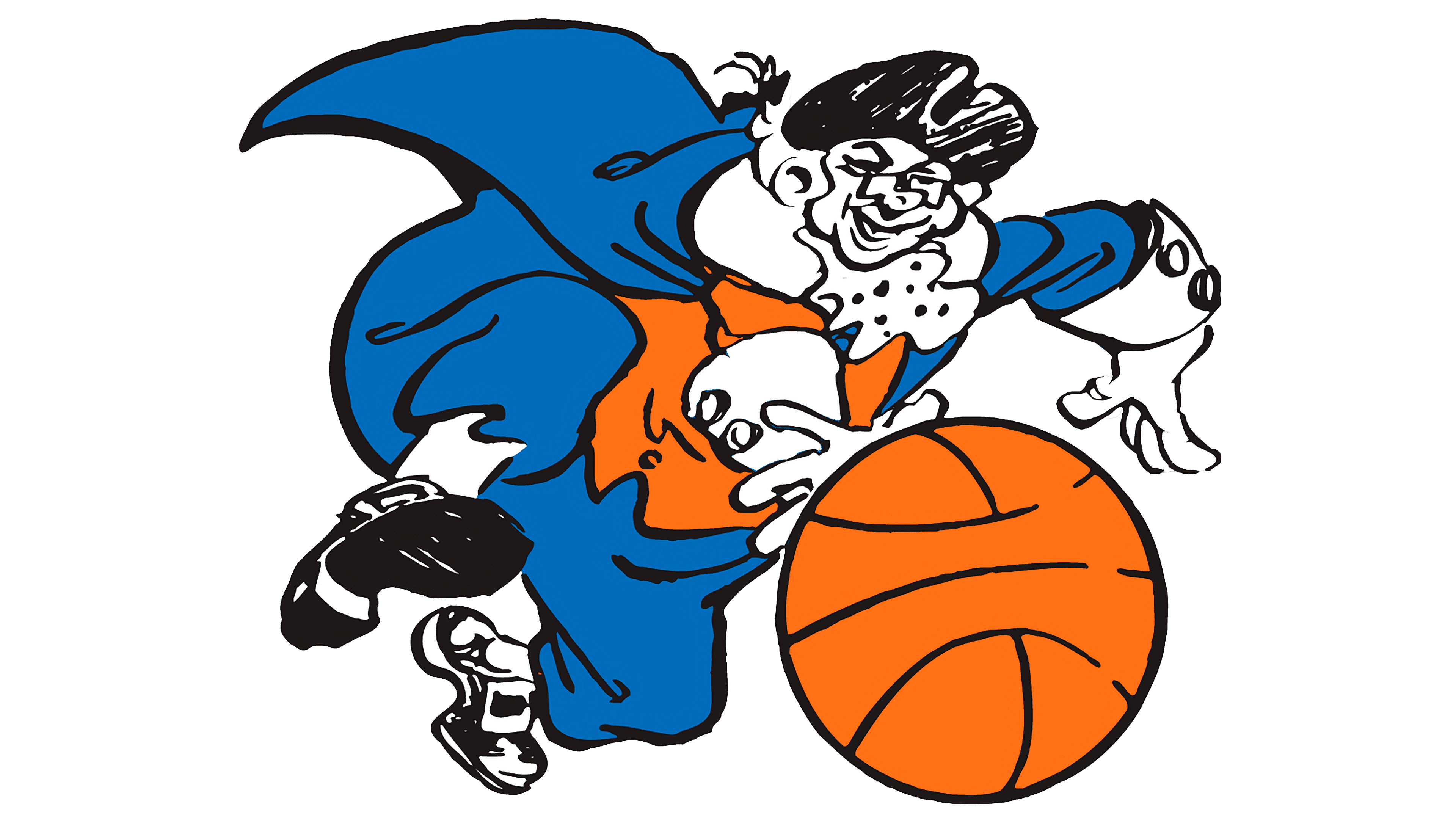
The debut emblem was designed for the first official basketball competition in the 1946/47 season. It featured a player nicknamed Father Knickerbocker. He is running forward, trying to catch a ball with both hands. The main character wears a black cap with a visor, a red-orange vest, blue pants, and a matching jacket. He wears boots with large buckles. Willard Mullin created the cartoon version. As an animator, he shaped the drawing style.
1965 – 1979
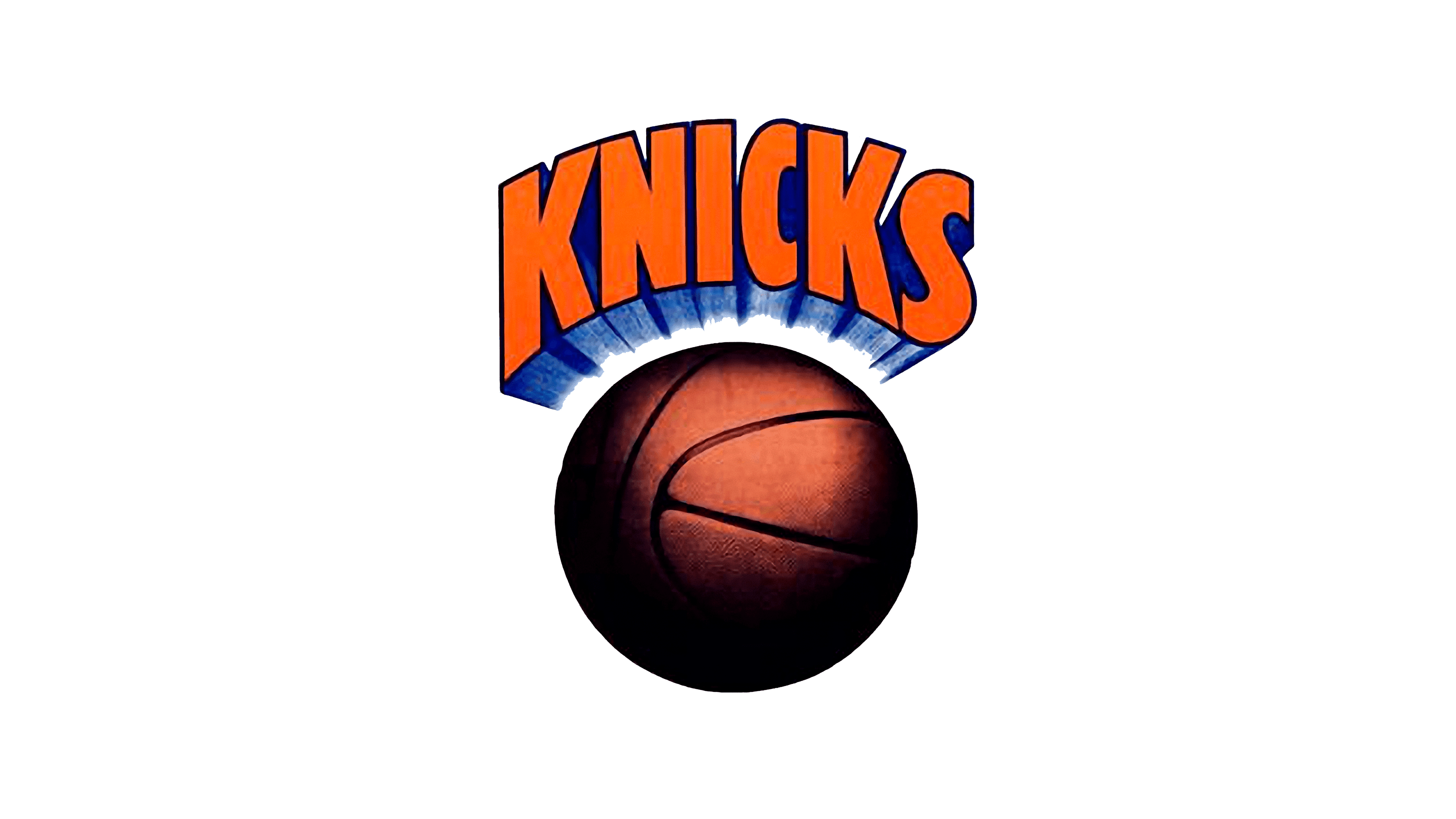
The New York Knickerbockers will present an iconic logo that will last for the next three decades. Bud Freeman of the advertising agency J.C. Bull developed it. The New York Knicks logo depicts a brown basketball “highlighted” by the word “KNICKS.” The letters are orange, with a shadow on the lower part for a 3D effect. The letters also have a black outline.
1980 – 1983
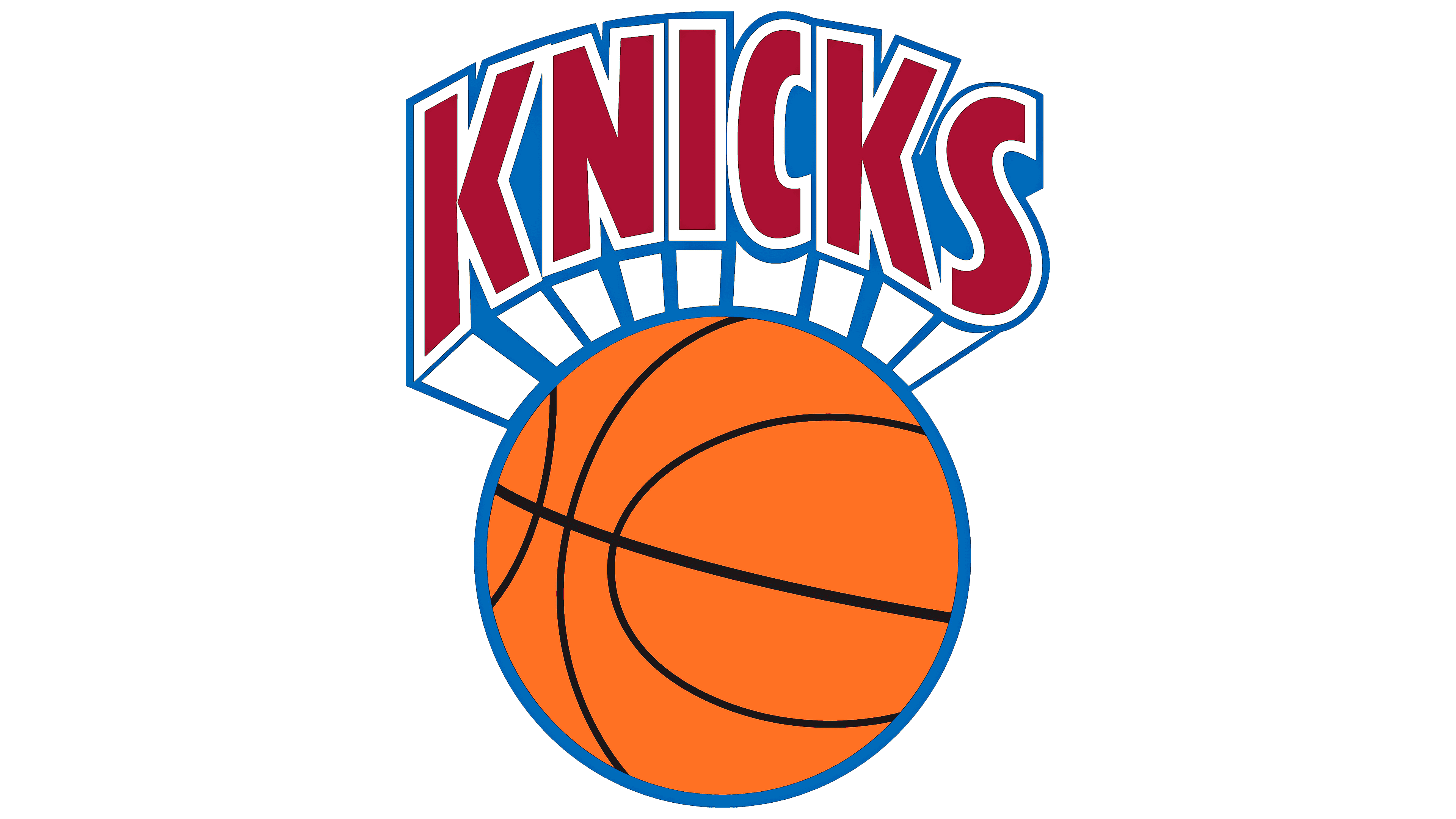
In this version of the New York Knicks logo, the designer changed the basketball’s color, making it much lighter. He also added black seams and a blue outline. The font remained the same; only the color scheme changed: the letters became burgundy with a white-blue outline. The shadow beneath the word “KNICKS” expanded and deepened, enhancing the 3D effect.
1984 – 1989
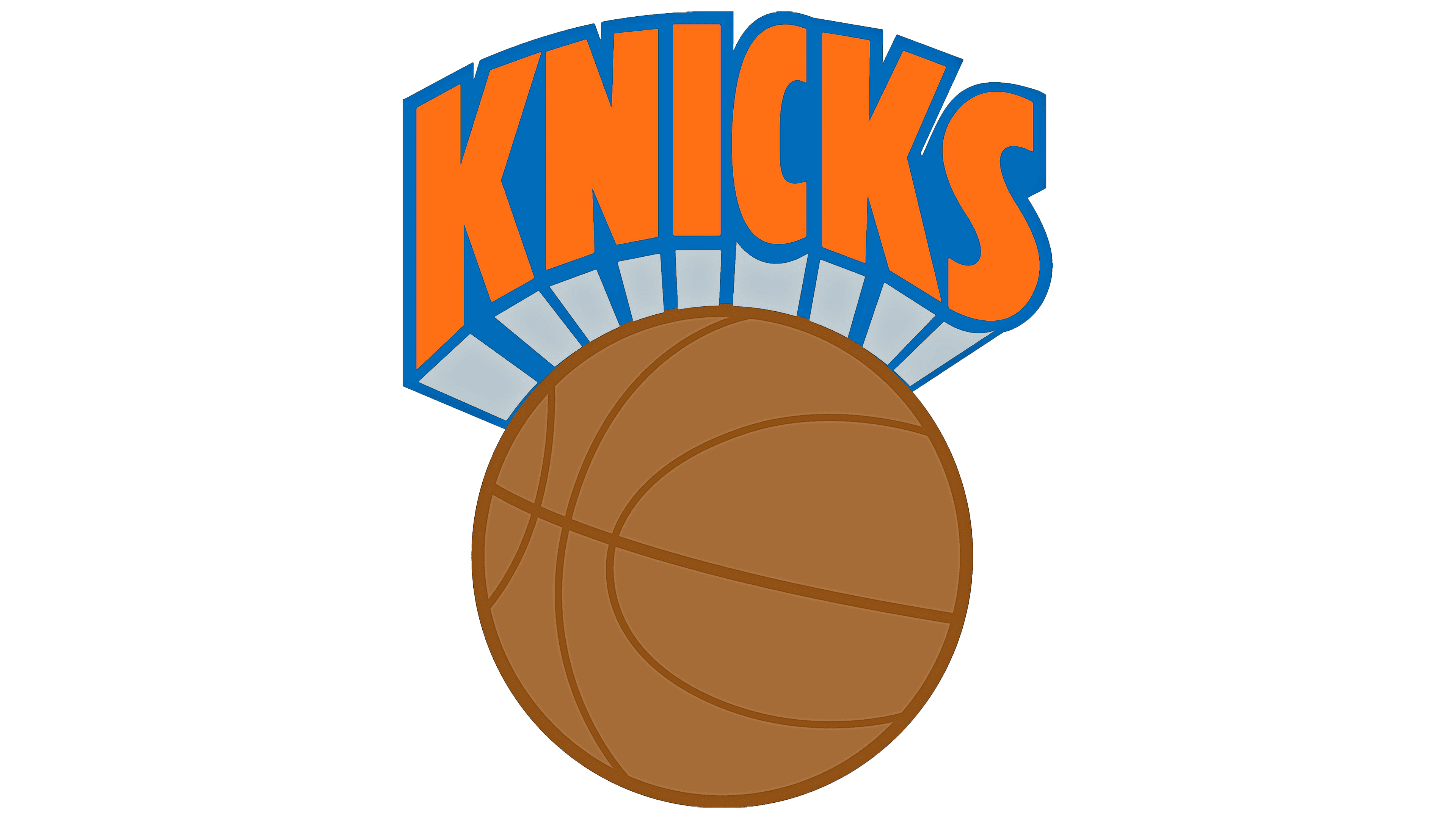
The New York Knickerbockers’ logo of this period had different colors, but the form, fonts, placement, and size remained the same. The color palette had pastel shades, so the elements did not look aggressive. The Knicks made minor changes to the logo, again changing the basketball to brown with dark brown seams. Reflecting light from below, the letters became blue. All details of the New York Knicks logo have a blue outline, except for the basketball, whose outline is dark brown, and the seams, which are also dark brown.
1990 – 1992
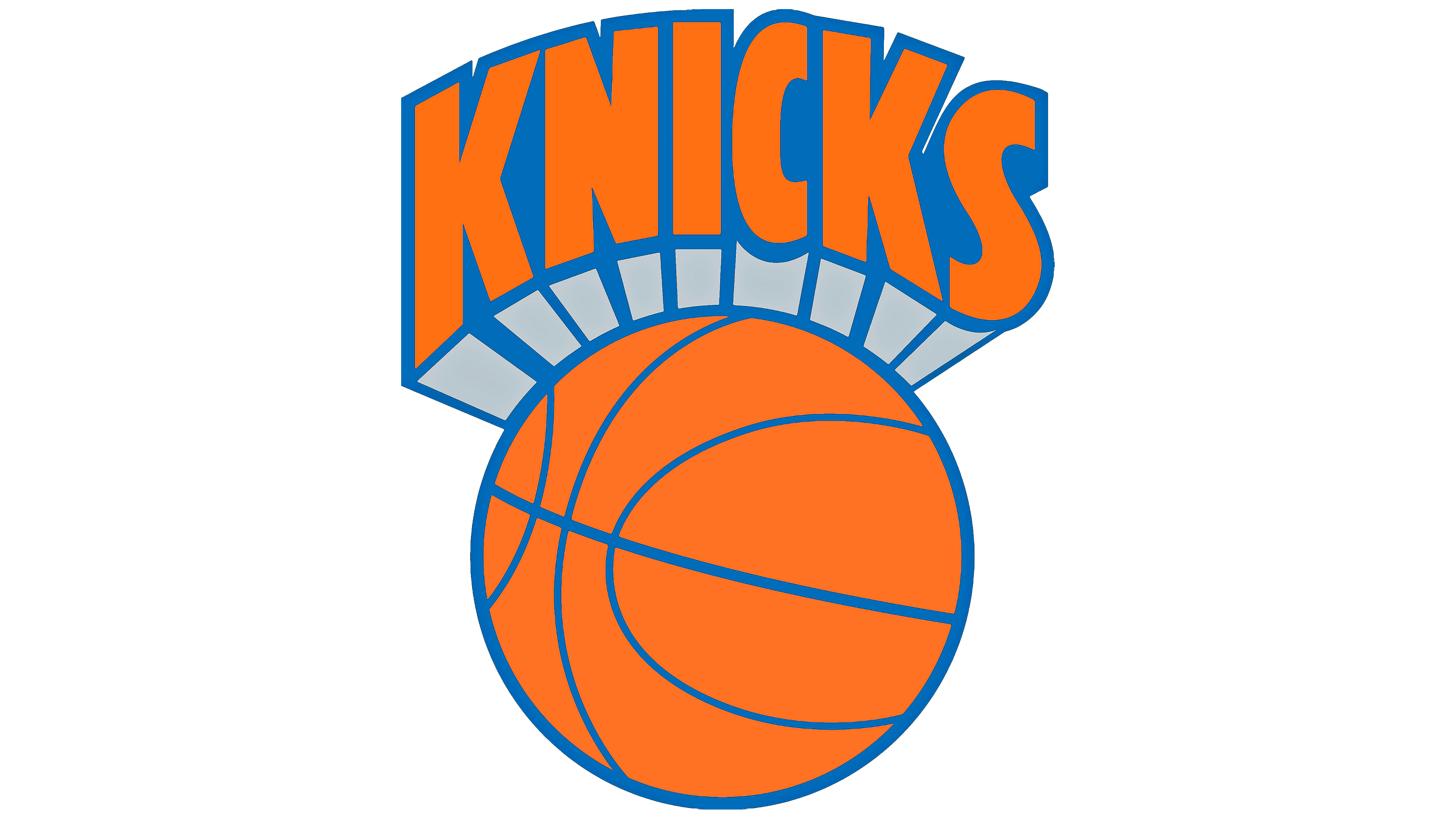
In this version of the New York Knickerbockers logo, the colors changed. The designers lowered the saturation and enhanced the foggy effect. The basketball became the same orange shade as the wordmark “KNICKS.” All key elements have a blue outline. The letters’ 3D shadows became bluish-gray.
1993 – 1995
In 1992, the Knicks updated their logo. Michael Doret proposed using a triangle. Tom O’Grady developed other elements. Against a bluish-gray geometric backdrop, the slightly tilted, backward word “KNICKS” appeared, enhancing the 3D effect. The letters extend beyond the triangle and are darkened from below. The basketball’s contour and seams are light blue. The primary color is orange.
1996 – 2011
The 1996 logo version has very minor color changes. The inscription “NEW YORK” is located above the team’s nickname between the letters “K” and “S.” The fonts, triangle, basketball, and its seams remained the same, as did the outlines of the elements.
2012 – today
The current version differs radically from the debut one: the only thing that connects them is basketball. Over time, the emblem gained more complex details than it originally had, even though it remakes the previous logo. The designers removed the black shadows (replacing them with a grayish tone) and toned down the brick color. Everything else was left unchanged.
Many Knicks fans were pleased to return to the blue color palette, which the club used for most of its history. Orange, blue, and white are New York’s official colors. But the blue color is very common. It looks neutral and suits any team in any sport. The current Knicks logo’s orange color is quite rare, and its focus on shine and confidence suits a team from a big city. In this case, the blue border looks good, and the white font draws attention to the team’s name.
The New York Knicks logo somewhat resembles a label from a second-rate laundry detergent and would be appropriate on the chest of some superhero. Of course, this isn’t very bad, but it somehow doesn’t feel serious for an enterprise of such a level and rich history.
Font and Colors
The team’s visual identification mark has gone through several stages. The most significant changes occurred in 1965 and 1993, more than half a century apart. In the first noted period, the design shifted to a simplified version in which the ball and the name were combined into a single 3D element. Bud Freeman offered the version that became the prototype of all subsequent ones from the advertising studio J.C. Bull. Michael Doret developed the 1993 version. He used a triangle in the emblem, a voluminous name, and a basketball.
The font’s main feature is its volume. To create a 3D effect, the artist used shadowing. Moreover, the letter style does not resemble any known commercial fonts. It’s unique because it was created specifically for this logo. The colon is visually tilted and narrowed towards the center.
The team’s color palette echoes New York City’s official palette. It consists of white, blue PMS 293, and orange PMS 165. Some periods also included silver and black.
FAQ
Why is there a triangle in the Knicks logo?
The inverted triangle became part of the New York Knicks’ emblem in the mid-1990s. They added it to make the team’s logo resemble a superhero symbol, as the triangular base, according to the developers, should evoke those associations. The design drew inspiration from the emblems of Gotham City, Batman, and Superman.
Who designed the Knicks’ logo?
Tom O’Grady created the original version of the current logo in 1993. Later, the New York Knicks’ designers remade the iconic symbol twice.
Where is the New York Knicks located?
The New York Knicks are based in the smallest and most densely populated borough of New York – Manhattan. Their home stadium, Madison Square Garden, is there.
Is the Knicks still a team?
Yes, the New York Knicks remain an original team of the National Basketball Association; they have never changed their name or relocated.