


 Halifax Logo PNG
“All roads lead to our bank,” the Halifax logo says. “If you are looking for the best in your business, this is the place for you.” The emblem suggests the institution can solve financial issues and stand out from other companies.
Halifax began in December 1852, when civic leaders in the Yorkshire town discussed creating a building society. Its rules were approved in February 1853, and the Halifax Permanent Benefit Building and Investment Society was registered. According to tradition, early meetings took place in a room above the Old Cock Inn. Jonas Taylor, a 24-year-old solicitor’s clerk, became secretary and held the post for nearly 50 years.
The model relied on pooled savings. Members deposited money, earned interest, and others used the fund to buy or build homes. Halifax grew mainly through branch expansion rather than takeovers. It opened 3 branches in its first year, reached 12 by 1862, and became Britain’s largest building society by 1913. In 1928, it merged with Halifax Equitable Building Society, then the country’s second-largest society. The new Halifax Building Society had assets of £47 million.
Financial liberalization in the 1980s allowed Halifax to add current accounts, credit cards, insurance, and estate agency services. In 1993, it opened Banco Halifax Hispania in Spain. In 1995, Halifax announced a merger with Leeds Permanent Building Society and a plan to demutualize. On June 2, 1997, Halifax plc joined the FTSE 100. In 2001, Halifax merged with Bank of Scotland in a £10.8 billion deal, creating HBOS. In 2007, Halifax plc’s assets moved to Bank of Scotland plc. The 2008 financial crisis exposed HBOS’s risky property lending. On January 19, 2009, the Bank of Scotland, including Halifax, became part of Lloyds Banking Group.
Meaning and History
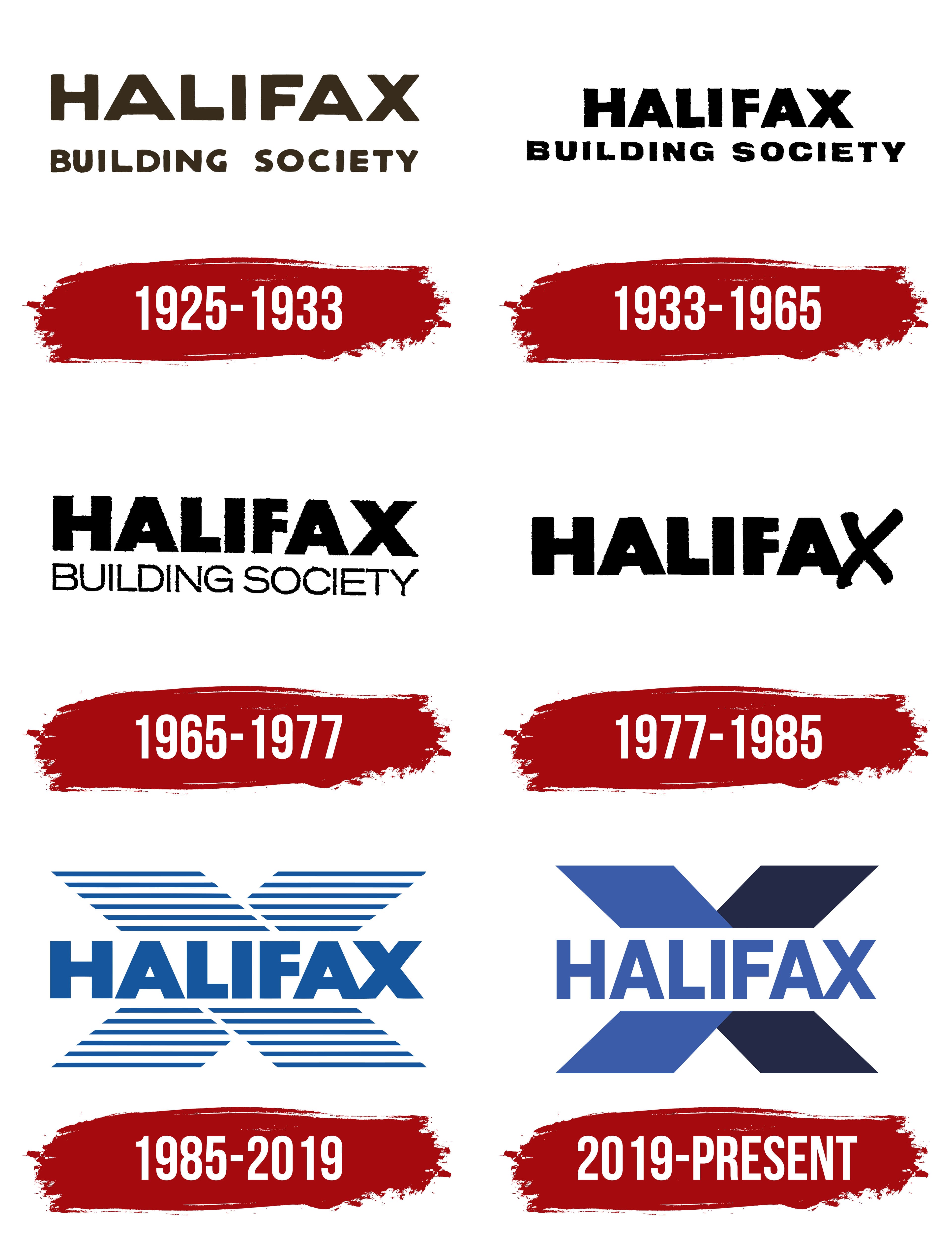
A brand with more than a century and a half of history strives to become relevant and modern; therefore, it regularly revises its visual identity. This approach helps it stay afloat amid competing fintech startups.
The famous “X” symbol associated with Halifax is relatively recent. Earlier logos focused on the company name and included no additional decorative elements. Wolff Olins designed the original enlarged X, which has become one of the UK’s most iconic emblems. Modern designers have slightly updated the brand’s appearance to appeal to both younger and older generations.
What is Halifax?
Halifax is a division of the Bank of Scotland and a leader in mortgage lending in the United Kingdom. The company was established in 1853, initially as a building society. Since then, its range of services has expanded significantly, as has the number of operating branches.
1925 – 1933
A year after opening the London office, Halifax adopted a new logo that mentioned its name. The word “HALIFAX” was at the top of the line and in large print. The second row read “BUILDING SOCIETY,” in smaller capital letters. The color was dark, something between black and brown.
1933 – 1965
The designers changed the characters’ widths and the letter spacing, so the inscription on the bottom line began to take up more space. By contrast, the word “HALIFAX” visually diminished. Small depressions appeared at the ends of the letters, although the style generally did not change. Black became the main color, and the background remained white.
1965 – 1977

In 1965, the font was slightly adjusted so that the two lines were equal in length. The letters in the phrase “BUILDING SOCIETY” became thinner, and the letters in the word “HALIFAX” became larger.
1977 – 1985

After another redesign, they removed the bottom inscription. The letter “X” looked non-standard, like an uneven hand-drawn cross.
1985 – 2019

In 1986, the building cooperative gained more financial freedom. Before expanding the business, it adopted a new logo with blue ‘HALIFAX’ lettering surrounded by the same blue stripes. The horizontal lines above and below formed an outline resembling the letter “X”.
2019 – today

The Halifax brand was relaunched on April 5, 2019, with the “Making It Happen” strategy. The corporate identity renewal was designed to make the brand more competitive against Starling, Atom, and Monzo. London-based creative agency Rufus Leonard developed the visual identity and also handles Lloyds Banking Group’s identity.
The current Halifax logo looks laconic. The letters are thinner, and the many horizontal stripes have been replaced with four colored blocks. Carlo D’Alanno, one of Rufus Leonard’s leaders, drew inspiration from other fintech companies’ aesthetics. That may be why CEO Monzo accused Halifax of plagiarism.
Font and Colors
The striped “X” looked like an IBM symbol. Moreover, the lines were erased in the digital space, contradicting the company’s goal of entering the modern financial technology market. The new interpretation solved this problem: the revised “X” consists of four large parallelograms visible at any scale.
Rufus Leonard’s agency didn’t make global changes, only slightly simplifying its identity. The designers said that Halifax has “nothing broken,” so there is no need to relaunch the brand completely. From their perspective, a slight style update was enough to attract new clients, especially young people.
The new font is thinner than the previous ones. The letters are thinner because they are elongated vertically. This is an almost exact copy of the typeface Falling Sky Blk developed by the printing studio Cannot Into Space Fonts.
The base color remains blue, as before. The palette has two shades: one darker (#011747) and the other lighter (#005EB9, similar to Honolulu blue). Against a white background, they look soothing because the designers wanted to create a welcoming atmosphere that wouldn’t feel too strict or official.