


 MMs Logo PNG
The modern M&M logo, the most famous candy brand, reflects the founders’ names and the material used in production. The simplicity and straightforwardness of today’s emblem have ensured the product’s visual appeal and recognizability.
M&M is a well-known chocolate candy brand produced by Mars. The brand is renowned for its entertaining advertising campaigns and vibrant candies, available in two varieties: with peanuts and without.
M&M’s originated during the Spanish Civil War, when Forrest Mars Sr. observed soldiers eating chocolate that didn’t melt easily. In 1941, he teamed up with Bruce Murrie from Hershey’s to create a unique chocolate candy that stayed solid in your hand. They named it M&M’s, after their last names.
By 1954, M&M was getting even better. It introduced peanuts into its chocolates and came up with the catchy slogan “Melts in your mouth, not in your hands.” This made it even more loved by chocolate fans everywhere.
In the 1960s, M&M’s reached new heights as the first candy to travel to space with NASA, giving astronauts a taste of home. However, a hiccup occurred in 1976 when red M&M’s were pulled from shelves over concerns about a certain dye, but they returned in 1987 with the full range of colors.
Over the years, M&M kept things exciting by adding new flavors like peanut butter and crispy, as well as mini versions of the candies. In 1995, they went digital by launching their website, becoming one of the first candy brands to do so.
The brand came to life with colorful characters like Red, Yellow, Green, Blue, and Orange, making it even more memorable.
The 2010s focused on innovation, with new flavors like Pretzel M&M’s and collaborations with other major brands. In the 2020s, M&M’s celebrated its 80th anniversary by introducing lower-sugar and vegan options to meet what people want.
For nearly 80 years, M&M’s has been evolving, bringing new flavors and joy to people across generations.
Meaning and History
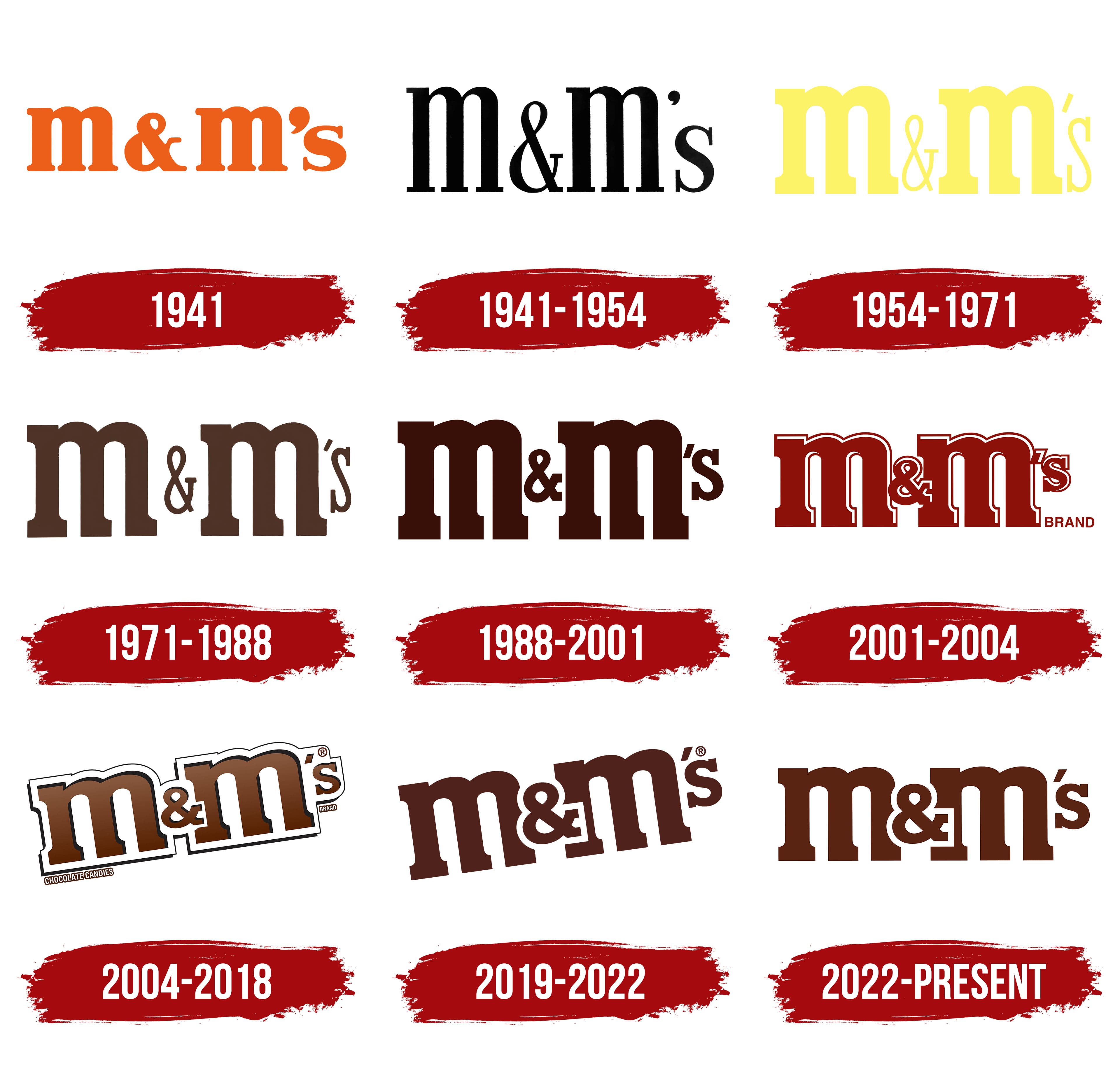
The packaging was introduced in 1941. The M&M logo has always been a wordmark with no additional symbols. The only differences have been the font and color palette.
What is M&M’s?
M&M’s is a brand of multicolored, round candies with a hard shell and a white letter “M” on them. It belongs to the American company Mars, and its name stands for Mars & Murrie’s. The first M&M’s appeared in 1941. The US Army purchased them so soldiers could carry chocolate that doesn’t melt in hot climates.
1941
M&M’s sugar-coated chocolate candies began production in Newark, New Jersey, in 1941. The candies went on sale in the United States that same year. A few months later, after the country entered World War II, production shifted to military rations. The candies were well suited to supplying troops in warm climates. The military reserved them until the end of the war, then returned them to retail stores.
The two M’s in the M&M’s name refer to the surnames of the brand’s creators, Forrest Mars and Bruce Murrie. The initials of Mars and Murrie were joined by an ampersand, the symbol for “and.” The partnership helped secure chocolate for the new venture, since Bruce was the son of Hershey executive William Murrie. Mars later bought out his partner’s share while keeping both initials in the name. The brand became part of the Mars family of confectionery brands.
The early wordmark spelled the name in lowercase as “m&m’s.” Two large orange m’s dominated the lettering, with rounded shoulders, thick vertical strokes, and short serifs. The ampersand between them and the final “s” were smaller than the Mars and Murrie initials.
1941 – 1954

Cardboard tubes from M&M’s early years featured a wordmark with tall, narrow letters. The name occupied a light band wrapped around the dark packaging. The black logo looked more restrained than the orange version, and the packaging remained monochrome.
The name was set in a traditional lowercase serif typeface. The elongated m’s combined thick vertical strokes with thin connecting strokes. A narrow, elongated ampersand stood between them, and the final “s” was smaller than the main letters.
1954 – 1971

The yellow M&M’s wordmark relied on a contrast between heavy and delicate letterforms. The two lowercase m’s had thick rectangular serifs and rounded tops. The ampersand and final “s” retained elongated proportions and thin strokes, making them appear lighter than the initials. The letters kept some hand-drawn irregularities, while the yellow stood out against black.
The candies themselves also received a brand mark. In 1950, a black lowercase “m” began appearing on the sugar shells to help customers distinguish M&M’s from imitations. A single letter from the name had been transferred to the product.
In 1954, the printed letter changed to white. Peanut M&M’s joined the product lineup that same year. The white “m” became a shared identifying mark across candies with different shell colors.
1971 – 1988

In 1971, the M&M’s wordmark changed from yellow to brown. The lettering was slightly refined while preserving the contrast between the heavy lowercase m’s and the thin ampersand and final “s.” The serifs grew heavier, and the letters’ upper curves became softer. M&M’s used the brown version for 17 years.
1988 – 2001

The next M&M’s update thickened the ampersand and final “s,” bringing their forms closer to the heavy m’s. The ampersand rose above the baseline and sat in the small gap between the initials.
The name took on a compact shape. Dark brown and chocolate tones brought the letters together in a tightly spaced horizontal line. The design retained the earlier wordmark’s foundation and remained in use for 13 years.
2001 – 2004
The 2001 M&M’s logo update kept the name’s arrangement while changing the letters’ color and treatment. The brown became lighter and took on a reddish tone. White interior lines and a brown outer outline gave the lettering a dimensional appearance.
The outlines followed the serifs and rounded portions of the “M”, creating several nested layers of alternating white and brown. A small “BRAND” inscription appeared at the lower right.
2004 – 2018
The diagonal M&M’s logo first appeared on December 8, 2003, and was formally introduced in 2004. The wordmark was tilted upward from left to right, and the letters were given a three-dimensional treatment. On brown packaging, the logo stood out against a white backing that followed its outer contours.
Within the letters, brown shifted from light to dark. A white border separated the fill from the dark edges, while an offset black shadow added depth. Some versions included the small words “CHOCOLATE CANDIES” beneath the name.
The update extended to the packaging and the markings on the candies. The printed “m” grew larger, and the blue and yellow shells became brighter. In 2018, the dimensional emblem was replaced as the primary logo. However, it continued to appear on packaging and in advertising materials worldwide.
2019 – 2022

Following Mars, Incorporated’s March 2019 rebranding, M&M’s replaced its 15-year-old dimensional logo with a flat design. The lettering moved closer to the 1986 version. Dark brown returned as the brand’s main color, while the letters retained their upward diagonal.
Gradients and layered outer outlines were removed, leaving a solid fill. The enlarged ampersand moved closer to the neighboring m’s and sat above the baseline. Its white outline separated its slender curves from the initials’ heavy strokes.
The diagonal emblem appeared on promotional packaging and some standard product packaging. The 2022 update replaced it with a horizontal logo.
2022 – today

Mars, the American corporation, brought back the horizontal M&M’s wordmark as part of a major brand overhaul. Agency Jones Knowles Ritchie developed the new identity. It launched on January 19, 2022, and the brand announced the changes on January 20. The designers were tasked with giving the identity a distinctive personality while preserving the brand’s overarching idea. The update supported its aim to bring people together through conversation and shared enjoyment, helping them feel a sense of belonging.
The logo’s arrangement moved closer to the 1986 and 1991 versions. Lowercase letters with heavy serifs were aligned horizontally, removing the upward diagonal. Brown remained, but a lighter shade made the wordmark feel more cheerful within the established color scheme. The circled “R” above the final “s” was removed.
The ampersand took a leading role in the new identity. Its white outline partially overlaps the two neighboring m’s, separating its curves from the heavy letters. Once a link between the Mars and Murrie surnames, it now expressed the brand’s desire to bring people together. It also began appearing on its own, paired with images of colorful candies.
The logo’s lettering became the foundation for All Together, a type family JKR created in collaboration with Monotype. Creative Type Director Charles Nix and designer Juan Villanueva worked on the project. They first developed All Together Serif from the logo’s letterforms and serifs, then added All Together Sans. The name All Together carried forward the theme of connection behind the M&M’s update.
Font and Colors
The letter “M” on the candies and in the M&M’s wordmark share the same wide, rectangular serifs. Moreover, all “M” s appear lowercase, although they are uppercase. In this case, it is not a full-fledged font but a unique set of glyphs. Although the candy manufacturer recently introduced its corporate font, it doesn’t use it in the logo. Jones Knowles Ritchie created this eclectic emblem in 2022. The emblem’s design has remained relatively unchanged over the past few years. Both “M” s resemble glyphs from the Aachen SB-Medium font. As for “s,” the ampersand resembles the corresponding ITC Lubalin Graph Demi symbols.
All elements are brown, although M&M’s is considered the most colorful chocolate brand. The inscription’s color is associated with cocoa beans, from which the candies are made, because under the bright glaze coating, all dragées are the same brown. Wide white lines are used as contours.