


 M&S Bank Logo PNG
The M&S Bank logo promises profit and security for investors’ finances. The brand’s wide range of services makes it a respected player in the market, attracts capital, and contributes to business growth. The emblem reflects balance and stability.
M&S Bank began in 1985, when British retailer Marks & Spencer entered financial services under the name Marks & Spencer Financial Services. The company used its store network and existing customer base to offer basic retail banking products. At first, the range was narrow: consumer loans and credit cards were available through Marks & Spencer branches, linking shopping and finance through a single channel.
By the late 1980s, the business had moved beyond its initial credit products. It added insurance and savings accounts, then launched a loyalty program connected to purchases in Marks & Spencer stores. In the 1990s, the bank introduced mortgages. It expanded its in-store presence through banking kiosks, giving customers access to financial services without leaving the retail environment.
The major institutional shift came in 2004, when Marks & Spencer Financial Services entered a partnership with HSBC, one of the world’s largest banking groups. HSBC provided infrastructure, banking technology, and operational expertise, while M&S kept the customer-facing brand tied to Marks & Spencer. The partnership helped the bank broaden its services and move beyond the limits of a store-based financial arm.
In 2012, the organization was renamed M&S Bank, reflecting its development into a fuller retail bank. That year, it opened branches separate from Marks & Spencer stores, expanding its physical presence. From 2013 to 2015, M&S Bank upgraded its online banking. It launched a mobile app, allowing customers to manage their accounts on computers and smartphones. In the following years, it continued developing digital services and security systems. By the early 2020s, its products included credit cards, consumer loans, mortgages, insurance, savings accounts, and current accounts.
Meaning and History
What is M&S Bank?
This financial organization in the United Kingdom combines a wide range of banking services with the trusted reputation of the popular British retailer Marks & Spencer. It is a joint venture between HSBC and Marks & Spencer, offering a range of financial products, including credit cards, loans, insurance, and current accounts. By providing financial services in stores, the bank ensures customers a seamless banking and shopping experience. It offers financial products that align with the company’s values, leveraging strong consumer loyalty to the brand known for its quality and service.
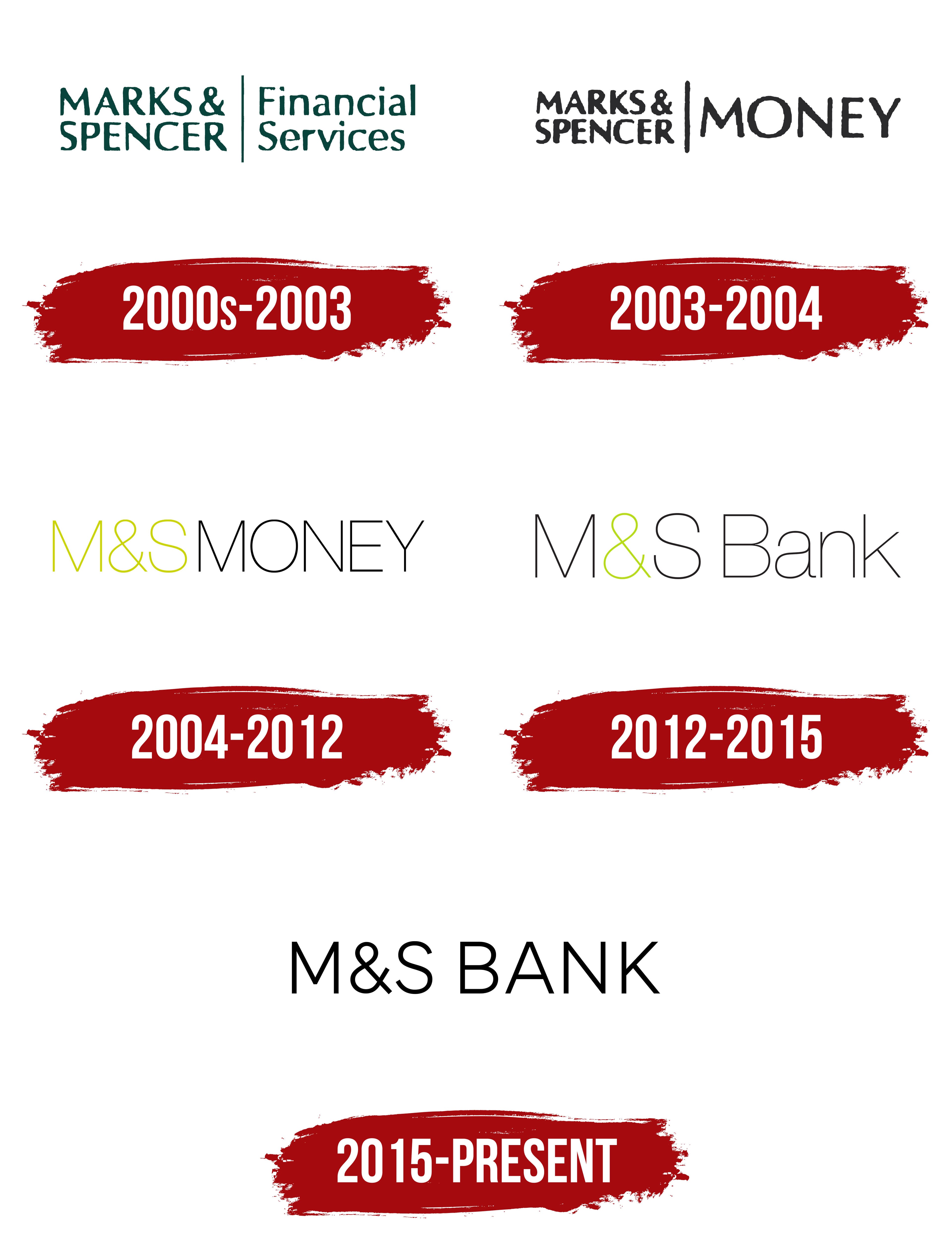
2000s – 2003

The emblem conveys information about the first financial enterprise established by Marks & Spencer, a well-known British consumer goods brand. A vertical line emphasizes the separation between the parent brand and the financial division.
On the left is the name of the main enterprise, Marks & Spencer, associated with its founders, Michael Marks and Thomas Spencer. On the right is the Financial Services area of activity, indicating the company’s development in this sector, including credit card issuance. The growing demand for these products facilitated the company’s expansion into the investment and banking markets.
The emblem is designed in dark green monochrome, symbolizing the financial enterprise’s respectability and solidity, evoking associations with monetary circulation. The green shade connects the financial division with the main brand, whose stores are traditionally decorated in green tones.
2003 – 2004

After changes in the business model, the division’s name was updated to Marks & Spencer Money. The design remained generally similar to the previous version of the visual identity. On the left is the parent company’s name, and to the right, the new division name is displayed after a vertical line. The word “Money” is highlighted in large capital letters, making it proportional and harmonious with the logo’s left side.
The color black conveys strength and confidence. It reflects the company’s ambition to hold leading positions in the financial market and indicates its ability to compete and succeed in this sector.
2004 – 2012
The emblem’s style was revised, and a new iteration was given. For the first time, the abbreviation “M&S” is used. Sleek, refined letters are arranged in a single line, emphasizing elegance and expertise in business operations. The words are highlighted in different colors to draw attention to key aspects.
The name “M&S” is gold, conveying the company’s strength and reliability and associating it with a respected and successful business. The word “Money” is displayed in black, signifying stability and a strong market position. The company secured a prominent place among the country’s leading credit card issuers. The change in company ownership to HSBC prompted a logo revision, reflected in the new design.
2012 – 2015
The company changed its name to M&S Bank, prompting an update to its emblem. The letters “M&S” became larger and are positioned higher, reflecting the company’s ambitions to increase sales volume over the next three years. The rebranding was part of a global strategy revision, including changes to store design and other aspects of the business.
Only the “&” symbol remains gold, a reminder of the company’s long history and high market status. The rest of the name is rendered in black, and “Bank” is written in capital letters, emphasizing the traditions of banking operations. This highlights the dependency on a larger structure. Due to debt obligations, the company is under HSBC management, and this process will continue until 2031.
2015 – today
The latest logo transformation showcased the business’s successful growth and the company’s confident position in the market. Financial difficulties are now past, and the new visual identity reflects stability. Capital letters and increased glyph thickness create a more balanced, powerful visual identity, emphasizing the company’s strength and confidence in its future success.