 MTA (Metropolitan Transportation Authority) Logo PNG
Business-like, strict, technical- all these describe the MTA (Metropolitan Transportation Authority) logo. Such characteristics make it a practical sign, conveniently placed on everything related to roads and passenger transport. It’s no wonder it represents an extensive network, demonstrating the reliability of one of the largest transporters in the USA.
New York’s MTA grew out of a transit system that had long been split among private operators. Public transport began with the 1827 Accommodation coach on Broadway, followed by steam elevated rail in 1870 and the first official subway in 1904. In 1940, the city bought BMT and IRT, bringing subway lines under public control. In 1953, NYCTA replaced the City Transit Bureau and introduced tokens.
The MTA’s origins date to 1965, when Governor Nelson Rockefeller proposed an authority to buy and rebuild the bankrupt Long Island Rail Road. On June 1, 1965, the Metropolitan Commuter Transportation Authority was created, and in December it bought LIRR from the Pennsylvania Railroad for $65 million. Rockefeller and Connecticut Governor John N. Dempsey also worked on saving New Haven commuter routes.
In May 1967, Rockefeller expanded the authority’s role across the New York region. Robert Moses resisted placing Triborough Bridge and Tunnel Authority toll revenue under the new body, but he yielded in February 1968. On February 29, 1968, the MCTA issued its Program for Action, calling for 50 miles of new subway lines and $2.9 billion in upgrades.
On March 1, 1968, the agency became the MTA, bringing NYCTA, TBTA, LIRR, New Haven, and New York Central commuter lines, and Staten Island Rapid Transit under a single structure. Deficits rose from $44 million in 1969 to $325 million in 1973. Later milestones included Metro-North in 1983, unified MTA branding in 1994, MetroCard in 1997, a 2017 emergency declaration, and the 2019 congestion-pricing law for Manhattan.
Meaning and History
This organization was created to regulate road and transportation facilities and to ease the control of the flow of passenger automotive and railway equipment for suburban directions. It helps maintain all transportation routes in New York and the surrounding regions and assists in monitoring the condition of the vehicle fleet. Under its jurisdiction are the subway, tunnels, and several toll bridges.
Governor Nelson Rockefeller proposed establishing the corporation, and it was expanded at the initiative of John N. Dempsey. Naturally, the MTA logo is uniform across all branches, subsidiaries, and technical parks. The company also pays significant attention to advertising, so its emblem is adapted to modern digital technologies: it’s flat, minimalist, and easily scalable.
What is MTA (Metropolitan Transportation Authority)?
MTA (Metropolitan Transportation Authority) is an organization that manages traffic flow and passenger transport on roads and railways in the state of New York and several nearby territories. It is the largest public passenger transport organization in North America. Under its control are roads, bridges, tunnels, and the subway. The corporation was established in 1965, with its headquarters in New York City, and expanded in 1967.
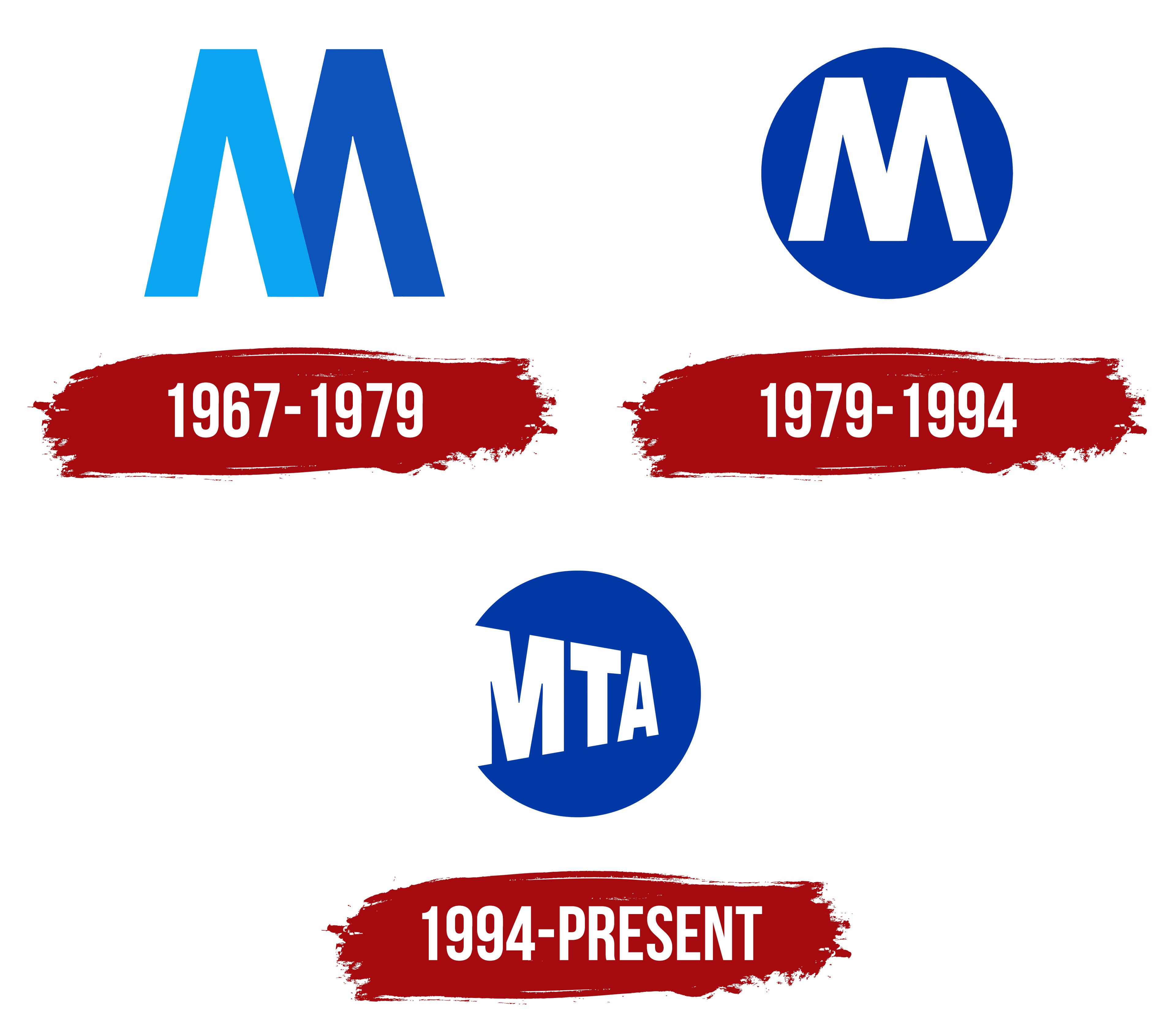
1967 – 1979

The logo, designed by Unimark International, is extremely simple. It uses a single glyph composed of several letters. Almost the entire abbreviated name, Metropolitan Transportation Authority (MTA), is encoded in it. The symbol looks like two “A”s without a crossbar. To emphasize this, the designers colored them: the left letter is sky blue, and the right one is cobalt blue. They are positioned to form a capital “M” with a wide, low middle. The font is custom, even, geometric, choppy, with smooth edges.
1979 – 1994

A redesign brought a radical transformation to the MTA logo. Now, it features only one letter “M,” the first in the transportation organization’s name. It appears as a classic symbol at the subway entrance. The glyph remains solitary, large, wide, bold, and choppy, but it is painted in a single color: white. The background is a dark blue circle.
1994 – today
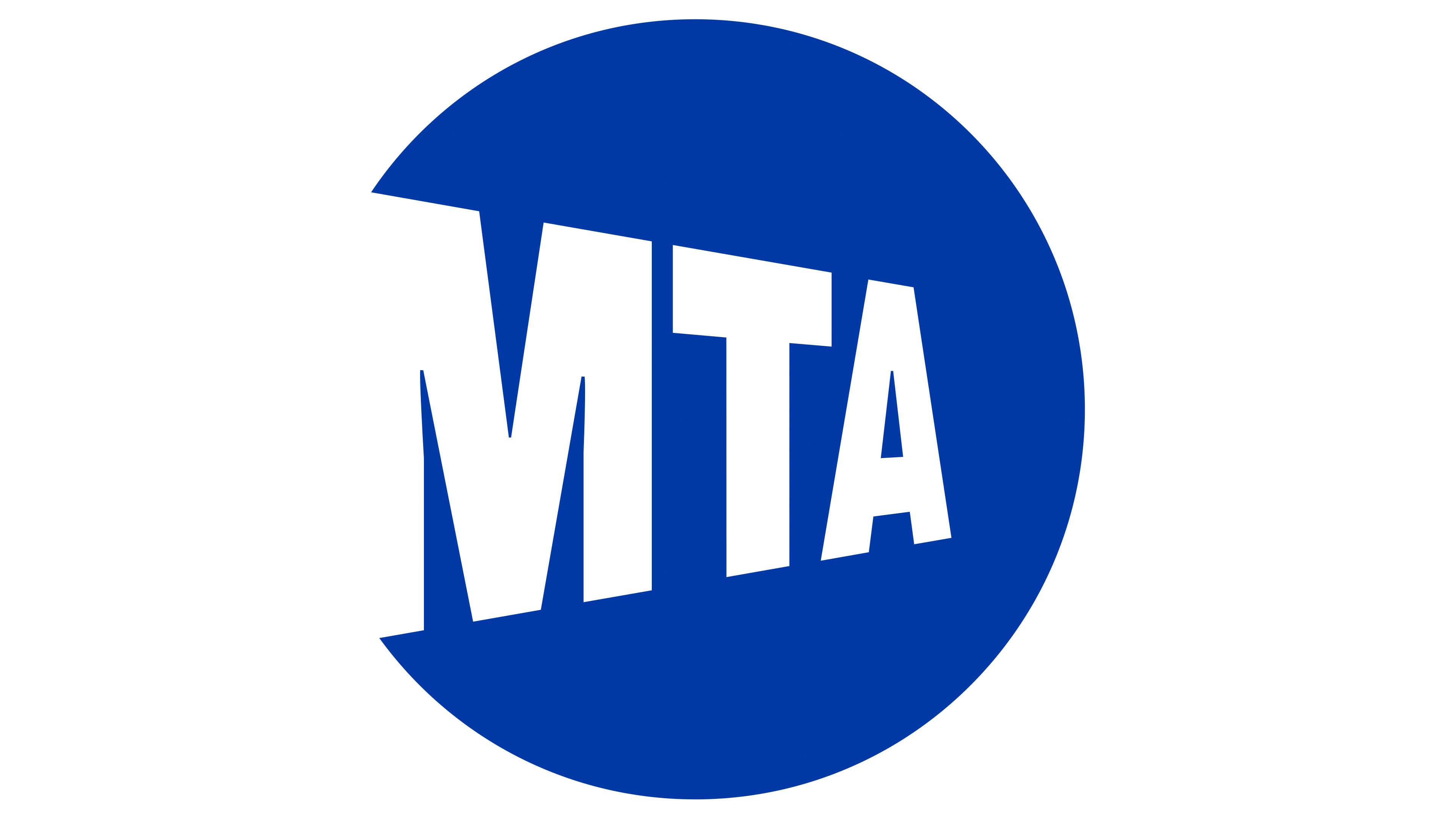
Retaining the cobalt-colored disc, designers at the studio Siegel+Gale changed the emblem’s interior. They inscribed all three glyphs of the abbreviation, and to fit them compactly without losing readability, the developers arranged them in decreasing order of size. That is, the first letter is the largest, the second is medium-sized, and the third is the smallest. Such diversity helped to organize the space properly, even though the left part of “M” merged with the edge, making the circle open: it literally goes beyond the bounds of the emblem.
Font and Colors
Helvetica is the official font of the modern MTA (Metropolitan Transportation Authority) logo. The geometrically even letters perfectly fit the strict visual identity. They are bold and do not contain serifs. In the first versions, the typeface was custom.
The brand’s corporate palette is built on several shades of blue: sky-blue, neutral, and cobalt. All of them complement white excellently, serving as its background or, conversely, as the primary color when used for the text.