


 NAB Logo PNG
The vigorous activity helps the organization rise higher and higher toward the sun, as the NAB logo suggests. The emblem is filled with energy and a desire for leadership. Success is built on knowledge and sober calculation.
National Australia Bank traces its roots to two 19th-century institutions. Commercial Banking Company of Sydney opened on November 1, 1834, while the National Bank of Australasia was announced in Melbourne in 1857 and opened its first branch on October 8, 1858.
National Bank of Australasia grew through regional acquisitions, including the Colonial Bank of Australasia in 1918, the Bank of Queensland in 1922, the Queensland National Bank in 1948, and the Ballarat Banking Company in 1955. It also opened offices in Tokyo, Singapore, Jakarta, and Hong Kong.
On October 1, 1981, the National Bank of Australasia merged with the Commercial Banking Company of Sydney. The new group soon became National Australia Bank Limited and chose a more aggressive overseas path than Commonwealth Bank and Westpac. In 1987, NAB bought Clydesdale Bank and Northern Bank from Midland Bank. It added Yorkshire Bank in 1990, Bank of New Zealand in 1992, and Michigan National Bank in 1995.
Some foreign acquisitions later created problems. NAB sold HomeSide Lending, bought in 1997, to Washington Mutual in 2001 after losses tied to mortgage derivatives. NAB sold Michigan National Bank to ABN AMRO in 2000. That year, NAB bought MLC Limited for A$4.56 billion.
In 2004, unauthorized foreign-exchange trading triggered a major internal crisis. CEO John Stewart led restructuring, including 2,000 job cuts in 2005. In 2015-2016, NAB spun off Clydesdale Bank and Yorkshire Bank as CYBG plc. Ross McEwan became CEO in 2019. In 2021, NAB bought neobank 86 400 and merged it with UBank.
Meaning and History
The initial structure that laid the foundation for nab was based on two progenitor companies (in this version, the progenitor companies’ current names are written). The first is the National Bank of Australasia, and the second is the Commercial Banking Company of Sydney. Together, they formed a finance corporation that later became the National Australia Bank. The former banks’ identities were not preserved, as the newcomer had to start from scratch.
The inflow of money into the money supply after the merger helped drive the significant expansion of offshore companies. By the end of the 20th century, NAB had opened offices in Beijing, San Francisco, New Delhi, Atlanta, Athens, Seoul, Shanghai, and many other major centers worldwide. He also acquired Scottish and Irish banks and changed their logos.
The most difficult period of his career was from 2000 to 2005, when he was forced to sell his assets. This marked the beginning of a new stage in the bank’s development with a logo redesign. There were two of them in total.
What is NAB?
This is the acronym for the National Australia Bank group of financial institutions, which is part of The Big Four. It was formed in 1982 due to the merger of two large banking institutions. In the 1990s, NAB expanded outside of Australia, opening branches in Asia, Europe, the United States, and the United Kingdom.
1982 – 2006

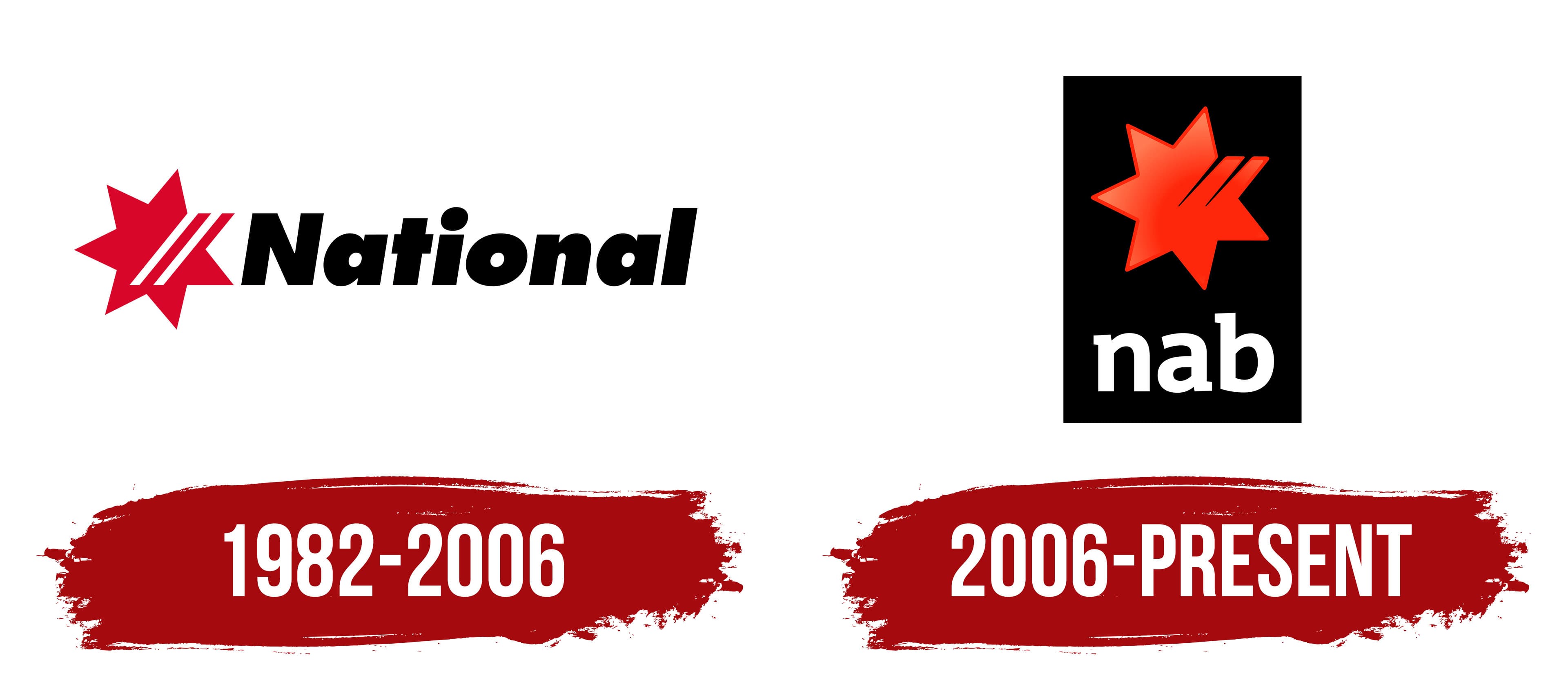
National Australia Bank emerged from the mergers of the largest financial institutions and significant banking market players. It received a personal logo, laconic, discreet, but meaningful. The logo was divided into two parts: a personal distinguishing sign (left) and a grotesque inscription (right).
The graphic designation was a seven-pointed red star with two white stripes. They began on one ray and extended far beyond the middle, but did not reach the opposite edge. Next to it was the word “National.” It was written in lowercase letters, except for the first one: “N” was capitalized. Simultaneously, “l” surpassed everyone in height, yielding only to the point above “I,” which was very large.
2006 – today

After the bank went through the hardest period in its history, it began rebuilding, starting with a logo redesign. The star was repainted from red to orange and moved from a white background to black in the current version, making it more eye-catching and distinctive. But the main color is an uneven gradient that transitions from peach to tangerine. The ray edges have a darkened outline. The two white stripes are replaced by deep chisels resembling ragged scratches with sharp tips. Below is the abbreviation “nab” in lowercase serifs.
Font and Colors

The bank’s logo changed only once after it emerged from a difficult situation and began a new round of activity. Despite the adjustments, it always featured a seven-pointed star. Now, alongside the abbreviated name, it sits in a wide vertical rectangle.
For the debut logo, the bank chose a typeface close to SoftMaker’s Limerick Serial Heavy Italic. The only difference is the more spacious lettering. In the second case, the inscription uses a modified font reminiscent of Exo Slab Pro Bold.

The corporate palette consists of black (letters, background), red (star), white (word), and orange (star in the second version of the logo). The latter color has a wide range of shades, from light #f7815a to dark #f1270d.
FAQ
What is the NAB tagline?
NAB, or National Australia Bank, uses the tagline “Life’s about more than money.” This shows the bank’s focus on supporting customers beyond financial matters. The brand highlights the importance of life experiences, personal growth, and well-being.
The bank offers services that help improve its customers’ overall quality of life. These services include financial advice, community support, and products that make life easier.
What are NAB colors?
The company uses three main colors in its branding: orange, black, and cool grey.
Orange adds energy and warmth, making the brand feel welcoming and approachable.
Black represents strength and reliability, giving the brand a professional and trustworthy image.
Cool Grey provides a neutral balance, complementing the boldness of black and the vibrancy of orange.
These colors create a strong visual identity, helping the brand stand out and communicate its values. The consistent use of these colors across platforms ensures a recognizable, professional look.
Has NAB changed its logo?
In September 2021, the brand temporarily changed its logo to “JAB” to promote COVID-19 vaccinations. This initiative aimed to encourage vaccinations and support public health.
In early 2022, the company moved its global headquarters to a new 39-story building at 395 Bourke Street. This new office, designed with natural light and greenery, provides a better working environment. The move to 800 Bourke Street in Docklands demonstrates the brand’s commitment to a modern, sustainable workspace for its employees.
Is NAB only in Australia?
The company serves customers in Australia, New Zealand, and worldwide. The brand caters to a wide range of financial needs for its diverse customer base. Its global reach lets the brand offer its expertise and resources to a broader audience, ensuring customers receive the financial assistance they need wherever they are. This international presence shows NAB’s commitment to serving local and global communities, reinforcing its role in the financial sector.
What does the NAB logo mean?
The logo has a clear and meaningful design. The word “nab” is lowercase, standing for National Australia Bank and suggesting catching or grasping, which reflects the bank’s goal of seizing opportunities.
The logo includes a red star with six rays. These rays symbolize the six British colonies that founded the Commonwealth of Australia. A seventh ray represents the brand’s founding. This seventh ray has two white stripes, indicating the bank’s main divisions: NAB and MLC.
What is the font of the NAB logo?
The logo uses a modified rectangular serif font. Its stroke widths are consistent, making it low-contrast. All letters are lowercase, giving it a modern and approachable look.
This font style is clean and professional, fitting for a financial institution. While the exact font is custom, similar typefaces are Exo Slab Pro Bold and TheMix. These fonts share low-contrast, rectangular serif features and closely match the brand’s chosen typeface.