 Okta Logo PNG
State-of-the-art fingerprint and face control technology showcases the Okta logo. All clients available to program users are in focus. The emblem promises that no one will go further until they are authorized.
Okta began with Todd McKinnon, a former Salesforce engineering executive, and Frederic Kerrest, who saw a growing identity problem as companies moved from local servers to cloud software. In January 2009, they founded SaaSure Inc. in San Francisco. In 2010, the company was renamed Okta, after “okta,” a unit used to measure cloud cover. The name reflected a focus on cloud technology without directly using the word “cloud.”
Its first products focused on Single Sign-On, allowing employees to use a single login across many corporate SaaS applications. Andreessen Horowitz provided early funding, later joined by Greylock Partners and Sequoia Capital. Okta entered a market shaped by Microsoft Active Directory and newer rivals such as OneLogin. Its main distinction was neutrality: the platform worked with major software vendors rather than pushing companies toward Microsoft or Google.
In 2011, Okta launched its first full cloud identity management platform. By 2012, it was signing large enterprise customers, proving demand for independent access management. In 2014, a $75 million Series E round helped fund expansion into the Asia-Pacific region. On April 7, 2017, Okta went public on NASDAQ at $17 per share, raising $187 million. At the IPO, Sequoia Capital held a 21.2% stake.
By 2019, Okta reported more than 100 million registered users on its platform. In May 2021, it acquired Auth0, adding developer-focused customer identity tools, and later separated its offerings into Workforce Identity Cloud and Customer Identity Cloud. In October 2023, Okta disclosed a breach in its customer support system, which was later found to be broader than first reported. In fiscal 2025, despite reputational pressure, Okta reported its first non-GAAP operating profit above $587 million.
Meaning and History
Okta’s services are in demand among corporate IT teams. Its clients include over 4,000 large and well-known organizations, including Nestle Purina, JetBlue, 20th Century Fox, Pandora, and LinkedIn. So it’s no surprise the company’s logo is always in sight. It contains the service’s actual name, written in round lowercase letters.
In meteorology, an okta is a unit of measure for cloud cover. It corresponds to 1/8 of the open sky. The word “okta” comes from the transliteration of the Greek “okτώ,” meaning “8”. In numerology, the number eight symbolizes a new beginning and a connection with the past.
The identity management service was previously called SaaSure. However, due to inappropriate associations, Frederic Kerrest and Todd McKinnon dropped the name. According to McKinnon’s wife, SaaSure sounded like a French perfume brand. This led to the unplanned rebranding.
What is Okta?
Okta is the new name of the American company SaaSure Inc. It creates cloud-based software that offers effective security solutions. Enterprises across industries such as manufacturing, healthcare, and finance use its products.
2009 – 2010

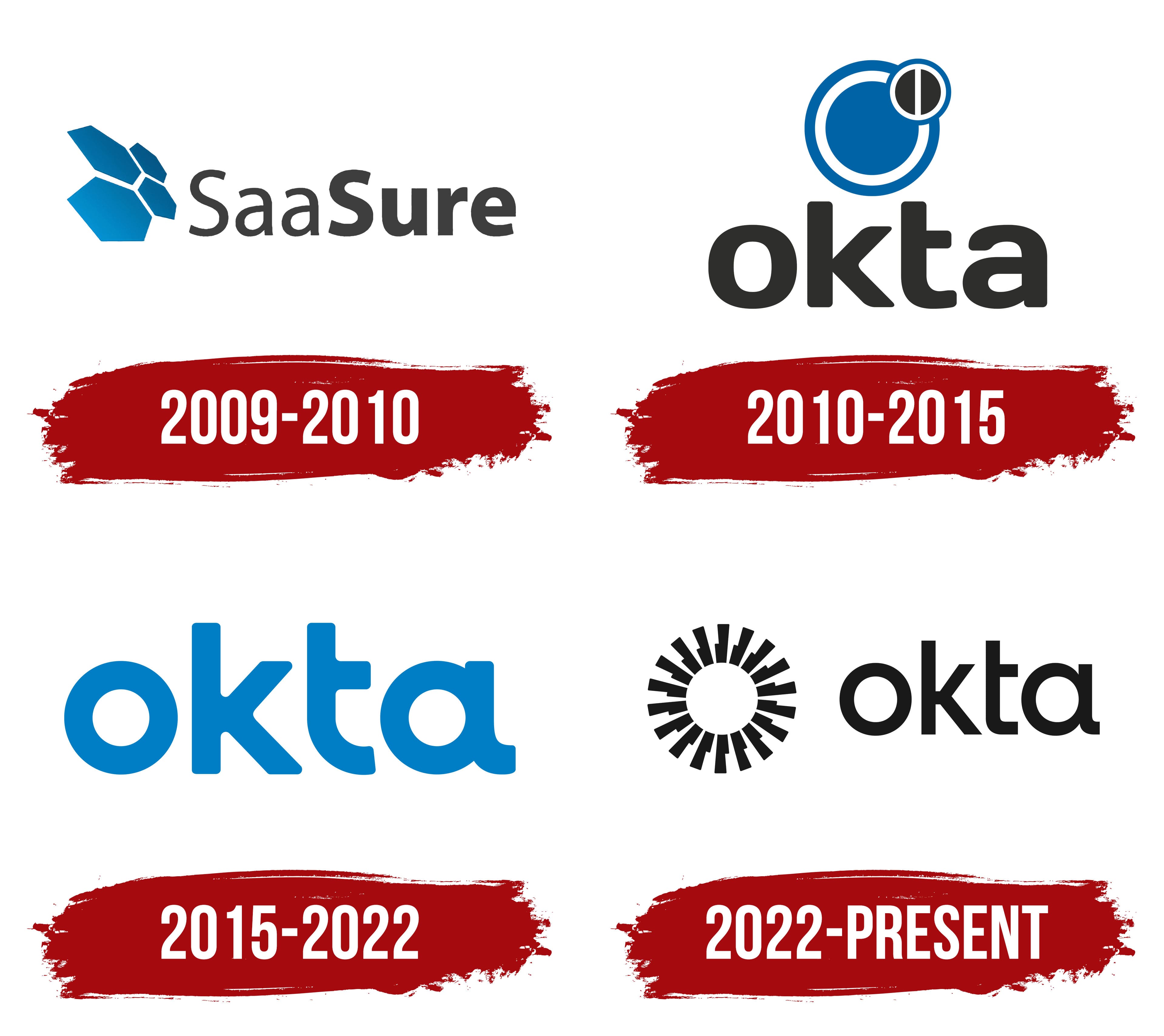
The logo has two parts: text and a graphic. The graphic symbol looks like blue beehives arranged in four hexagons. They’re separated by a thin white line and are tilted sideways. This visual effect makes the right part appear distant to the viewers while bringing the left part closer. This is achieved by placing larger elements in the foreground and smaller ones in the background. On the right is the word “SaaSure,” written as a single word. At the same time, the right and left segments of the letters have different thicknesses. The font is mainly lowercase and rounded.
2010 – 2015
Saasure Inc. appeared in 2009, and just a year later, it was renamed Okta. With the name change came a new logo depicting several concentric circles in white and blue. The largest blue circle symbolizes Single Sign-On, a technology that lets users access applications from any device without re-authenticating. The two rings around it resembled the letter “O” and connected the emblem with the inscription “okta.”
A smaller circle sat on the right. It looked like an inverted prohibition sign with two black semicircles inside. This symbol represents secure access to applications and protection against data loss. The company name was at the bottom. Smooth, curved letters combined with circles, and the dark inscription matched the chosen palette.
2015 – 2022
In the updated logo, the designers removed the geometric-shape composition, leaving only the word “okta.” The lowercase letters “o” and “a” are now circular to compensate for the missing emblem. The inscription is light blue, not black, another attempt to preserve the familiar corporate identity.
Dropping the logo with circles, Okta relied on the wordmark. She had to leave the encrypted message in the caption: “o”; the main part of “a” is shaped like a ring, which in the company’s iconography symbolizes each user, application, and process. The concentric circles on the old emblem had a similar meaning.
For Okta, lettering comes first because it’s the logo’s only element. The current typeface is vaguely similar to Odudo, created in 2016 from ITC Avant Garde and Futura. The only distinguishing details are Okta’s rounded corners and the lowercase “a”‘s extra bottom line.
The wordmark’s developers did not focus on Odudo; instead, they created a modified typeface. It was based on the first company logo’s font. It resembles Days Regular, created by Jovanny Lemonad in 2011. Okta has a smoother “k” with no curves on the diagonal lines.
The lettering is presented in the company’s blue corporate color. It is #007BBF and close to azure. Previously, the emblem palette included three colors: blue (#0169AA), white (#FFFFFF), and black-brown (#212121). Now, white is used only as a neutral background.
2022 – today
Okta’s logo explores its identity by introducing a new symbol alongside its brand name: a circle composed of multiple vertical rectangles, evoking the iconic Easter Island statues. Positioned with their wider sides toward the center, these rectangles coalesce to form a symbolic sun with blunt rays. This unique feature ties directly to the company’s focus on identity, blending ancient civilization and modern tech into a single, seamless design.
Next to this striking symbol, the brand name “Okta” sits harmoniously centered within the adjacent circle. The letters are designed with geometric precision. Each character has a balanced side ratio, and the typography features unique alterations that make it memorable. The “k” features a tiny crossbar, while the “t” lacks the left half of its horizontal line. The “a” has a rounded, elongated tail. These elements support a meticulous design strategy that captures Okta’s essence: precision, balance, and a touch of innovation.
The company adopted a strict monochrome color palette, removing distracting hues. The black-and-white shades convey professionalism and straightforwardness, qualities Okta values. The monochrome scheme serves as a stark backdrop that emphasizes the design’s intricacies, making every element pop.
The Easter Island-inspired figures are more than an aesthetic choice. These statues were often placed along the island’s perimeter as protective monuments. Similarly, Okta aims to serve as a guardian of digital identity, safeguarding the sanctity of user information. The sun-like formation of these statues conveys radiance, clarity, and omnipresence, qualities a company specializing in identity and authentication should embody.
The Okta logo combines elements of history, typography, and design to create an identity that is deeply meaningful and visually compelling. It stands as a confluence of ancient wisdom and modern technology, wrapped up in a design that is as functional as it is aesthetically pleasing.
Font and Colors

In different versions of the Okta logo, the inscriptions use bold lowercase fonts with smooth lines. The base font is Days Regular, created by typographer Jovanny Lemonad in 2011. As a result, the developers modified it several times to fit the company’s concept. In the end, they created a version that resembled Odudo, with rounded corners and an elongated leg on the “a.” The “k” is also slightly different: it’s smooth, without bends on the diagonal lines.
The corporate color palette is based on azure blue (#007BBF), classic black, and white (#FFFFFF). Previously, the scheme included dark brown (#212121) and blue (#0169AA).