 Opera Logo PNG
At the company, the Opera logo features the same iconic symbol as the program’s icon: the red letter “O.” It has a three-dimensional design, achieved through color transitions. The “O” stands for Opera.
Opera began in April 1994 inside Norway’s state telecom company Telenor. Jon Stephenson von Tetzchner, a Reykjavik-born programmer educated at the University of Oslo, worked with Geir Ivarsøy on an internal research project. Their aim was practical: to make web pages load faster on the slow connections of the time. The result was MultiTorg Opera, but Telenor abandoned the project and stopped funding it.
Von Tetzchner and Ivarsøy secured the right to take the source code. They registered Opera Software AS in Oslo on August 30, 1995. The company first relied on the founders’ savings. Opera 2.10, its first public version, appeared in 1996 under a shareware model: 30 days free, then a paid license or advertising. That set it apart from Netscape Navigator and Microsoft Internet Explorer, which were already free.
Speed remained Opera’s core argument. The team developed the Presto engine, added tabs and mouse gestures, and, with Opera 4.0 in 2000, introduced a portable core for Windows, macOS, and Linux. A free ad-supported version launched the same year and tripled the audience within twelve months. Opera was listed on the Oslo Stock Exchange in 2004 and entered the mobile market in 2005 with Opera Mini, whose server compression reduced data traffic by up to 90 percent.
By 2010, Opera Mini had about 50 million users. In 2007, Opera complained to the European Commission about Microsoft’s bundling of Internet Explorer, leading to BrowserChoice.eu in 2010. In 2013, Opera dropped Presto in favor of Chromium/Blink. In 2016, Kunlun Tech, Qihoo 360, and Golden Brick Capital bought the browser business for $600 million. Opera went public on NASDAQ in 2018 and launched Opera GX in 2019.
Meaning and History
In Italian, “Opera” means “work” and encompasses both the process of labor and its result. This is very symbolic, given how much effort the web browser creators put into developing their promising project. But branding was a separate work. The designers have identified the center of the identity as the letter “O.” They made it red for two reasons. First, the bright color immediately attracts attention. Secondly, the inscription on the first Opera logo was also red, a tribute to tradition.
What is Opera?
Opera is a Norwegian company formerly known as Opera Software. It produces software, including its famous web browser for computers and mobile devices. It owns several branches in ten countries around the world.
1994 – 1999
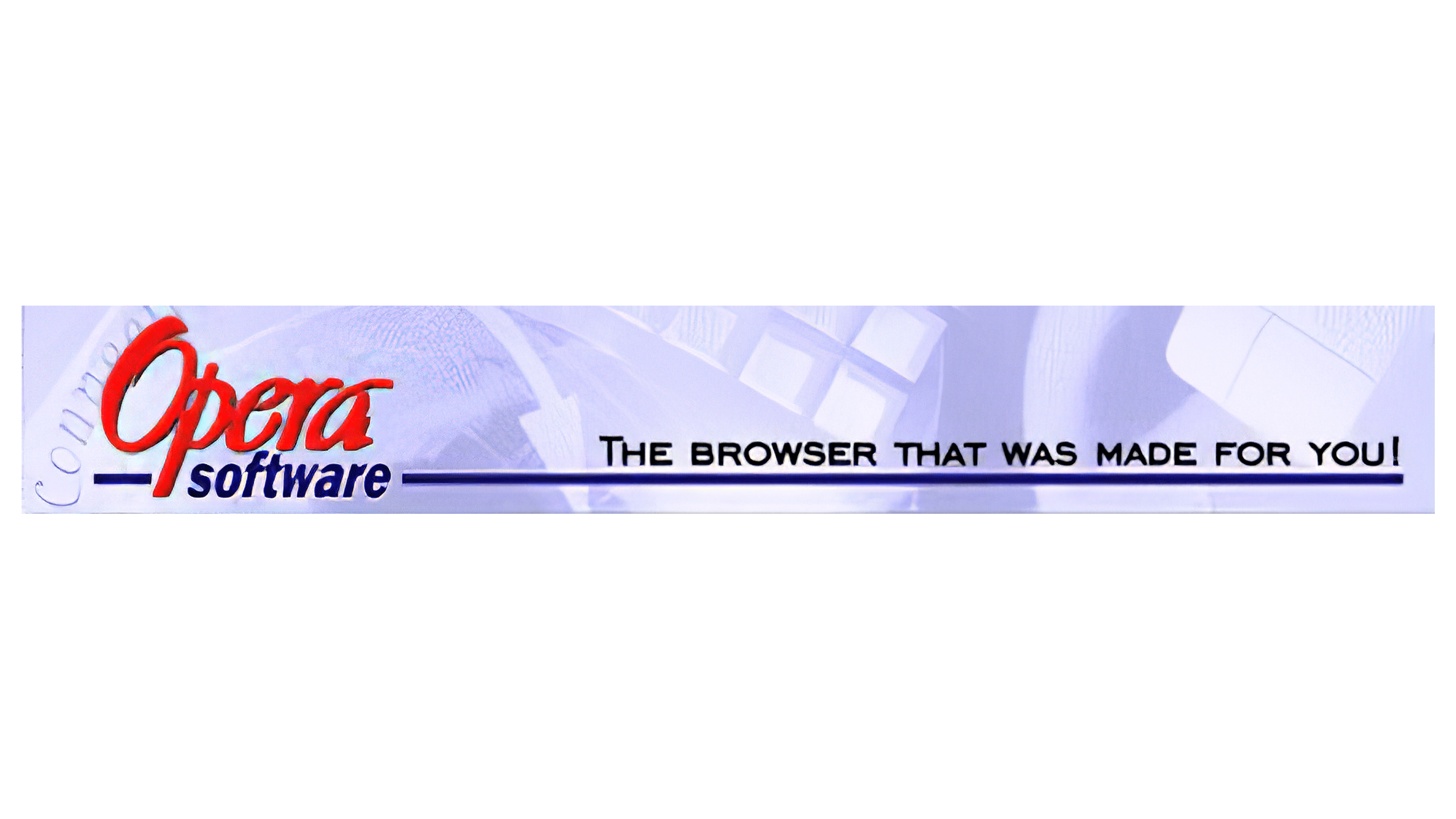
The browser, which has been in development since 1994, has a lot of text in its logo. The most important and noticeable was the red word “Opera.” It was done in a typeface stylized as handwritten. At the bottom was the second part of the name, “software.” Designers designed it with lowercase bold italics. On the right was the promotional phrase “THE BROWSER THAT WAS MADE FOR YOU!” in black. Capital letters were used there, with the first “T” enlarged. A long horizontal stripe underlined the motto, the same dark blue as the word “software.” The background for all the inscriptions was a rectangle with computer-themed drawings.
1999 – 2001
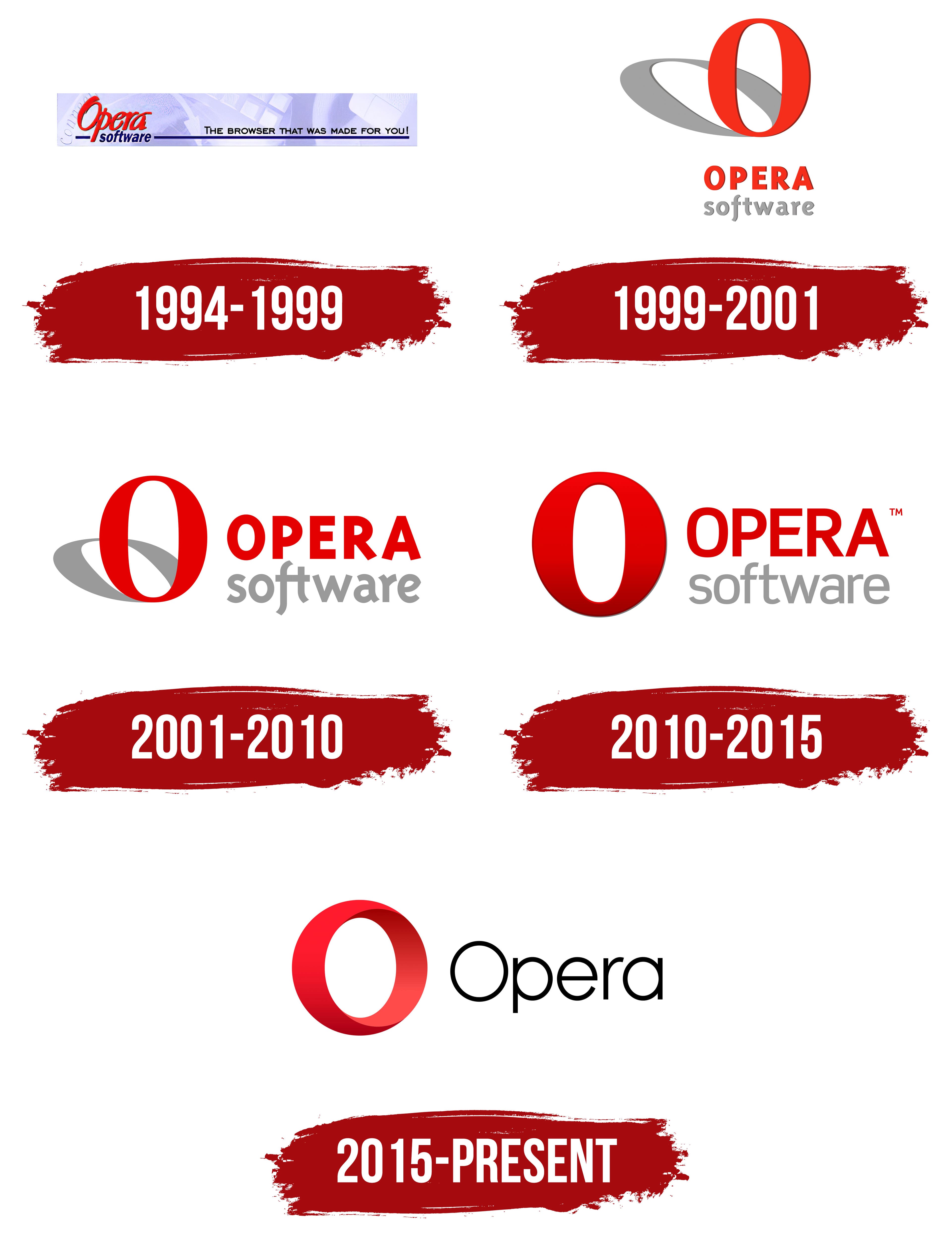
In 1999, designers created a logo for Opera with a large red “O.” It was outlined with thin lines and cast a gray shadow, making the image look three-dimensional. The company name was written at the bottom, split into two lines and centered. The first word consisted of bright red capital letters, set in a stylized Greek font. And for the second, an individual set of gray lowercase glyphs was used.
2001 – 2010
After the redesign, the “O” had no outlines, but a gray shadow remained. The inscription has been moved to the right and enlarged for better readability. At the same time, the font was slightly modified, especially in the word “software,” where the letters “f” and “t” were connected by a common horizontal stroke.
2010 – 2015
In 2010, the “O” lost its shadow, but a gradient created the volume: the letter was darkened at the bottom. The designers enlarged the company name and updated the typeface with a more standard bold sans serif for both words. The case and location of the inscription remained unchanged. But the colors have changed: the red has become more saturated, and the gray has become lighter.
2015 – today
In September 2015, Opera Software rebranded and became simply Opera. At the same time, its logo also changed: the second half of the inscription disappeared, and the “O” took the form of a three-dimensional ring. Designers have achieved volume with a smooth gradient and a sharp delineation of shades, combining them into a single letter. The word on the right is composed of thin black sans-serif glyphs and has nothing to do with past design options.
According to the designers of the Opera logo, “O” is not just a letter. This is the gateway to the Internet, where users can expect engaging communication, useful information, and opportunities to learn and enjoy themselves. The three-dimensional “O” serves as a portal to an interesting new world.
Font and Colors
Since 2015, the Opera logo has been written in a thin geometric sans-serif typeface. With their thickness and round shape, the letters resemble the corresponding characters from SoftMaker’s Montreal Serial Light, BluHead Studio’s Churchward Legible Light, and other similar typefaces. The wordmark’s solid black color complements the red gradient on the 3D “O” emblem.