


 Rosenborg Logo PNG
Since its founding, the club has actively developed and earned its place in the sun. The Rosenborg logo conveys a desire to win and demonstrate mastery. The team has its way in the world of sports. The emblem claims that it will be successful.
On 19 May 1917, twelve youths from Trondheim’s Rosenborg district founded a club named Sportsklubben Odd, after Odd in Skien. Weekly dues were 25 øre, enough to fund a kit within a year. In July 1918, the team beat Falk 2:1 in its first match.
League entry was delayed for years. In 1923, the squad nearly collapsed and played one game. In 1927, it was renamed Rosenborg Ballklub because of a naming conflict. By 1928, the club entered sanctioned Class B competitions and began a gradual promotion.
In 1931, Rosenborg won the regional championship unbeaten and moved up. The club made its Norwegian Cup debut in 1932. Postwar seasons brought instability until 1957, when the club moved to Lerkendal Stadion and secured a permanent home.
The breakthrough came in 1960 with a Cup final against Odd. After a 3:3 draw, Rosenborg won the replay 3:2 in extra time. Another Cup followed in 1964. In 1967, the club entered the top division and won it immediately. Odd Iversen scored 17 goals in 18 matches, then 30 the next season.
After a long gap, the 1985 title win over Lillestrøm reignited growth. Professional status followed in 1988. Under Nils Arne Eggen, Rosenborg won 13 consecutive league titles from 1992 to 2004.
In Europe, the club reached the UEFA Champions League group stage in 1995 and qualified for it every year until 2002. In 1996–97, it beat Milan 2:1 at San Siro and reached the quarterfinals, where it lost to Juventus. In 2000, John Carew was sold to Valencia for a record fee. After 2004, dominance faded, but the club won four titles between 2015 and 2018.
Meaning and History
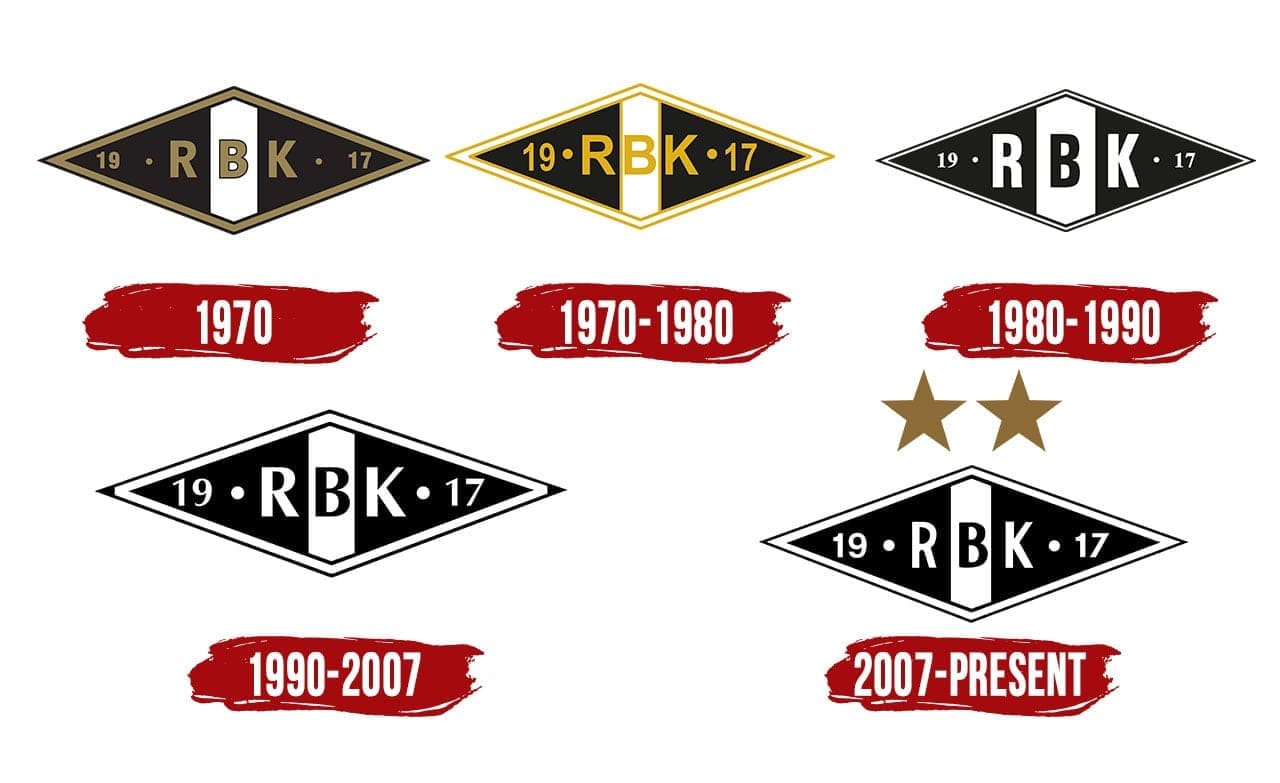
The club had not changed its usual design since the 1970s, when it used a black-and-white diamond logo with short captions. That said, the black-and-white combination has been the team’s official color scheme since it was called Odd, when the team first appeared on the field in black shorts and white shirts.
What is Rosenborg?
Rosenborg is a shortened and commonly used name for Rosenborg Ballklub. This is a professional Norwegian soccer team based in Trondheim. The team competes in Eliteserien and has won 26 league titles. The club was founded in 1917 as Odd and received its current name in 1928.
the 1970s
The emblem of that period looked like a parallelogram standing at one corner. A white vertical stripe divided the geometric shape into two black triangles. In the left corner were “1” and “9”. They were followed by the abbreviation “RBK,” with the letter “B” on a white background and the letters “R” and “K” on black backgrounds. The right corner was occupied by the number “17”, which, together with “1” and “9,” formed the year Rosenborg was founded: 1917. The frame around the diamond and the inscriptions were dark gold.
the 1970s – 1980s
The logo appears smaller because the designers have narrowed the white stripe and enlarged the letters and numbers. The year the club was founded is now yellow, and the abbreviation that was gold is now white. The border is white, with thin yellow lines on both sides.
1980s – 1990s
In the 1980s, “B” was black, and “R,” “K,” “19”, and “17” were white. The frame around the rectangle’s edges is also black and white because Rosenborg chose to reflect his club’s colors in the emblem.
the 1990s – 2007
The developers changed the scale of the elements while keeping everything in place. To do this, they widened the rhombus border, narrowed the central white stripe, slightly increased the numbers, and reduced the letters. The two dots separate the abbreviations from the year the team was created, which is now bold.
2007 – today
Rosenborg won its twentieth title in 2006, so the logo added two gold stars a year later.
Font and Colors
The elements of the club’s visual identity reflect its name and founding year. However, the designers had to split the number “1917” into two parts to avoid taking up too much space on the small diamond-shaped figure. For the same reason, the designers reduced the phrase “Rosenborg Ballklub” to three letters: “RBK.”
The designers didn’t want to overload the logo with unnecessary details, so they chose a simple sans-serif font. The color scheme is also minimalist: the black-and-white combination distinguishes the Rosenborg graphic sign from other club crests. The same monochrome palette appears on the players’ home kits.