


 Scratch Logo PNG
The bright and appealing Scratch logo symbolizes a playful approach to learning. It reflects the simplicity and accessibility of programming for users of all ages, as the service allows gradual mastery of coding basics. The emblem is associated with creativity, encouraging creative experiments.
Scratch began in the early 2000s at the MIT Media Lab, where the Lifelong Kindergarten group, led by Mitchel Resnick, studied how children could learn programming through creation. The project grew from the ideas of Seymour Papert, creator of Logo, and Alan Kay’s Squeak and Etoys, both of which shaped its visual and educational base.
Work started in 2002 through cooperation with after-school Computer Clubhouse programs in Boston and Los Angeles. Researchers found that children were ready to create stories, games, and animations. Still, text-based programming often held them back because of its syntax rules. In 2003, Resnick, Yasmin Kafai, and John Maeda received a National Science Foundation grant, which financed Scratch through 2007.
Scratch 1.0 was released on May 15, 2007, together with scratch.mit.edu. The site let children create, publish, and share projects within a single community. Version 1.1 followed on May 26, 2007, with updated control blocks. Compared with many children’s coding tools of that period, Scratch used colored blocks that joined visually, removing syntax errors from the learning process.
By 2009, Scratch had reached one million registered users. In 2013, Resnick and David Siegel founded the Code-to-Learn Foundation, which was renamed the Scratch Foundation in 2015, to support the platform beyond MIT. Scratch 2.0 arrived in May 2013 with a browser-based editor, and ScratchJr launched in July 2014 for children aged 5 to 7. Scratch 3.0 was released on January 2, 2019, after the platform moved to modern web technologies. By February 2023, Scratch had over 103 million users and more than 123 million published projects. On April 12, 2024, its billionth project was created.
Meaning and History
The Scratch logo reflects its name, which is actually not related to programming but to music. It comes from the term “Scratching,” a technique used by DJs involving spinning a record back and forth to create new sound effects. Similarly, the website allows users to create creative content by mixing different media files. Since it is designed for children and teenagers, its name is styled in a friendly way: the cartoonish white-orange inscription encourages learning the programming language in a playful form.
What is Scratch?
Scratch is a programming language designed to teach children ages 8 to 16. It was developed in 2003 by the Lifelong Kindergarten Group, based at the Massachusetts Institute of Technology. It has its own website where users can create and edit projects, including animations, images, music, simulators, and games.
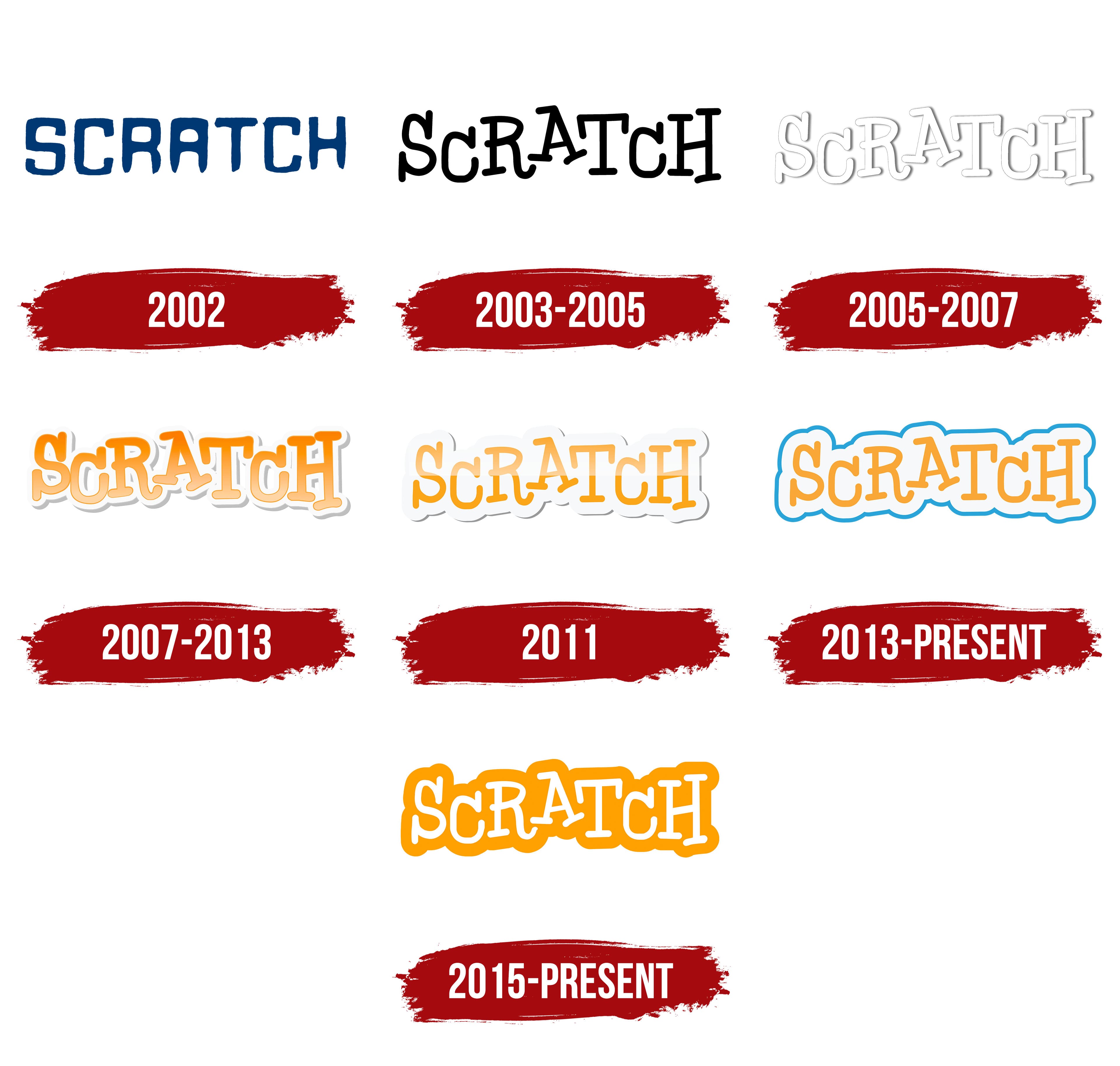
2002
Although Scratch was launched in 2003, its working page on the Lifelong Kindergarten site appeared at the end of 2002. A logo unrelated to programming was used as a placeholder. It contained a promotional poster of an American hip-hop artist performing under the pseudonym Scratch. The emblem looked like a photograph turned sideways and hanging in a green space. It featured a smiling face on a red background, with the project name at the bottom in a white frame. The top of the photo card was creatively torn.
2003 – 2005
Until 2005, the site’s beta versions featured a logo with the black inscription “Scratch” on a gray background. The word was set in the Black Boys on Mopeds font, developed by Jakob Fischer, characterized by thin, asymmetrical letters with serifs.
2005 – 2007

When the website was under the domain Scratch.mit.edu, its logo was white with blurred gray shadows. It was also used in the “Scratch 1.x” project editors, where the menu bar was painted in gray.
2007 – 2013
The “Scratch 1.x” series programs began to be released in 2007. An orange wordmark with a linear gradient from dark (at the top) to light (at the bottom) was created for them. Each letter had a wide white outline following its shape and gray shadows of uneven thickness, which made the inscription voluminous. This emblem ceased to be used in 2013 when Scratch 2.0 was officially released.
2011
Even during the development phase of Scratch 2.0, an alternative logo design could be seen. Here, the orange glyphs became thinner, and their white contours merged into one large cloud, surrounded by gray shadows. The gradient’s shape also changed: light highlights shifted upwards, concentrating closer to the middle.
2013 – today
Designers created a new logo for Scratch 2.0 without the gradient. The brand name remained orange on a white background, but now, without different shades, the inscription seems flat. The uneven gray shadows were replaced with a solid blue outline resembling a child’s drawing of a cloud.
2015 – today
This logo was actively used after the release of the Scratch 3.0 program. Now, the word is painted in white and outlined with wide, bright orange bands. This allows the wordmark to be placed on any light background.
Symbol
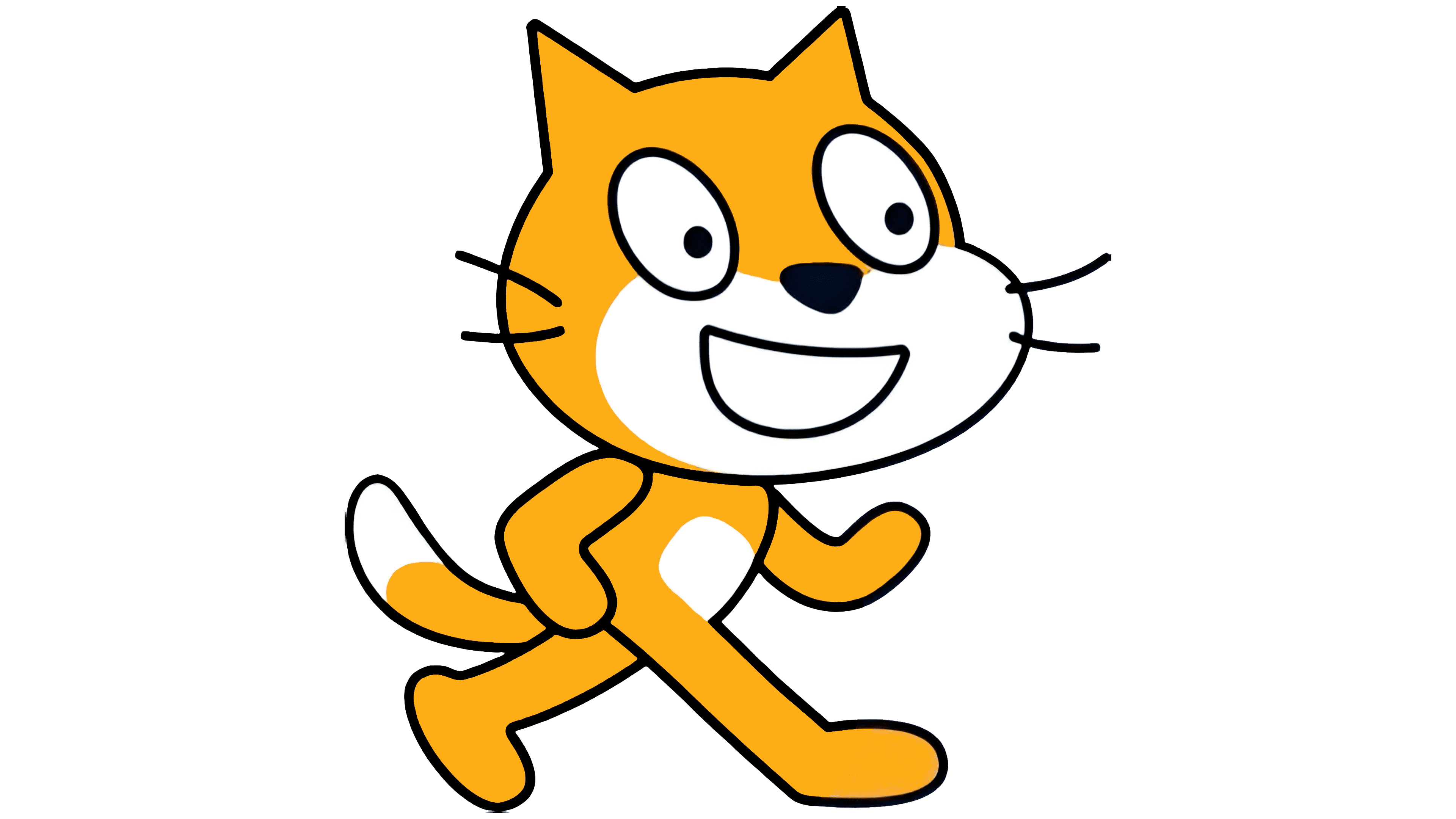
The website has its own mascot named Scratch Cat. It is also the starting sprite, meaning the character that appears in each new project and can be programmed to perform various actions. Artist Wing Ngan conceived the design. In the original version, it is an anthropomorphic red cat with white spots on its chest, face, and the tip of its tail. It smiles cheerfully and walks on its hind legs.
Font and Colors
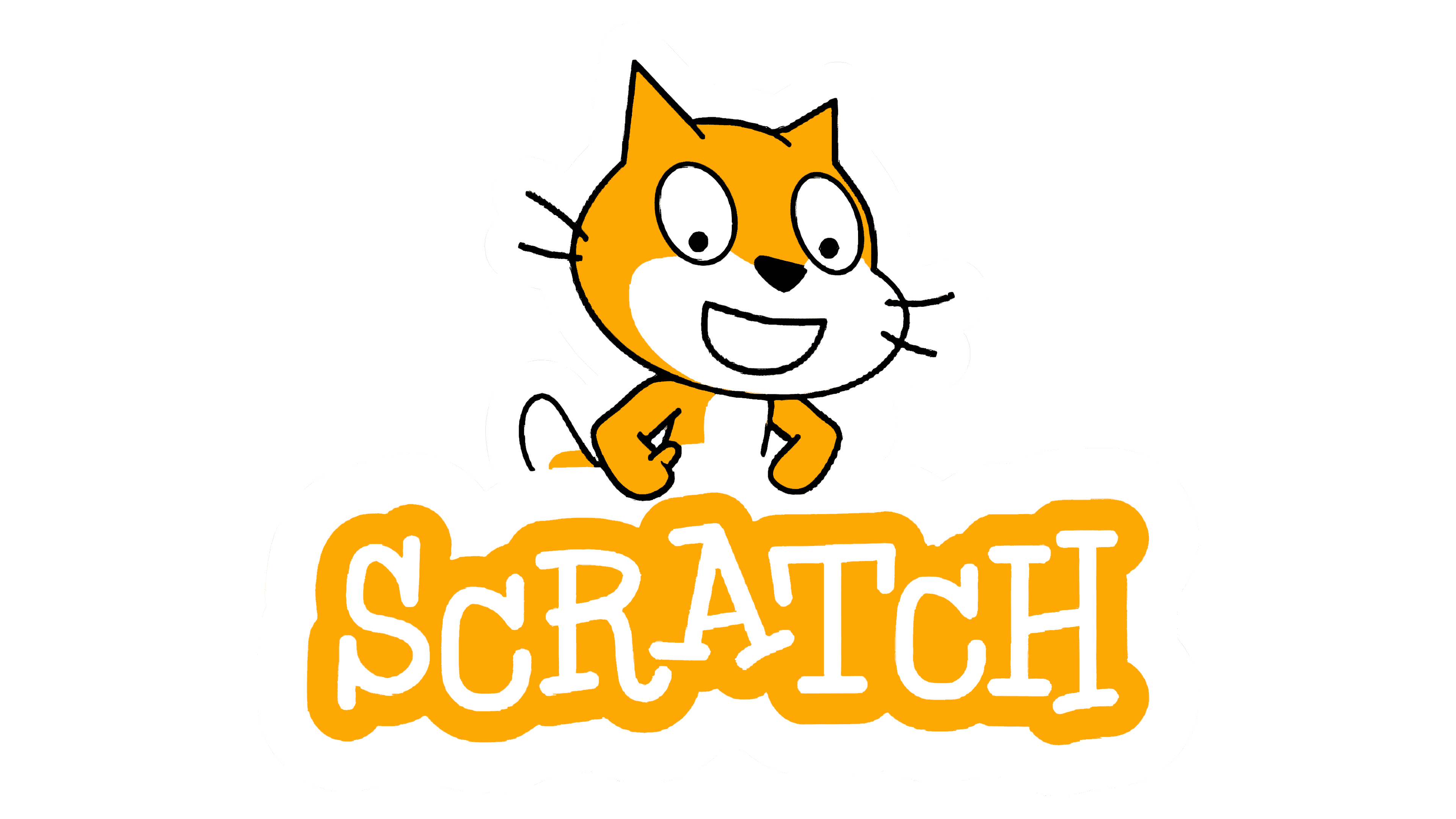
The programming language’s name is written in the Black Boys on Mopeds font, created by Jakob Fischer under the nickname Pizzadude. The letters are styled in a cartoonish manner and appear as if hand-drawn. They are asymmetrical, “bouncy,” with uneven serifs.
The Scratch logo has long used orange, a color associated with positivity and good mood. It symbolizes the ease of learning, as the program is adapted for children. Usually, orange is combined only with white, but some emblems also include blue or gray.