


 Seton Hall Pirates Logo PNG
The Seton Hall Pirates logo symbolizes the fighting spirit of the Seton Hall University teams. The pirate image embodies the strength of the university’s athletes. The “Pirates” became known for the success of the men’s basketball team, which has a long history of tournament play and has developed top-level players.
Founded in 1856, Seton Hall University laid the groundwork for the Pirates’ storied athletic tradition. In 1931, inspired by local pirate lore, Reverend Thomas J. Gilhooley proposed the “Pirates” nickname, which the university officially adopted.
Basketball quickly emerged as the school’s flagship sport, with competition beginning in 1903. In 1937, Seton Hall joined the Metropolitan New York Conference, expanding its competitive reach. The team reached national prominence by winning the 1953 NIT Championship, its first national title.
In 1979, Seton Hall became a founding member of the Big East Conference, significantly enhancing its national presence. The Pirates made their NCAA tournament debut in 1988, followed by a historic 1989 run that ended in a narrow loss to Michigan in the NCAA Finals.
Throughout the 1990s and early 2000s, the program secured conference titles in 1991, 1993, and 2004, along with notable NCAA performances, including a Sweet Sixteen appearance in 2000. The women’s team also advanced to its first NCAA Sweet Sixteen in 2006.
The 2010s and early 2020s saw consistent NCAA tournament appearances, highlighted by four consecutive bids from 2016 to 2019 and another in 2022. Program alumni, including NBA talents Terry Dehere, Mark Bryant, and Andrew Gaze, exemplify Seton Hall’s long-standing basketball tradition.
Meaning and History
What are the Seton Hall Pirates?
As a Catholic institution, Seton Hall University competes in NCAA Division I in the Big East Conference. The men’s basketball team plays at the Prudential Center, known as “The Rock,” in Newark, where the team’s blue-and-white colors and fan support create an intimidating atmosphere for opponents. Basketball is the main source of pride, and baseball, which prepares players for professional careers, also holds a special place among the 14 university teams. The mascot, which embodies courage, inspires all athletes in competition.
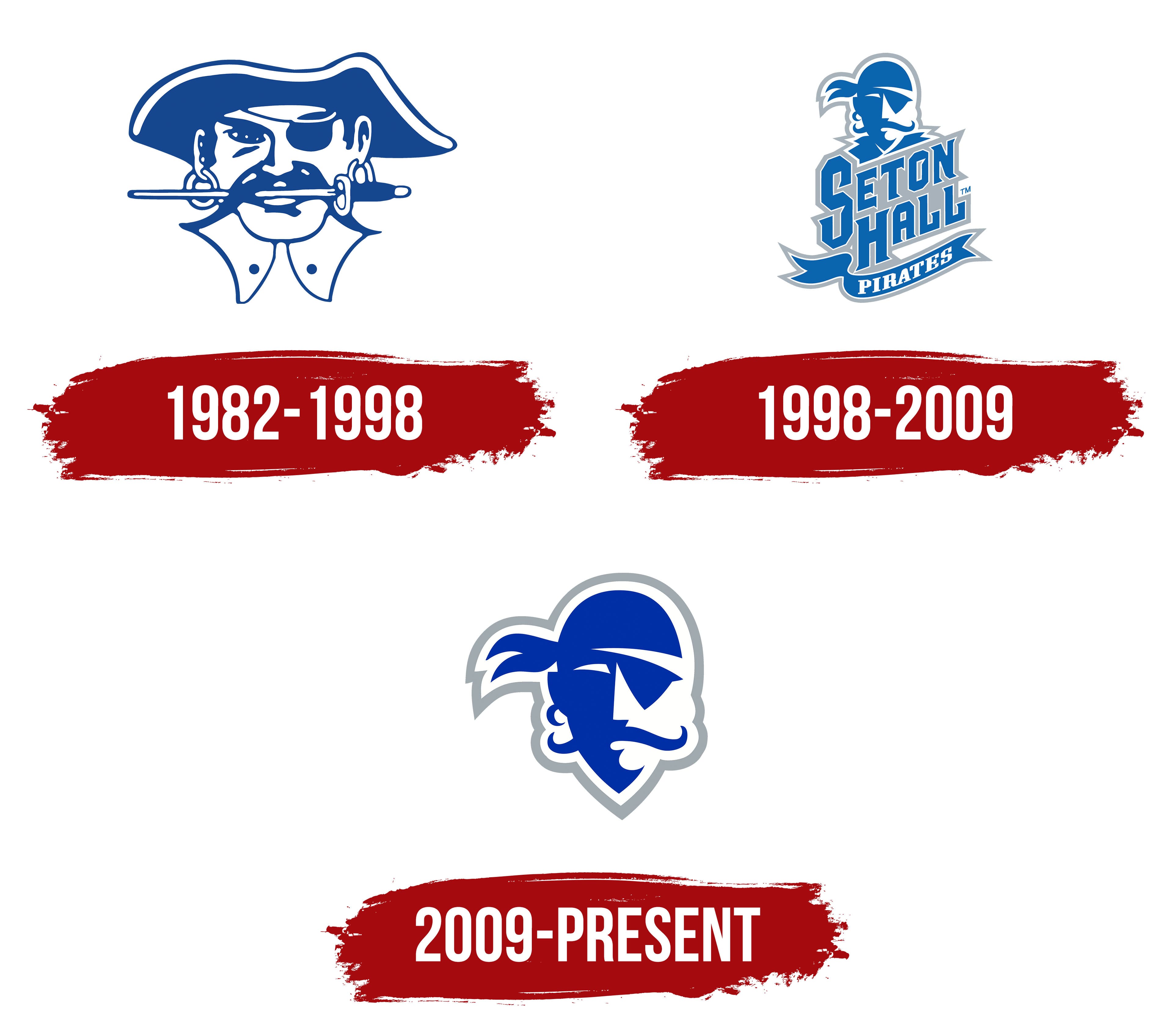
1982 – 1998

At the turn of the 1980s and 1990s, Seton Hall University gained wide popularity in sports thanks to its pirate logo, which became a symbol of victories and major achievements. Under this emblem, the university team reached the NCAA Championship final in 1989 and drew large crowds to basketball games.
The logo is simple, using only two colors: blue and white. The pirate’s portrait faces forward and features bright, recognizable elements. These include a wide-brimmed triangular hat, a large hoop earring, and a pirate eye patch. Another important accent is the dagger clenched in the pirate’s teeth, reinforcing the image of a tough sea raider.
The emblem’s main color is a rich blue, Seton Hall’s standard color. The mustache, collar, and bright buttons are rendered in white. The pirate’s collar is simple, but the buttons make it stand out and balance the composition.
The pirate’s facial expression is calm and stern. His gaze shows no humor or exaggeration, only composed determination and readiness for competition. This style accurately reflects the atmosphere of university sports and helped the Seton Hall Pirates team gain popularity beyond the student community.
1998 – 2009
The updated Seton Hall Pirates logo combines the pirate image with a large text block featuring the university name in a white, blue, and silver color palette. The emblem’s center features the mascot’s frontal portrait, distinguished by an eye patch, curled mustache, hoop earring, and bandana tied around the head. The character is vivid, simple, and memorable.
The emblem’s color scheme is based on Seton Hall’s official shades. The dominant blue (Pantone 286) connects to the university, silver outlines and highlights individual elements, and white adds accents and freshness to the overall image.
Below the pirate, the inscription “SETON HALL” is split into two lines and set in a bold, diagonally slanted serif font. This adds energy and movement to the emblem. A ribbon completes the composition with the word PIRATES, designed in the same style.
The image’s unity comes from minimalism and precise execution.
2009 – today
Since 2009, Seton Hall University has used an updated logo featuring a minimalist pirate profile with no text. The absence of inscriptions underscores the emblem’s independence and strength.
The image is based on the pirate’s profile and uses the university’s three standard colors. The main silhouette is rendered in a rich blue shade (Pantone 286); the facial details are drawn in white, and a thin gray line marks the head outline, completing the composition and adding neatness.
Traditional attributes define the pirate’s appearance. A bandana covers the head, a patch hides one eye, and a large earring is visible. The clearly defined mustache adds expressiveness to the silhouette. The face shows no additional emotion but conveys seriousness and composure.
The minimalist design and clean shapes make the emblem versatile, suitable for both athletics and the university’s official materials.