


 UAB Blazers Logo PNG
The UAB Blazers logo symbolizes the strength, tenacity, and sportsmanship of the University of Alabama at Birmingham teams. It combines tradition with a desire to win, recalling the club’s constant struggle and new challenges. Each season is a story of overcoming, but one thing that remains unchanged is the excitement of rivalry and the thirst for victory.
UAB Blazers athletics began in 1977, when the University of Alabama at Birmingham created its first intercollegiate program. Gene Bartow left UCLA after taking the team to the 1976 Final Four and accepted the task of building the entire new department. On January 13, 1978, students approved the Blazers name and a fire-breathing dragon mascot. The first basketball squad finished 15-11.
Bartow developed the program rapidly. UAB reached the NIT in its second season, then earned seven consecutive NCAA Tournament appearances. The Blazers advanced to the Sweet Sixteen in 1981 and the Elite Eight in 1982. During 18 seasons, Bartow recorded 366 victories and nine national tournament berths, and the university later named Bartow Arena in his honor.
Football began as a club team in 1989, entered Division III in 1991, moved to Division I-AA in 1993, and reached Division I-A in 1996. UAB joined Conference USA in 1999 and played its first bowl game in 2004. The university closed the football program in December 2014, despite a 6-6 season. Still, protests and $17.2 million in outside commitments led to its reinstatement in June 2015.
The team returned in 2017 and won league titles in 2018 and 2020. Its 2018 season brought a program-record 11 wins and a Boca Raton Bowl victory. UAB moved to Protective Stadium in 2021 and became a member of the American Athletic Conference on July 1, 2023. Basketball had earlier reached another Sweet Sixteen in 2004 and won its league tournament in 2022.
Meaning and History
What is UAB Blazers?
It is a team representing the University of Alabama at Birmingham at the NCAA Division I level, competing in various sports. Athletes compete in the American Athletic Conference, participating in baseball, basketball, soccer, and American football. The talisman is a dragon named Blaze. Home American football matches are held at the Protective Stadium, located in the center of Birmingham. The basketball team’s strong traditions and the football team’s development attract loyal fans, who, in green and gold colors, create a bright atmosphere in the stands.
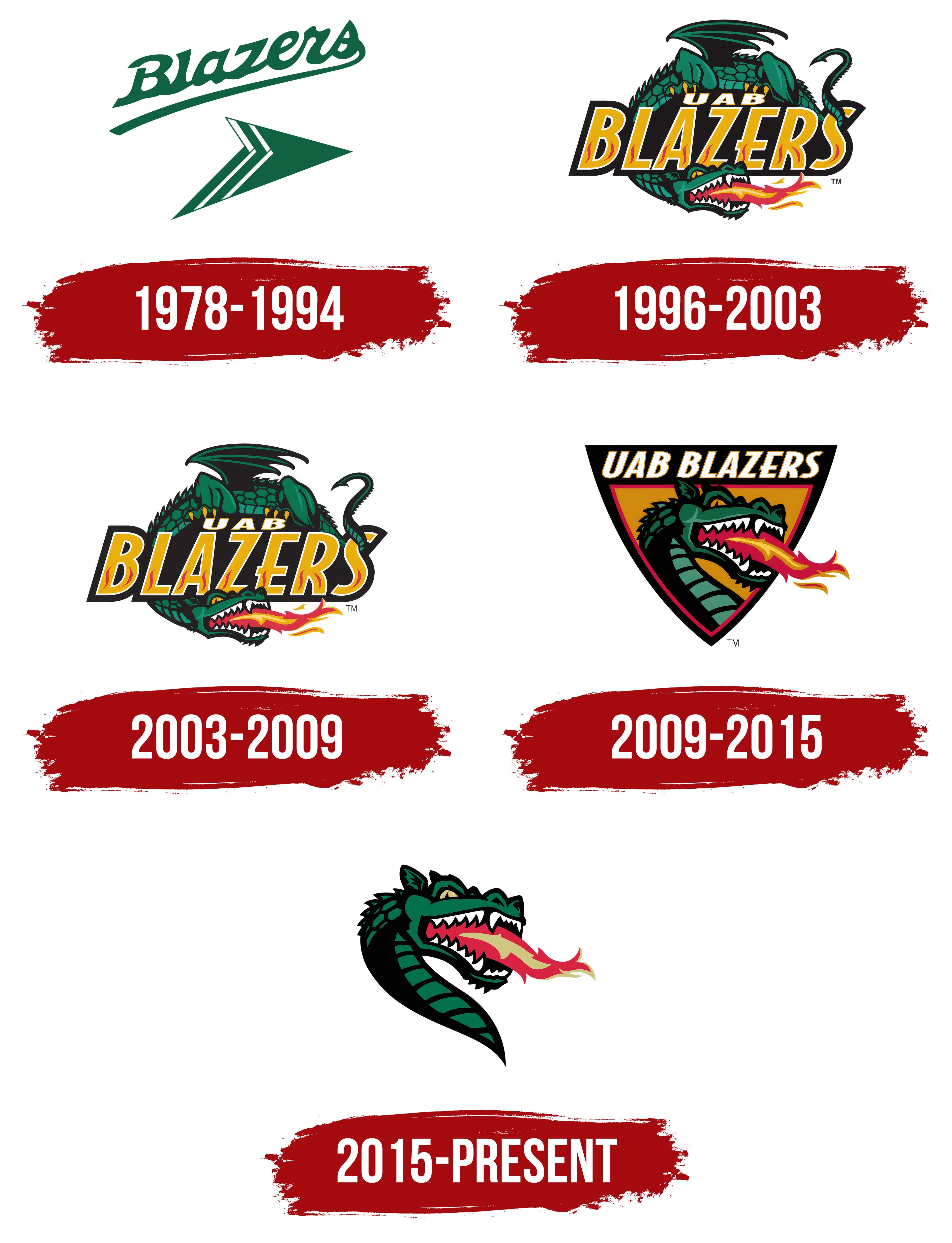
1978 – 1994
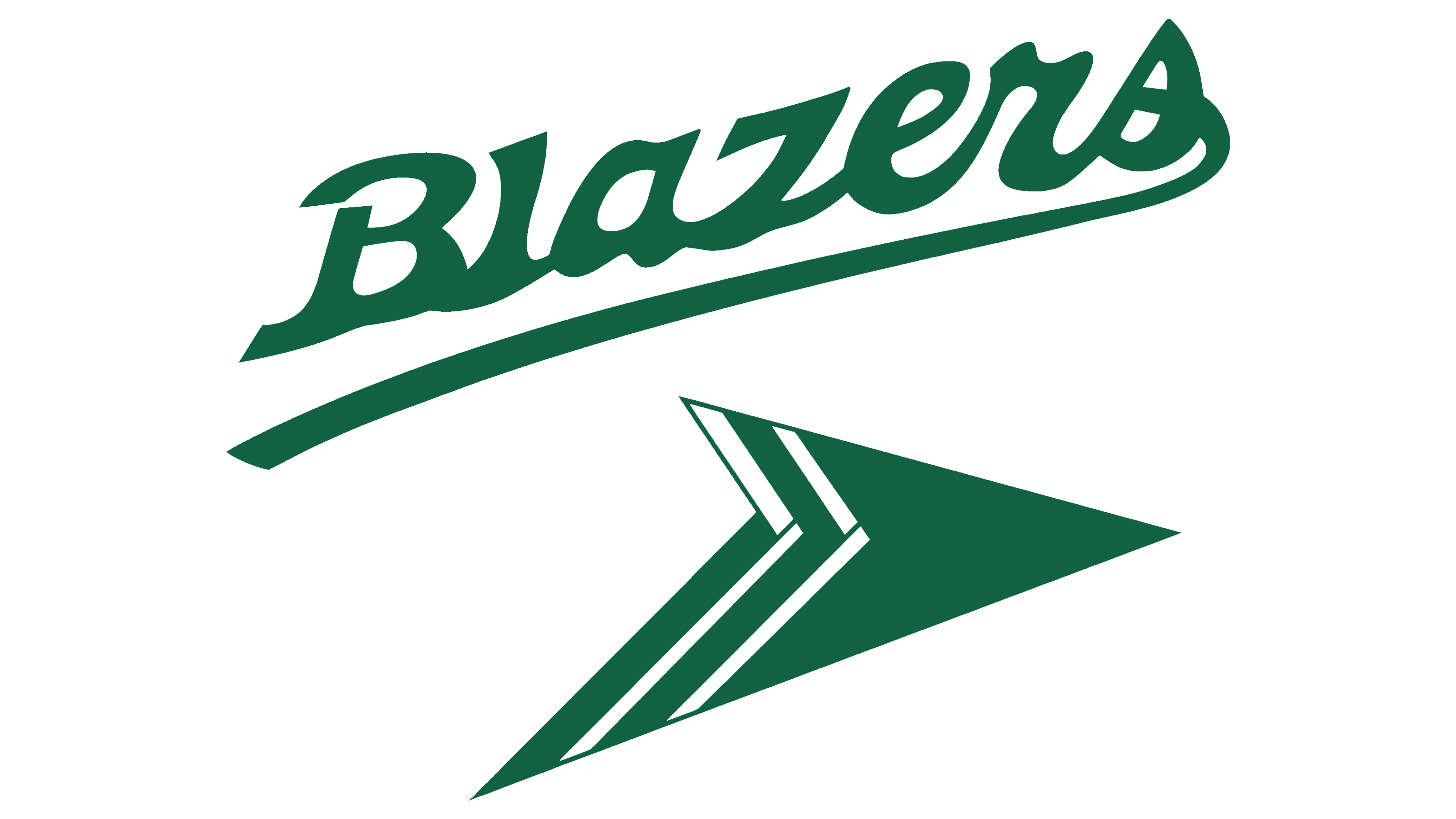
The Blazers are the University of Alabama sports teams at Birmingham, participating in NCAA collegiate tournaments since the late 1970s. Their first logo is energetic and full of character. The inscription is placed at the top, with an arrow pointing to the right beneath it. It symbolizes the team’s drive toward victory.
The name is written in a lively, handwritten cursive font, with letters that flow smoothly into one another, and the capital “B” stands out in size. Under the word is a line extending from the final letter “s.” It connects the text and the symbol, visually emphasizing their relationship.
The arrow at the bottom of the logo adds a dynamic feel. It is a large, dark-green triangle, inside which two thin white lines resemble arrows. The symbol is perceived as an indication of speed and aspiration.
The deep, dark green color symbolizes stability and composure, highlighting the institution’s athletic nature and academic status. The logo looked excellent on uniforms and symbolized the Blazers’ athletes’ energy, speed, and determination.
1996 – 2003
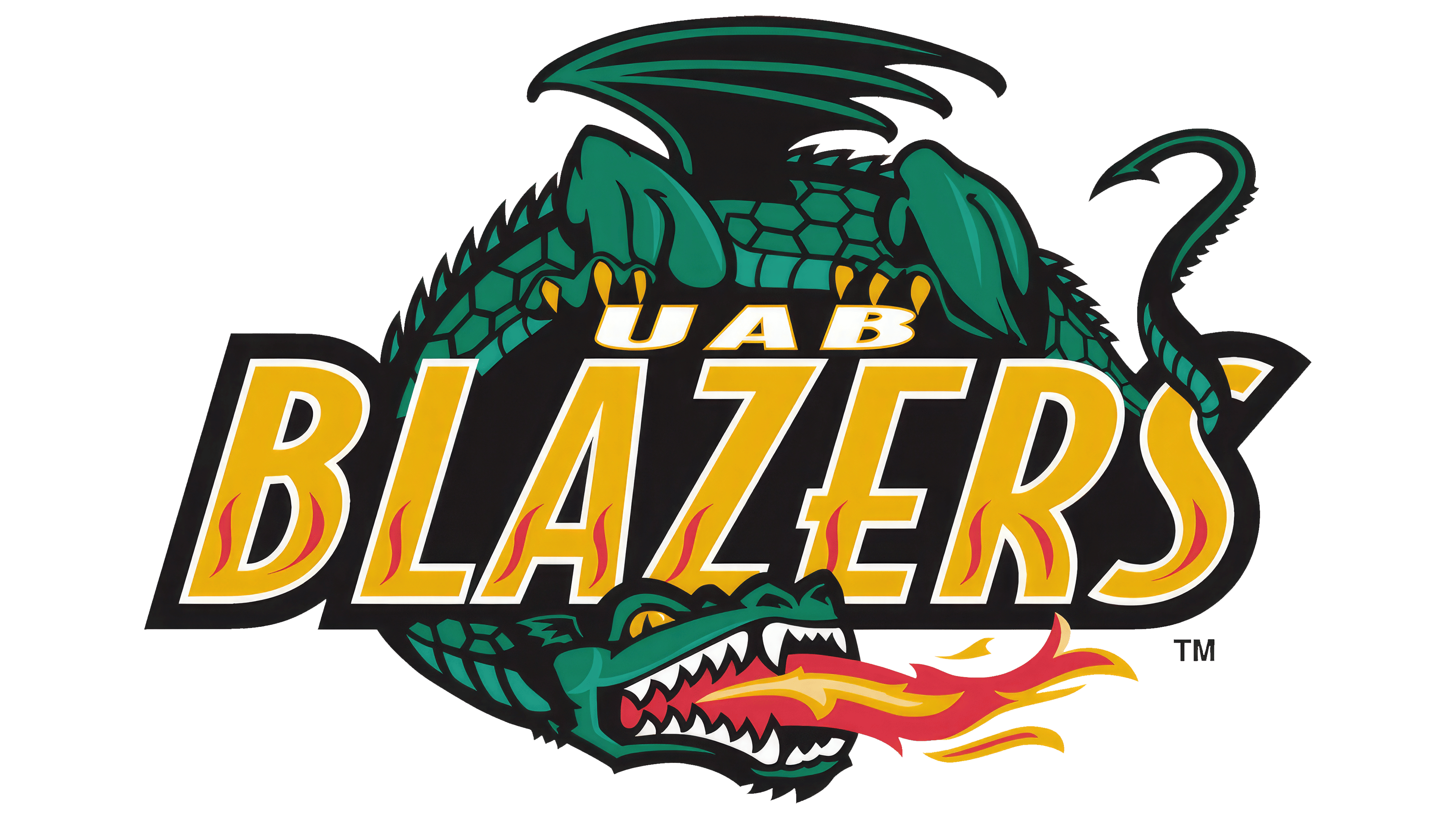
In 1996, the University of Alabama at Birmingham’s teams received a new logo that looks extremely energetic and aggressive. The name “UAB Blazers” is surrounded by a huge green dragon, which has become the primary symbol of the university’s athletes.
The dragon’s body arches, creating a backdrop for large, bold, slightly italicized text outlined in gold. Within the letters, red flames are visible, adding heat and a fiery atmosphere to the team’s name. Slightly above the word “BLAZERS” is the white inscription “UAB,” with a thin gold outline that visually divides the composition into two parts and indicates the team’s university affiliation.
The dragon is depicted in great detail: green scales, black outlines, spread wings with veins, and sharp-clawed feet create an image that is both aggressive and powerful. With its open mouth, the dragon’s head extends beyond the text, emitting a fiery stream of red and orange colors that emphasize the team’s athletic character, strength, and will to win.
The color palette is rich and diverse: the dominant green reflects the university’s tradition, while the combination of gold, red, and orange accents adds energy and conveys a passion for sports and excitement. The logo became iconic for the university teams, conveying assertiveness and a pursuit of high performance in collegiate sports competitions.
2003 – 2009
In 2003, the logo of the UAB Blazers teams changed slightly; the dragon and the inscription remained in place, but the shades became somewhat calmer and less vivid. The dragon’s green appears more muted and softer, creating a less aggressive and more balanced overall appearance.
The name “BLAZERS” retained its powerful serif letters with a golden outline, inside which flames are still visible. Everything remains in place, but without the previous vibrancy of colors.
The dragon began to look slightly calmer, losing some of its earlier color and aggressiveness but retaining the dynamic pose and shape. The flame from the dragon’s mouth, combining orange and red, appears softer.
2009 – 2015
In 2009, the UAB Blazers logo underwent a redesign. It is executed as a triangular shield with clear borders and sharp angles. The new emblem appears athletic and solid, fitting the style of the university’s teams.
At the top of the shield is the inscription “UAB BLAZERS.” A bold, serifed athletic font is used. The letters are uppercase, slightly elongated vertically, and tilted forward, creating a sense of forward momentum. The white text is complemented by a yellow outline, making the lettering stand out against the black background.
Below, the text depicts only a dragon’s head looking to the right. The head is drawn in detail: green scaly skin, sharp white teeth, yellow eyes with black pupils, and an open mouth from which flames burst forth, transitioning from yellow to bright red. The fire spills beyond the shield’s borders, emphasizing the team’s athletic intensity and energy.
The shield background is black with a double-colored outline: red and golden-yellow. The logo’s color palette includes traditional Blazer shades of green for the symbol, vivid flame colors, and white text with yellow outlines, making the emblem more emotional.
The overall impression of the logo is athletic and aggressive, reflecting the team’s character, emphasizing their confidence, energy, and readiness to compete on the field.
2015 – today
Since 2015, the University of Alabama at Birmingham (UAB Blazers) teams have used a concise emblem featuring a single main symbol, the dragon’s head, without additional frames or inscriptions.
Previously, the logo was enclosed in a frame and accompanied by the team’s name. Now, the dragon stands alone. It faces right with a fierce expression, yellow eyes, and clearly defined black pupils. The mouth is wide open, revealing sharp white teeth and a red tongue. Flames burst from the mouth, yellow and red, highlighting the team’s aggressive, athletic spirit.
The dragon’s skin is green, with pronounced scales and dark contours highlighting its texture and details. The head is slightly tilted, giving the emblem an asymmetrical shape. The flames from the mouth stretch to the right, adding energy and power to the image.
The emblem’s color scheme is bright and contrasting. Green connects to the university’s historical colors, while black defines contours. Red and yellow serve as key accents, representing fire and emotion.
Font and Colors
The UAB Blazers use a deep green base with vivid red and gold splashes. The dragon mascot, breathing fire, symbolizes strength rooted in university lore. Officially, UAB’s brand palette includes multiple shades of green, including PMS 3425, PMS 350, and PMS 376, paired with vibrant yellow (PMS 109), warm gold (PMS 7503), and a subtle smoke gray (PMS Cool Gray 9). Originating from student votes in the 1970s, the dragon imagery became an iconic representation of competitive spirit for athletics teams.