


 Arkansas State Red Wolves Logo PNG
The bearded red-and-black wolf is the mascot of the Arkansas State Red Wolves, and its logo honors the program’s history while reflecting the brand’s identity. The colors and name reflect the brand’s philosophy and the bravery and fearlessness inherent in proud Native Americans.
Arkansas State University opened in 1909 as an agricultural and mechanical school serving the Mississippi Delta. Sports programs appeared early, and in 1911, the football team played its first games against Paragould High School. Early nicknames included Aggies and Gorillas, later replaced by Indians in the 1930s.
Football paused during World War II, then returned stronger in the 1950s under Forrest England, with four bowl appearances from 1951 to 1953. In 1953, the program moved from NJCAA to NCAA competition.
The program peaked in 1970 under Benny Ellender. The team finished 11:0, won the Pecan Bowl against Central Missouri State, and was named national champion of the College Division, now Division II.
Arkansas State moved to Division I in 1975 and briefly competed at the FBS level from 1978 to 1981. In the 1980s, led by Larry Lacewell, the team reached the Division I-AA playoffs four times and played in the 1986 national championship game, losing to Georgia Southern.
In 2001, the program joined the Sun Belt Conference. The first title came in 2005 with a trip to the New Orleans Bowl. In 2008, the nickname changed to Red Wolves, and the NCAA approved a new identity.
The team followed with a strong run in the early 2010s. In 2011, Hugh Freeze led the team to a 10:2 record and a perfect conference run before leaving for Ole Miss. Success continued under Gus Malzahn and Bryan Harsin, bringing three straight Sun Belt titles from 2011 to 2013. In 2016, Arkansas State shared the title with Appalachian State and beat UCF in the Cure Bowl.
Basketball programs developed in parallel. The men’s team reached the NCAA Tournament several times, while in March 2025, the women’s team beat James Madison to win the Sun Belt Tournament and returned to the NCAA Tournament for the first time since 2014.
Meaning and History
What is Arkansas State Red Wolves?
It is Arkansas State University’s sports program. Its participants compete in NCAA Division I and are part of the Sun Belt Conference (except for women’s bowling). The department is located in Jonesboro and includes 16 student teams.
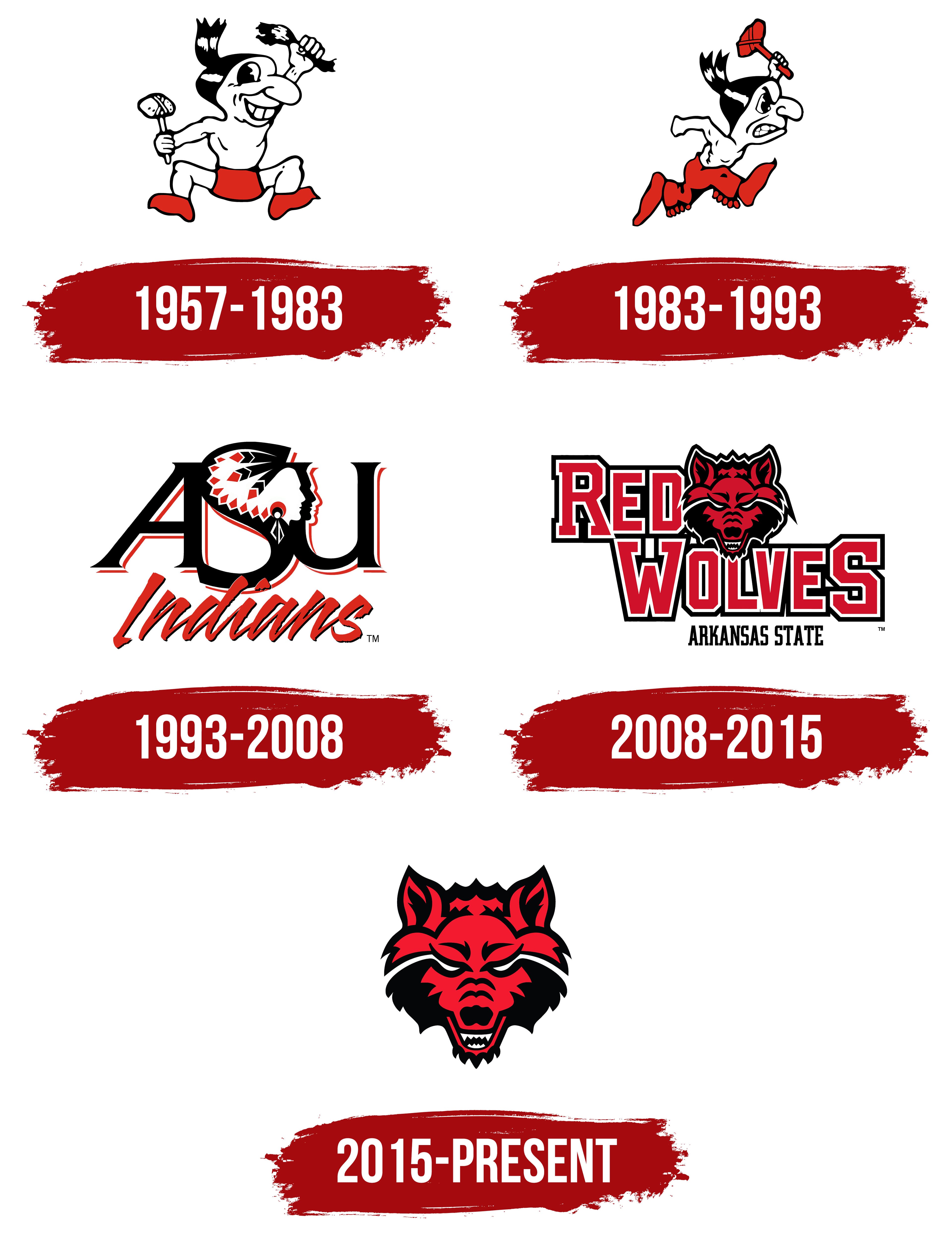
1957 – 1983

Arkansas State’s early emblem originated in a student election. In 1951, Gary Dales, a junior from Piggott, drew Indian Joe for the Independent Student Association’s candidates. The character became known as Jumpin’ Joe. The popular illustration entered university athletics, where Joe became the football team’s mascot.
Today, Arkansas State University’s teams in Jonesboro compete as the Arkansas State Red Wolves. When Joe first appeared, the team was known as the Indians. That name was adopted in 1931, following Aggies, Gorillas, and Warriors. Aggies reflected the institution’s agricultural focus; it was founded in 1909 and began classes in October 1910. Its official name changed as well. It became Arkansas State College in 1933 and Arkansas State University in 1967, when it gained university status. The abbreviation ASU later became part of its athletic identity.
The emblem used from 1957 to 1983 depicted the Indians as a caricature of Joe with an oversized head, a long nose, and a smile showing two front teeth. His bent legs spread apart, and his arms extended upward in opposite directions. He held a stone tomahawk in one hand and a scalp in the other.
A feather adorned Joe’s black hair, while his loincloth and moccasins were red. A thick black outline separated the white areas of his face and body from the background. The character from a student campaign cartoon represented the teams through their athletic nickname.
1983 – 1993

In 1983, Arkansas State changed the character’s name and pose. Jumpin’ Joe became Runnin’ Joe. His figure faced right and stretched diagonally, with one leg thrust forward and his free arm extended behind him. He held a tomahawk, now red, above his head. The scalp was removed.
Furrowed brows and a snarl replaced the earlier smile. Red-fringed pants replaced the loincloth. The black hair and feathers, red footwear, and white areas of the body carried over from the previous version.
1993 – 2008

In 1993, Arkansas State sought to retain the Indians name while replacing the cartoon character. By the early 1990s, faculty members had raised objections to Runnin’ Joe. A profile of a person wearing a feathered headdress replaced him as the university sought a more respectful portrayal of a Native American figure. The new emblem remained in use until 2008.
The profile was incorporated into the interlocking ASU initials. An enlarged “S” wrapped around the face and headdress, uniting the image with the lettering. The black initials had fine serifs and contrasting thick and thin strokes, with a red outline offset down and to the right. The face remained white, while white, black, and red sections formed the feathers. A separate red line echoed the profile’s contours on the right. Beneath the monogram, slanted red Indians lettering had a black shadow. Its uneven edges resembled brushstrokes and contrasted with the formal letterforms of the initials.
Alongside the profile emblem, the university used a mark combining an “A” with STATE. The word crossed the large “A,” pairing an abbreviation for Arkansas with State. Pantone 186 red and black were approved for the university version. This lettermark developed independently of the mascots, and its history began long before Runnin’ Joe was replaced.
Matt Melzer, a Monticello student and team manager, prepared the first sketches in the mid-1970s. They remained in a desk drawer until the early 1980s, when head football coach Larry Lacewell needed a new emblem. The rediscovered drawings were submitted for review, after which the university began using STATE across a large “A.”
2008 – 2015
The Red Wolves name connected Arkansas State’s new athletic identity to an animal that once inhabited Arkansas, the North American red wolf, Canis rufus. Chancellor Robert Potts explained the name’s ties to local wildlife and the species’ pack behavior. After adopting the name, Arkansas State became the first four-year university in the United States to use the Red Wolves’ name.
The name change followed NCAA restrictions on Native American nicknames and imagery. The association’s policy affected universities’ eligibility to host NCAA championships and the use of such imagery at championship events. On June 18, 2007, a university committee recommended replacing the Indians name and associated imagery. On January 30, 2008, the mascot selection committee proposed Wolves or a variation with a modifying word. Consultation with Phoenix Design Works helped the university settle on Red Wolves and establish requirements for the new emblem. The Board of Trustees approved the name on March 7.
A farewell to the Indians took place on February 28, 2008, during halftime of a men’s basketball game against Louisiana-Monroe. The ceremony came before the transition was complete. The teams continued under their previous name through the end of the 2007–08 athletic season. They began competing as the Red Wolves in fall 2008.
The university’s Publications and Creative Services department, led by Ron Looney, produced the final artwork. Art director Mark Reeves and designer Mary Williams prepared the initial wolf sketches. Heath Kelly developed custom lettering, while Michael Johnson contributed to discussions about the image and the digital refinement of the drawings. The team then created versions for different applications.
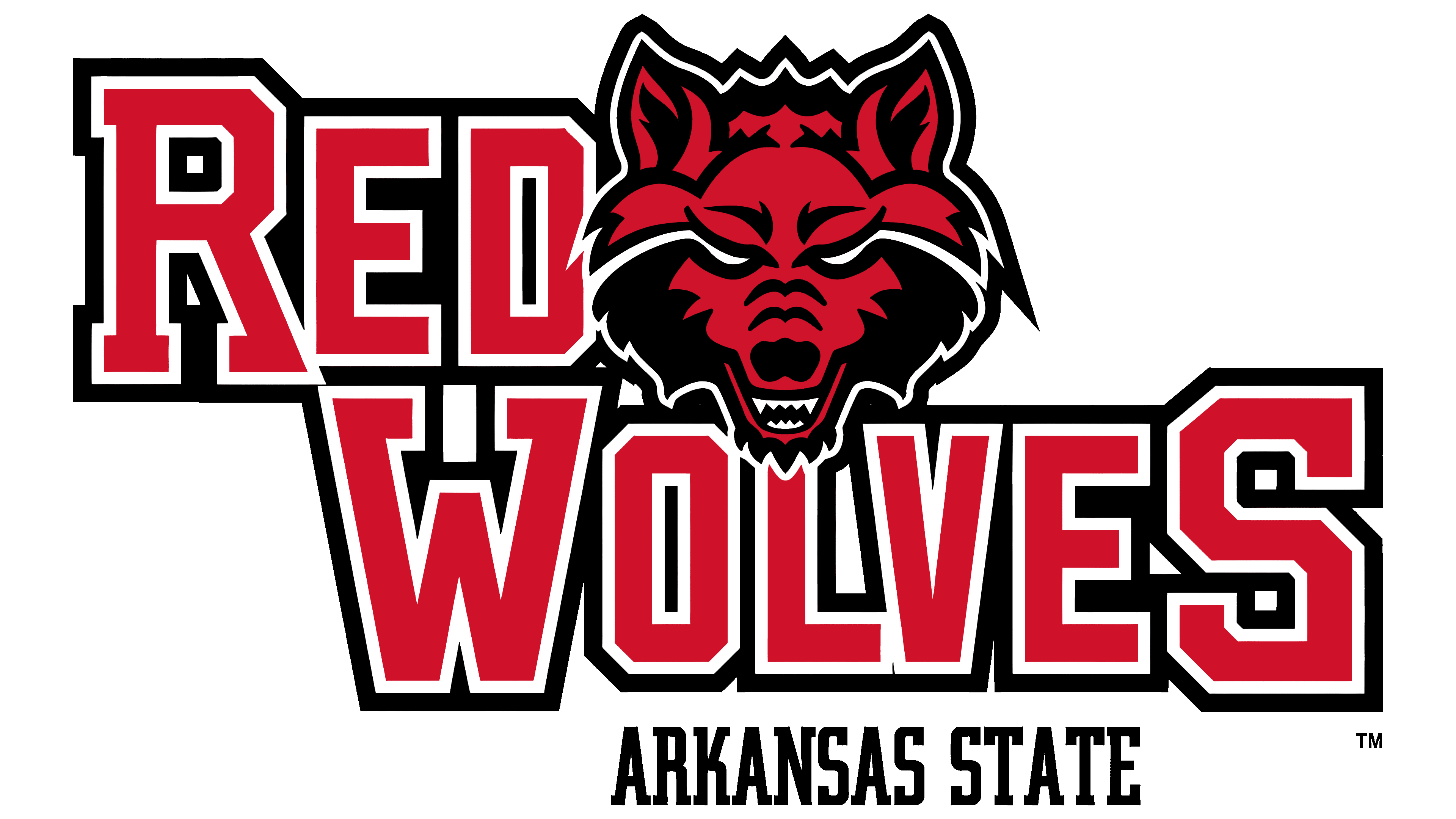
The primary emblem used from 2008 to 2015 paired a wolf’s head with RED WOLVES on two lines. RED sat at the upper left, while WOLVES shifted to the right on the lower line. The wolf’s head appeared beside RED and partially overlapped WOLVES. White edging and a thick black outline surrounded the red letters. Even strokes, clipped corners, and rectangular serifs connected the lettering to American collegiate lettermark traditions. ARKANSAS STATE appeared below in narrow black uppercase serif letters.
The wolf faced forward, with nearly symmetrical left and right sides. Tall, pointed ears and jagged fur framed a face with narrowed eyes and an open mouth. Red filled the forehead, bridge of the nose, and inner ears. Black defined the cheeks, nose, folds above the eyes, and outer contours of the head. White stripes extended from the eyes toward the sides of the muzzle, and white triangles formed the teeth. The new mascot retained the university’s established combination of red, black, and white.
The new identity was unveiled outside the student center on March 13, 2008. A large black banner bearing the emblem was unfurled from an upper floor of the building. Quarterback Corey Leonard and the student government president displayed additional versions. The presentation was accompanied by the university song, revised for the new mascot.
2015 – today

In 2015, the wolf’s head that had accompanied the large RED WOLVES lettering became Arkansas State’s primary athletic emblem. It had served as a secondary mark since 2008 before taking the lead role in the updated identity. Use of the large wordmark became optional.
The wolf’s head retained its established ear shapes, red face, black cheeks, white eyes, and bared teeth. Reproduction standards require a white outer outline. The eye areas must remain white regardless of the background.