 Cincinnati Bearcats Logo PNG
The large letter “C,” shaped like a predatory animal’s track, is the logo of the Cincinnati Bearcats, the University of Cincinnati sports team. The name was given by the enigmatic mascot, “born” from the football fans’ chant “Come on, Bear Cat!” who supported the game of Leonard K. “Teddy” Bear.
The University of Cincinnati athletic program dates back to 1885, when it formed its first football team. In 1888, Cincinnati faced Miami University in Ohio’s first intercollegiate football game. The “Bearcats” nickname originated in the early 20th century and was associated with the binturong.
Basketball began in 1901–1902 and moved through conferences including the Ohio Athletic Conference, the Buckeye Athletic Association, and the Mid-American Conference. The program rose significantly in the late 1950s with Oscar Robertson, a three-time All-American who averaged 33.8 points per game. Cincinnati reached the Final Four in 1959 and 1960.
Under coach Ed Jucker, the team won NCAA titles in 1961 and 1962 against Ohio State, led by Jerry Lucas and John Havlicek. In 1963, Cincinnati reached a third straight final but lost to Loyola Chicago in overtime. The program made five consecutive Final Four appearances and built a 90-game home winning streak.
The decline continued until Bob Huggins took over in 1989. By 1992, Cincinnati returned to the Final Four and then reached the NCAA Tournament 14 consecutive times, winning 10 regular-season titles and 8 conference tournaments. In 1999–2000, the team held the No. 1 spot in the AP rankings for 12 weeks, led by Kenyon Martin. Players like Nick Van Exel and Danny Fortson came through the program.
Football rose under Brian Kelly, posting 11 wins in 2008 and an unbeaten regular season in 2009. In 2021, under Luke Fickell, Cincinnati went undefeated, beat Notre Dame, won the American Athletic Conference, and reached the College Football Playoff, the first “Group of Five” team to do so.
In 2023, Cincinnati joined the Big 12 Conference after competing in the American Athletic, Big East, and Conference USA.
Meaning and History
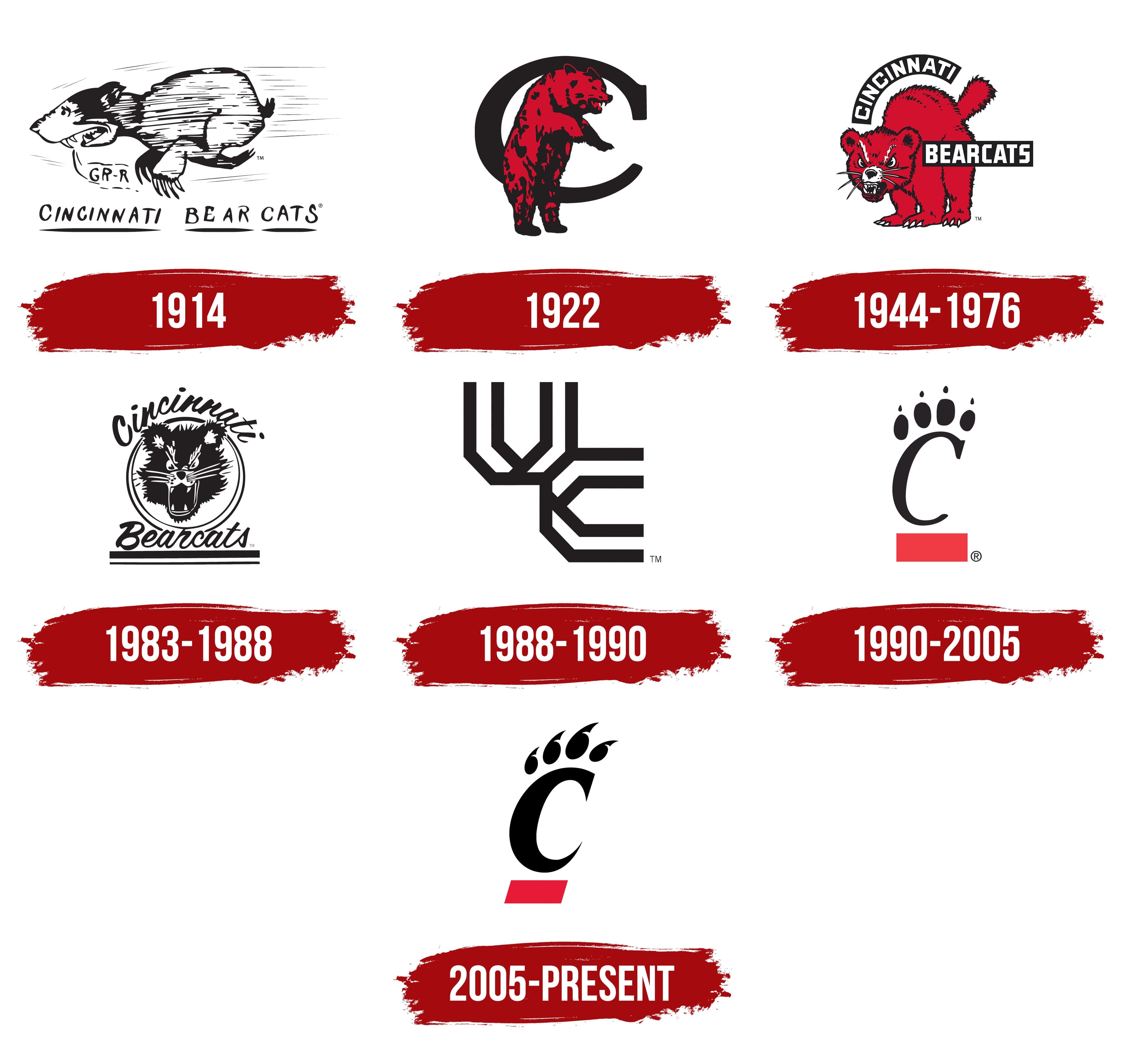
On most emblems from the 1950s onward, the same enigmatic beast, the Bearcat, is represented. According to the author’s idea, it’s somewhere between a cat and a bear, but it was initially drawn as a wolverine. A similar image appears on the 1959-1968 emblem. The depicted animal resembles a bear, although it arches its back and fluffs its fur like a cat. The composition was complemented by the inscription “Cincinnati Bearcats.”
In 1983, the team removed the name. Only the Bearcat head remained, set in a double ring and facing forward. The beast hisses, displaying four sharp fangs. In 1990, artists abandoned the predatory wolverine image and replaced it with a gray cat that marches forward belligerently. Its raised paw corresponds to the second letter “C” in “Cincinnati.” This part of the image became the next logo.
What is Cincinnati Bearcats?
The Cincinnati Bearcats are the University of Cincinnati athletic department and comprise 23 student teams. It participates in the intercollegiate program and is a member of the Big 12 conference, joining it in 2013. The football team competes at the NCAA Division I (FCS) level.
1914
1922

1944 – 1976

1983 – 1988

1988 – 1990

1990 – 2005

2005 – today