


 Arkansas Razorbacks Logo PNG
The University of Arkansas sports community chose a fierce attacking boar as its mascot. The Arkansas Razorbacks logo, rendered in dark red with black edging, reflects the moment of attack, symbolizing a commitment to history, focus, and victory.
Arkansas Razorbacks trace their origins to the University of Arkansas, founded in 1871. The football program began in 1894, and the Razorbacks’ name appeared in the early 20th century, along with the “Woo Pig Sooie” chant.
Early football years unfolded within the Southwest Conference. Under Frank Broyles, who coached from 1958 to 1976, the team reached its peak. In 1964, Arkansas finished 11:0 and was named national champion by the Football Writers Association of America. In 1969, the “Game of the Century” against the Texas Longhorns drew national attention, with President Richard Nixon in attendance.
Basketball developed in the 1920s. Francis Schmidt led the team to five straight conference titles from 1926 to 1930. In the 1970s, Eddie Sutton built a strong roster around Sidney Moncrief, Marvin Delph, and Ron Brewer, leading the team to the 1978 Final Four.
A defining period came under Nolan Richardson, appointed in 1985. His “40 Minutes of Hell” system brought consistent results. Arkansas won the NCAA title in 1994 against Duke University with a 31:3 season and returned to the final in 1995, losing to UCLA.
Under John McDonnell, track and field won 41 NCAA titles, dominating cross-country, indoor, and outdoor events. Arkansas won multiple “triple crowns” and controlled much of the 1990s.
In 1992, the program joined the Southeastern Conference and began facing Alabama, Auburn, and LSU. Arkansas won the SEC West in football in 1995. In 2021, baseball secured a regular-season title and its first SEC championship. In March 2026, basketball won the SEC tournament for the first time since 2000.
Meaning and History

The sports faculty’s debut logo dates to 1872 and looks very different from the current one. The boar image came from the athlete’s nickname and is based on a real boar born in Russia that weighed 400 pounds. Its name was Tusk. The current mascot is its direct descendant and is kept on the Stokes family farm in Dardanelle. The boar is depicted in the moment of attack. It focuses on the opponent and shows readiness to “tear it to shreds” with its powerful tusk-cutters, hence the team’s name.
But in the early versions, the pig was a parody, drawn in a humorous style. This image was borrowed from coach Hugo Bezdek, who said they played like a herd of razorback hogs after a match against LSU. In 1910, the team’s name and mascot were changed (it had initially been called the Arkansas Cardinals). Only the burgundy color remained from the previous emblem.
What are the Arkansas Razorbacks?
The Arkansas Razorbacks (or Hogs) are a team in the University of Arkansas’s athletic department in Fayetteville. They represent the university in the NCAA Division I and compete in the Southeastern Conference.
1931 – 1937

The hog in the Arkansas Razorbacks emblem used from 1931 to 1937 represented an animal associated with Arkansas since the 19th century. A razorback is a feral hog with a narrow, bony ridge and prominent bristles along its back. The name combines “razor” and “back.” Arkansas identifies the state and the University of Arkansas in Fayetteville, whose athletic teams share the Razorbacks name. The institution was founded in 1871 as Arkansas Industrial University and renamed the University of Arkansas in 1899.
The emblem used from 1931 to 1937 depicted the animal with a rounded body, an arched back, and short legs tucked beneath it. Its head faced right. An open mouth, curled tail, and large white eye with a black pupil gave the hog a cartoon appearance. Red filled most of the figure, while black defined the bristles, shadows, and markings on its body. The tusk, eye, and small gaps within the illustration remained white.
Red entered the teams’ history before the Razorbacks nickname. In 1895, students voted on a school color, choosing between red and heliotrope, a lilac-purple shade. Red won and was later paired with white. The teams’ previous name, Cardinal, reflected the cardinal red color.
Students and sportswriters were already using the Razorbacks nickname in 1905. Football coach Hugo Bezdek helped popularize it. After a victory over Louisiana State on October 30, 1909, he compared his players to a “wild band of razorback hogs.” In 1910, students voted to make Razorbacks the official team name. During the 1920s, fans began cheering the team with “Wooo Pig Sooie,” known as the Hog Call.
The hog’s path to becoming a university emblem began with uniforms and student publications. The Rootin’ Rubes women’s cheering group wore its image in 1911, and it appeared on baseball uniforms in 1913. The university yearbook changed its name from Cardinal to Razorback in 1916. The next development was the Running Razorback, drawn by Hank Hancock in 1924. University organizations adopted the illustration, and it gradually became the institution’s de facto emblem. By 1931, the running hog was already part of university tradition. The emblem used from 1931 to 1937 continued that tradition long before the introduction of a modern athletic logo system.
1938 – 1946

The Arkansas Razorbacks emblem used from 1938 to 1946 gave the hog an elongated snout in place of the earlier rounded one. Teeth and a tusk protruded from its open mouth. A small eye sat beneath a heavy brow. Large black areas covered the head and upper body, contrasting with the red.
A high, hunched back and large, uneven tufts of bristles added to the figure’s angular outline. Its legs were gathered beneath its body, and its tail formed a loop. As in the previous emblem, the hog faced right.
1947 – 1954

The 1947 Arkansas Razorbacks emblem depicted the hog running. Its body stretched horizontally, its head lowered, and its snout thrust forward. Short horizontal strokes and curved lines around the animal suggested speed, reinforcing the pose.
The illustration changed as well. Black shadows were removed, leaving a red silhouette with white cutouts for interior details. A few white lines defined the ear and eye, while a jagged row of bristles ran along the back. The body had fewer small markings than in the previous version.
1955 – 1963
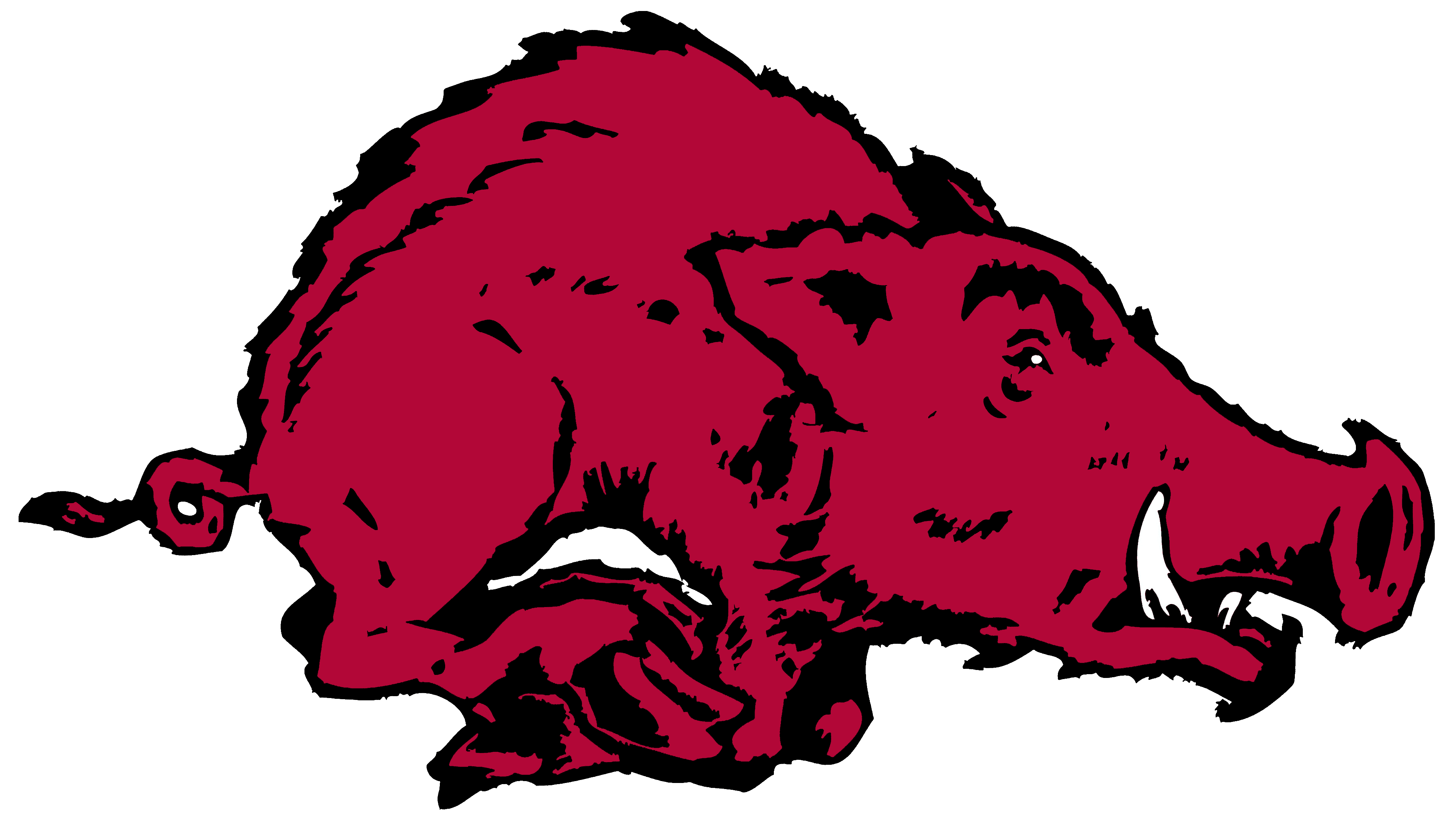
The Arkansas Razorbacks emblem used from 1955 to 1963 restored the red-and-black combination. It gave the hog a more detailed treatment. Black hatching defined its hair, skin folds, and shadows beneath the belly and around the mouth. Numerous small markings filled the figure, while its outer edge remained uneven. A white tusk stood out against the red head.
The hog’s body became heavy and rounded, with a high back. Its long muzzle ended in a large snout, and bent legs were gathered beneath its body. The abundance of interior detail again gave the image the appearance of an illustration.
The next stage in the emblem’s history involved football equipment. A white hog appeared on the red helmet shell in 1964, and details were added to the decal in 1967. The profile became known as the Helmet Hog, alongside its official name, Profile Hog. The hog helmet became part of the Arkansas Razorbacks’ appearance on the football field.
1967 – 2001

From 1967 to 2001, the Arkansas Razorbacks used a revised hog profile. This period also saw the beginning of the university’s licensing program. As versions of the animal circulated, the university sought formal protection for its marks and, in 1987, launched a licensing program with Collegiate Licensing Company.
The applications included three versions of the running Razorback and two images combining the hog with a capital “A.” They separately included the university’s name and the wordmarks Razorback, Razorbacks, Arkansas Razorbacks, Hogs, and Go Hogs. In 2014, after this version had ceased to serve as the primary emblem, “Woo Pig Sooie” joined the list.
The hog in the 1967–2001 emblem continued to leap to the right, but its proportions changed. The head, back, and hindquarters formed a horizontally elongated silhouette. Raised bristles, long tusks, pointed ears, and a spiral tail were rendered in detail. In the red-and-white version, white lines defined muscles, hair, and facial folds and separated the legs. An alternate version of the same profile combined red and black.
The white hog emblem remained on the football helmets. Its size was increased by 15% in 1995.
2001 – 2014

The 2001 Arkansas Razorbacks update retained the familiar Arkansas hog. The university commissioned Phoenix Design Works to revise the existing Razorback, create a secondary emblem, and develop accompanying wordmarks. Jamie Skiles and the studio team worked on the project. At the same time, Matt Shanklin oversaw it for the university as its marketing representative.
The primary version used from 2001 to 2014 retained the red body, spiral tail, and legs tucked beneath the torso, but the illustration style changed. Large areas of color replaced the detailed hair. Nearly all the fine hatching was removed, leaving a few interior lines. Black defined the shoulder, rear leg, lower jaw, and folds near the eye.
A thick, even outline surrounded the figure. The bristles along its back formed a row of sharp triangular points, and the white tusks and teeth became pointed. The hog’s silhouette remained, with fewer small details inside it.
2014 – today

The Arkansas identity update unveiled on April 21, 2014, was intended to give all 19 athletic teams a unified appearance. The university worked with Nike for nearly two years to develop shared standards for colors, emblems, lettering, and uniform numbers. Todd Van Horne, vice president and creative director of Nike Football and Baseball, participated in the unveiling.
The running hog remained the primary emblem, retaining its established profile outline. In the 2014 version, the body received a deep, wine-toned cardinal red, while the black outline and white teeth remained. Red and white continued as the primary colors, with black used for outlines and accents. Red is specified as Pantone 201 C and hex code #A32136, black as #222222, and white as #FFFFFF. The standards allow single-color versions of the running hog and combinations of the emblem with wordmarks.
Nike used a different angle for the secondary emblem. The hog’s head faces forward in a nearly symmetrical illustration with raised ears, narrowed eyes, a large snout, and projecting tusks. The head’s position was associated with the Razorbacks’ aggressive style of play and focus on the opponent. Intended for use across the university’s teams, it complemented the animal’s profile. Custom angular lettering was developed for the ARKANSAS and RAZORBACKS wordmarks. The baseball and softball teams retained the “A” on their caps.
The Slobbering Hog remained part of the basketball identity. Its history is tied to the courts at Barnhill Arena and Bud Walton Arena and to Nolan Richardson’s teams of the 1980s and 1990s. On October 9, 2024, Arkansas announced that the historic illustration would return to the center circle at Bud Walton Arena ahead of John Calipari’s first season as head coach. On the court, the Slobbering Hog served as a distinct basketball emblem, preserving a connection to Richardson’s teams.