


 Duke Blue Devils Logo PNG
The “devilish” embodiment of Duke University’s sports department symbol, founded in 1936, creates complex visual associations. The Gothic-style letter D, matching the team’s colors, links the Duke Blue Devils logo to the name’s history and honors the mountain infantrymen.
Duke University’s athletic history began in the late 19th century, when students at Trinity College played football and basketball. In 1906, athletic director Wilbur Wade Card introduced basketball rules, setting the foundation for the program’s main sport. The “Blue Devils” name appeared in 1922–23 and, after the school’s 1924 renaming, became permanent.
Football gained attention under Wallace Wade, who arrived in 1930 after success at Alabama. In 1938, his “Iron Dukes” allowed no points in the regular season and reached the Rose Bowl, losing 3:7 to Southern California. In 1942, the game was moved to Durham, becoming the only Rose Bowl played at Duke’s stadium.
Basketball rose in the 1960s under Vic Bubas with Final Four appearances in 1963 and 1966. In 1978, Duke reached the NCAA final under Bill Foster but lost to Kentucky. Cameron Indoor Stadium became the program’s home and a defining venue.
A turning point came in 1980 with Mike Krzyzewski. After early struggles, Duke reached five straight Final Fours from 1986 onward. Duke won its first national title in 1991, defeating Kansas after beating UNLV, and again in 1992 against Michigan.
Further titles came in 2001 against Arizona, in 2010 against Butler, and in 2015 against Wisconsin. Krzyzewski retired in 2022 with 1,202 wins and a record number of NBA draft picks, including several first-overall selections.
Rivalry with the North Carolina Tar Heels defined the program, including a 2022 Final Four meeting that North Carolina won. Beyond basketball, Duke won NCAA titles in soccer in 1986 and men’s lacrosse in 2010, 2013, and 2014, as well as multiple championships in women’s golf and tennis.
Meaning and History
What is Duke Blue Devils?
The Duke Blue Devils are an intercollegiate program representing 27 teams at Duke University. Located in Durham, North Carolina, they are members of the Atlantic Coast Conference and compete at the NCAA Division I level. The name originates from the French phrase “les Diables Bleus,” which referred to the Chasseurs Alpins during World War II.
1936 – 1947
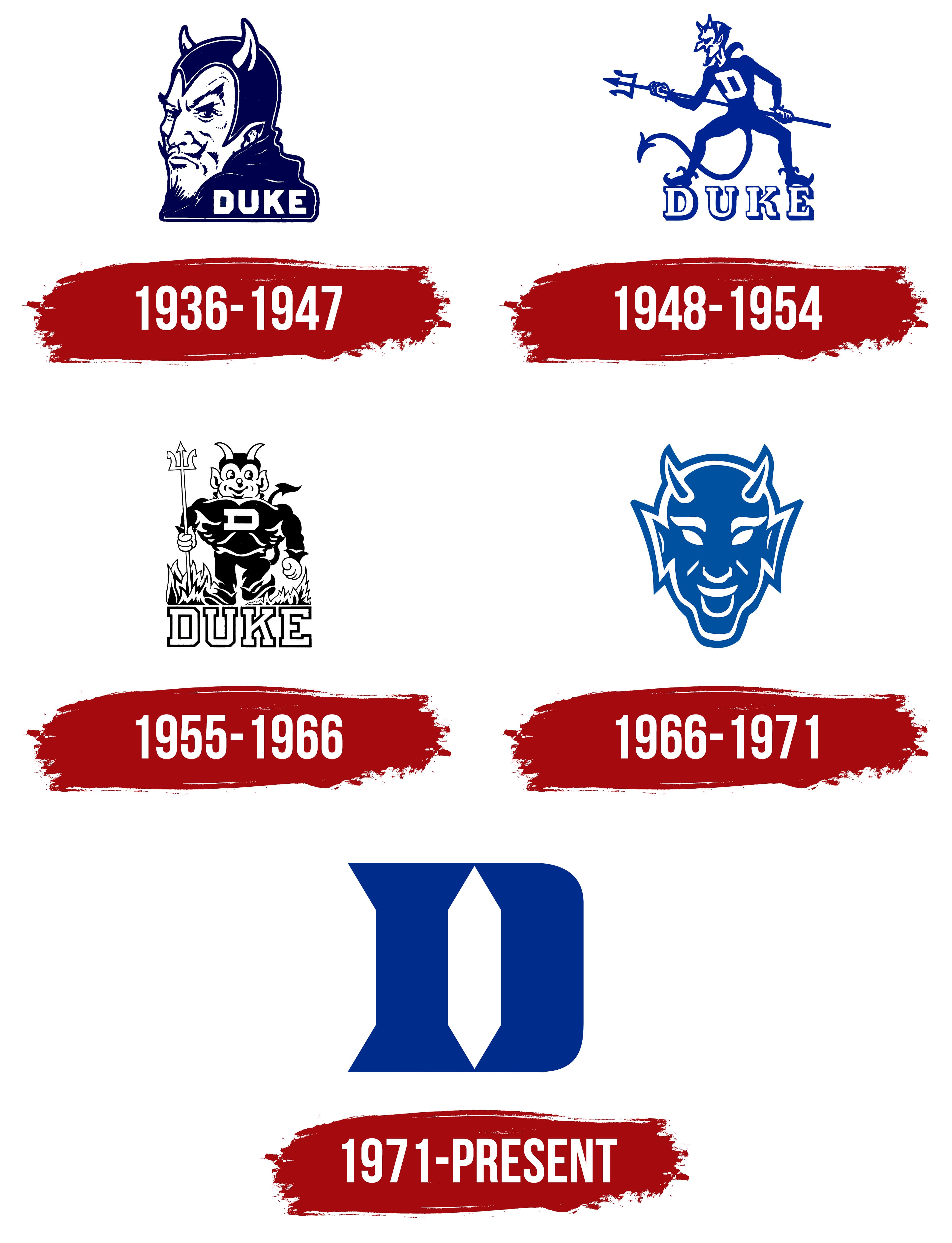
The Duke Blue Devils name predates the university’s current name. The athletic nickname originated at Trinity College and stayed with the institution’s teams in Durham, North Carolina. A horned character appeared in the emblem used from 1936 to 1947, although the name itself has French military origins.
The inspiration came from the Chasseurs Alpins, French mountain infantry known during World War I as les Diables Bleus, or the Blue Devils. American audiences recognized their blue uniforms, capes, and berets. In September 1921, the Trinity Chronicle began searching for a team name to replace Methodists and Blue and White, which referenced the college’s Methodist roots and school colors. Suggestions included Blue Titans, Blue Eagles, Blue Warriors, and Blue Devils. A vote left the question unresolved. In October 1922, editors William H. Lander and Mike Bradshaw began regularly using Blue Devils in sports coverage. The nickname gradually spread from newspaper articles into campus usage.
The Duke name followed two years later. In 1924, James Buchanan Duke established The Duke Endowment, after which Trinity College became a university named for his father, Washington Duke. The benefactor family’s surname joined the existing athletic nickname.
Over time, depictions of a devil replaced the military reference in the imagery. Artists drew horns, pointed ears, a tail, and a trident. A student performed as the Blue Devil at athletic events. In the 1930s, the costume consisted of long-sleeved coveralls, with a cape and mask added later. The illustrations and live mascot developed under the same name.
The emblem used from 1936 to 1947 featured a detailed head in three-quarter view. Heavy brows hung over narrowed eyes, and a curved mustache accompanied a long, pointed goatee. Two light-colored horns projected above a dark head covering, while a high collar framed the portrait below. White areas of the face and fine interior lines broke up the blue illustration. DUKE appeared in heavy white uppercase sans-serif letters within the lower-right portion of the silhouette. The name became part of the portrait, connecting the Blue Devil to the university.
1948 – 1954
The Duke emblem used from 1948 to 1954 replaced the portrait with a full-body cartoon figure. A thin devil stood above the university name with his legs spread, holding a long trident across his body. The face retained its long nose and goatee. A pointed tail looped between the legs, and the toes of the shoes curled upward.
A “D” and the DUKE name identified the university. A white “D” appeared on the chest of the blue costume, while the full name formed a base beneath the character’s feet. The letters below had large rectangular serifs, white fills, and blue outlines.
1955 – 1966
A smile and squat proportions changed the devil’s appearance in the Duke emblem used from 1955 to 1966. A rounded face with large eyes accompanied a muscular torso. The trident stood vertically to the left of the figure, and flames appeared beneath his feet.
The “D” remained on the chest. DUKE formed a compact base below the character, with heavy rectangular serifs and an outline. In the black-and-white version, dark fills defined the costume and hair, while lines outlined the flames. The face, hands, horns, and letter interiors remained white.
This emblem’s use coincided with the standardization of the university’s blue. Trinity College students had adopted dark blue in the late 1880s, and blue and white appeared regularly in songs and cheers by 1910. Work on a doctoral gown prompted the selection of an exact shade. In 1961, president J. Deryl Hart assigned the project to a committee. After its work, the Board of Trustees’ executive committee approved Prussian blue, known as Duke blue, on September 23, 1965.
1966 – 1971
A standalone devil’s head returned to Duke’s emblem in 1966. The DUKE name, trident, costume, and flames disappeared. A forward-facing blue silhouette with nearly symmetrical contours replaced the detailed portrait.
White openings defined the eyes, brows, nose, smile, and lower face. Horns rose above the rounded forehead, and pointed ears projected from the sides. An elongated chin completed the lower outline.
Tom Harp’s football teams wore the image on their helmets from 1966 to 1969. The historic head returned to the helmets in December 2015 for the Pinstripe Bowl.
1971 – today
The Iron Duke D became one of the primary athletic emblems in 1971 and has remained alongside the devil imagery. The university permits its use by athletic and student units, as well as the community supporting its teams. In the standalone version, the initial alone identifies Duke.
The blue “D” has thick vertical strokes and horizontal upper and lower edges. The right corners are rounded, while the left terminals flare outward into wedge-shaped projections. A vertically elongated white opening tapers to points at the top and bottom. The letterform differs from the typeface used in the university name.
The university-wide Duke wordmark uses the serif typeface Garamond LT 3, with a two-line version adding University. Other wordmarks are approved for use with the athletic emblems. Script Duke uses handwritten forms, Gothic Duke and Gothic Duke University use blackletter, and Block Duke features rectangular serifs.
The official collection pairs Iron Duke D with a standalone Devil Head and a combined Iron Duke D with Devil Head. The 2011 catalog included versions of the “D” with basketball and football imagery. The athletic catalog revised on March 20, 2024, includes single-color and two-color letters, the devil’s head, a combined version, script and block wordmarks, and designs featuring a trident. The lettermark was developed alongside the character, and the teams continued to use both.
Since 2009, athletic imagery, apparel, and merchandise have used Duke Royal Blue, Pantone 287 U/C (#00539B), paired with white. The darker Duke Navy Blue, known as Academic Blue, is specified as Pantone 280 U/C and #012169. The brighter shade serves athletics and the darker shade academic uses, while the shape of the “D” remains unchanged.
In August 2024, a secondary emblem highlighted the football team’s connection to Durham. Duke Athletics introduced a devil wearing a headband bearing the city’s BULL CITY nickname. Two hands below the face have their thumbs extended outward. They recreate Bull Hands, the gesture athletes and fans use to celebrate successful plays. The emblem also references the city alongside Iron Duke D.
