


 New Hampshire Wildcats Logo PNG
Teams under the Wildcat emblem defend New Hampshire’s sporting interests. The New Hampshire Wildcats logo signifies cunning, the ability to “read” an opponent’s tactics, and the organization’s athletes’ characteristics, including attention, concentration, strength, and ferocity.
The New Hampshire Wildcats program began in 1893 in Durham, when the school was still known as the New Hampshire College of Agriculture and the Mechanic Arts. Early football schedules featured local teams, while basketball did not appear until the late 19th century. For years, the team had no fixed nickname until a 1926 student vote selected “Wildcats” over “Durham Bulls”.
The mascot evolved through several stages. In 1927, a live wildcat named Maizie debuted at Homecoming, followed by other animals before the university moved to costumed figures in 1968. Later additions included Wild E. Cat and Gnarlz, reflecting a shift toward a modern game-day identity.
Participation in the National Collegiate Athletic Association (NCAA) placed the program in national competition. Most teams compete in the America East Conference, while football plays in the Colonial Athletic Association and hockey in Hockey East.
Hockey became the leading sport. Under coach Charlie Holt in the 1970s, the team reached the NCAA Tournament for the first time and won a conference title in 1979. With Dick Umile, UNH claimed Hockey East titles and reached the Frozen Four in 1997 and 1999.
Football built consistency under Bill Bowes from 1972 to 1998, earning multiple playoff appearances. The rivalry with the Maine Black Bears dates to 1922, while the schools have played basketball annually since 1904. In 1985, women’s lacrosse won a national title, and the football program later produced more than 20 NFL Draft selections.
Meaning and History

Although the sports program began in 1866, the cat on the organization’s logo first appeared in 1926. Following a vote, Wildcat became the college’s official nickname. Students chose it from options like “Durham Bulls,” “Eagle,” “Husky,” and “Unicorn.” They decided a name associated with a wild cat – small and aggressive, like New Hampshire – would be more harmonious for the teams.
What is New Hampshire Wildcats?
The New Hampshire Wildcats are a sports program that participates in intercollegiate competitions on behalf of the University of New Hampshire. It includes 19 student teams from the America East Conference that compete in NCAA Division I. Some teams are members of other associations, including skiers in EISA, gymnasts in EAGL, hockey players in Hockey East, and football players in the CAA. Their primary location is Durham.
1993 – 2000

A snarling wildcat head was part of the New Hampshire Wildcats’ athletic identity long before it was paired with UNH. Early illustrations featured detailed fur and whiskers. In the version used from 1993 to 2000, the face occupied the center of a large lettermark. The image’s history began with a student vote and the arrival of a live mascot.
The New Hampshire Wildcats represent the University of New Hampshire in Durham. New Hampshire identifies the state, while Wildcats supply the animal nickname. The institution traces its origins to an agricultural and mechanical college founded in Hanover in 1866. In 1893, it moved to Durham on land bequeathed by Benjamin Thompson. It became the University of New Hampshire in 1923. The abbreviation UNH later appeared in athletic emblems.
The results of the team-name vote were announced on February 4, 1926. Students considered bulls, huskies, eagles, a unicorn, and a wildcat. Local newspapers were already calling the hockey team the Durham Bulls. Wildcat supporters cited the animal’s speed, agility, cunning, and resourcefulness. They also offered a practical argument. A compact wildcat would be easier to bring to games than a bull. After the vote, the Blue Key student organization raised money for a live mascot. A wildcat named Mazie was captured near Meredith and introduced at Homecoming in 1927.
Blue and white connected the athletic identity to New Hampshire’s geography. The university associates white with the White Mountains and blue with the Atlantic Ocean. The colors represent the state’s mountain and coastal regions, with the campus area connected to the Atlantic through Great Bay. Silver-gray later joined the traditional blue-and-white combination.
A snarling wildcat appeared on baseball warm-up jackets in 1929, followed by a wildcat head on hockey uniforms in 1939. A surviving drawing from 1935 shows the early mascot. Its face looks forward beneath tall, triangular ears. Long whiskers extend to either side, and two upper fangs show in the open mouth. Blue hatching defines the fur and shadows around the eyes. Varying line weights, broken contours, and individual strokes give it the appearance of a pen drawing. The snarling head remained in later emblems, although detailed fur gradually gave way to broader shapes.
The logo used from 1993 to 2000 combined the animal with UNH. The “U” sat on the left, with the “N” above the “H” on the right. Closely packed blue letters with heavy rectangular serifs formed a stepped arrangement. White gaps and an outer blue outline separated adjacent sections. A black-and-white wildcat head overlapped the center. The frontal view revealed both eyes, ears, and fangs. Numerous fine facial lines and long whiskers preserved the style of the university’s early mascot illustrations.
2000 – 2019

Inconsistent team uniforms prompted New Hampshire to develop a shared athletic identity. Football used red, white, and navy, while women’s basketball combined light blue, navy, and white. According to associate athletic director Dot Sheehan, Collegiate Licensing representatives pointed out the differences. The university hired New York-based SME Design Inc. It formed a committee of approximately 30 representatives from university departments, coaching staffs, and local retailers to review the project.
Development and approval took about two years. Navy and white remained the foundation, while several discussions determined the secondary color. Light blue was rejected because it resembled the University of Maine’s colors, and yellow brought the University of Rhode Island to mind. Silver joined the final collection, with black available for selected versions. The coordinated system was intended to replace the assorted illustrations and color combinations.
In 2000, a full-body wildcat paired with NEW HAMPSHIRE became the primary emblem in a horizontal logo. The full state name replaced the vertically arranged initials. NEW appeared to the animal’s left, while HAMPSHIRE occupied the lower line beneath it. White uppercase serif letters slanted right, with gray areas along the edges suggesting beveled surfaces. A navy background united the lettering and animal.
The wildcat crouches over the lower line, its front paws reaching toward the lettering’s edge. Its head faces left, and its mouth is open. Gray body areas, white openings, and navy outlines define the shoulders, paws, muzzle, and fur. This version remained the primary athletic logo until 2019.
In 2000, the university distinguished its competitive athletic image from its mascot for children’s events. A fierce wildcat represented the teams, while the friendly Wild E. Cat was intended for younger audiences. The character’s illustration became the basis for a costume approximately six feet tall. The muscular Gnarlz joined later. More than 50 names were proposed for him, with an online vote determining the final choice. Gnarlz debuted at a football game on September 20, 2008.
2019 – today
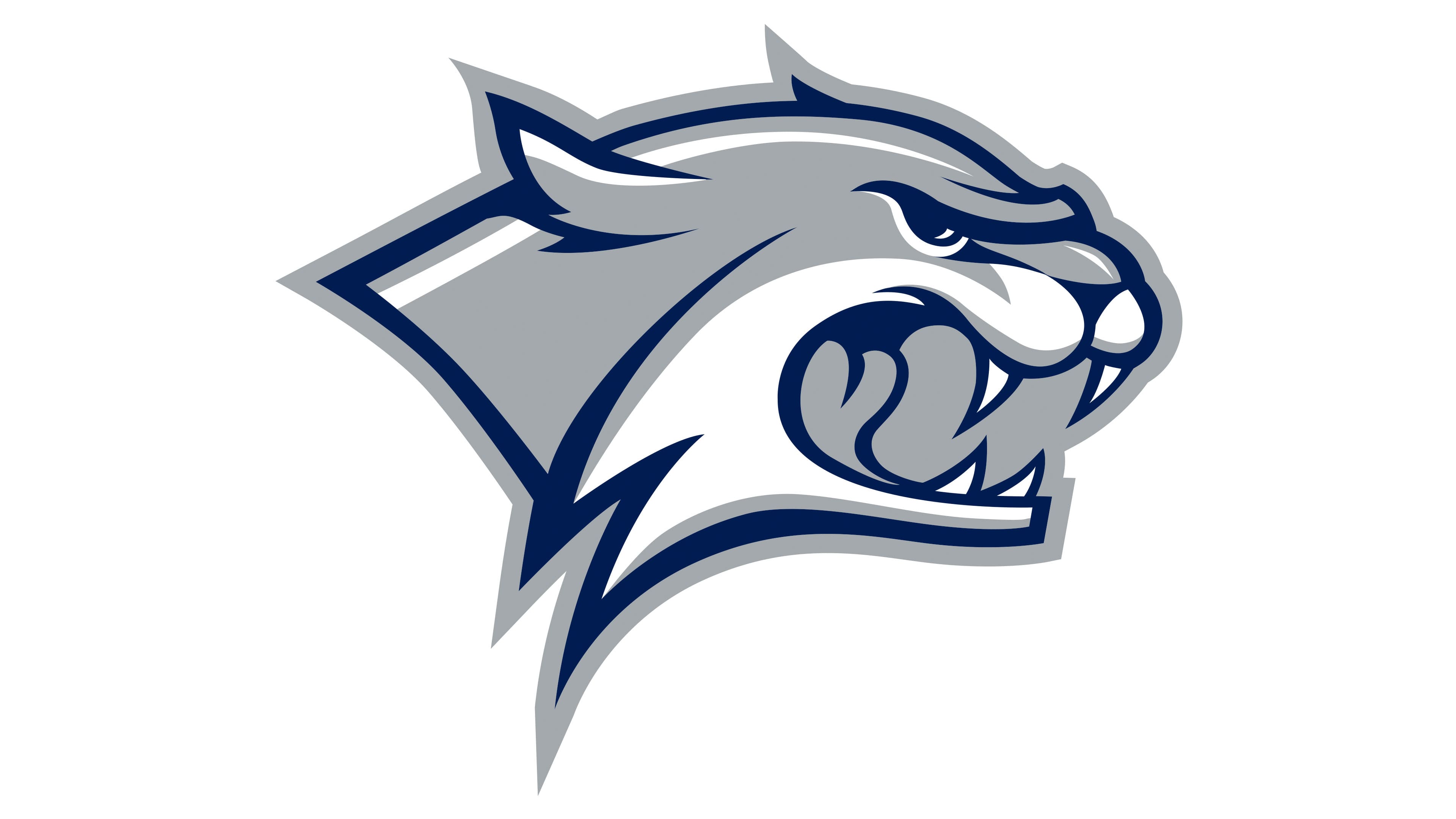
In 2019, a wildcat head from the secondary collection became New Hampshire’s primary athletic emblem. The university community already knew the image, so the change preserved a connection to the previous identity. A standalone profile replaced the full animal and NEW HAMPSHIRE wordmark as the primary logo.
The face points right. Sharp tufts of fur on the left create an elongated silhouette leading toward the nose and open mouth on the right. Pinned-back ears and furrowed brows intensify the animal’s threatening expression. A curved tip is visible at the bottom of the mouth, while white areas define the teeth and part of the muzzle. Gray fills the interior surfaces, and navy outlines the silhouette, eye, and mouth. Compared with the 1993 emblem, large areas of color replace the detailed hatching and long, thin whiskers.
New usage rules accompanied the change in the primary logo. The full-body wildcat with NEW HAMPSHIRE, several other animal illustrations, the paw print, and Wild E. Cat were designated for club and student-life use. Varsity teams received a separate identity. Older athletic emblems were placed in the historic marks category.
Font and Colors

The graphic and textual elements are executed in a unified palette of blue, white, and gray. These colors symbolize the teams and their relation to the surrounding landmarks. The deep blue Pantone 287 represents the waters of the Atlantic Ocean, and white represents the White Mountains.