


 Westpac Logo PNG
The emblem immediately conveys the organization’s global presence, solidity, and reliability. The Westpac logo illustrates the powerful flow of funds through bank accounts. As a result, it grows and spreads, creating branches.
Westpac began in November 1816, when 39 colonists in Sydney met to discuss the colony’s unstable finances. Governor Lachlan Macquarie backed the idea, and on April 8, 1817, the Bank of New South Wales opened in a rented house on Macquarie Place. Sergeant Jeremiah Murphy was its first depositor, placing £50 with the new bank.
The bank accepted deposits and issued banknotes in a colony short of coins. In 1828, British authorities rejected its original charter, so it was reorganized as a joint-stock company. During the 19th century, it expanded with the colony, opened seven branches in New Zealand in 1861, and served mining towns during the gold rushes.
In 1927, the Bank of New South Wales merged with the Western Australian Bank, followed by the Australian Bank of Commerce in 1931. In 1957, it bought a 40% stake in Australian Guarantee Corporation, and in 1974, Australian banks entered the credit card market.
In October 1982, the Bank of New South Wales merged with the Commercial Bank of Australia, founded in Melbourne in 1866. The new name, Westpac Banking Corporation, was derived from “Western Pacific,” following the largest banking merger in Australian history.
Westpac developed the IBM-based CS90 banking system from 1984 onward and expanded it to Los Angeles, Seoul, Kuala Lumpur, and Taipei. After a A$1.6 billion loss in 1992, it restructured and bought Challenge Bank, Trust Bank New Zealand, and Bank of Melbourne. In 2008, Westpac merged with St George Bank in an A$19 billion deal, keeping St George as a separate brand.
Meaning and History
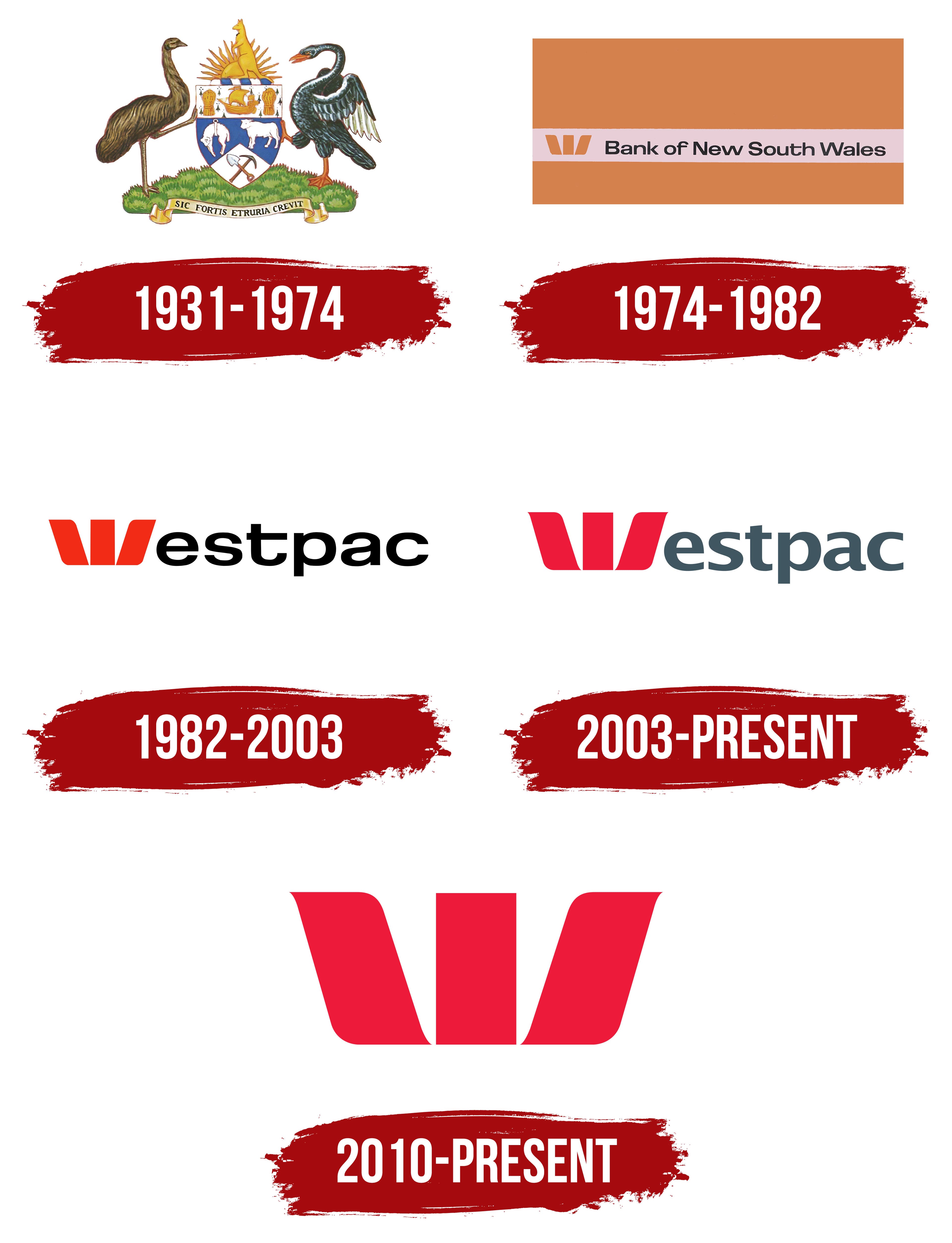
The bank was conceived as the largest financial institution in the vast Western Pacific area. First, BNSW (short for Bank of New South Wales) opened branches across Australia and most of Oceania. This expansion spanned the 19th and 20th centuries. In 1850, it opened a branch in Moreton Bay; a year later, in the city of Victoria; in 1861, in New Zealand; in 1877, in the southern part of the country; and in 1883, in the western part. The bank then expanded further: in 1901, it opened a branch in Fiji; in 1910, it opened branches in Papua New Guinea and Tasmania. As a result, the Westpac logo gained widespread recognition.
This was followed by several mergers and offshoots, which the corporate logo did not reflect. Its current name reflects this. It comprises two parts indicating this financial institution’s region: “WESTern” and “PACific.” In some cases, it used the full name; in others, it used an abbreviated version. In total, the bank has five basic logos in its history.
What is Westpac?
Westpac is Australia’s oldest bank, dating back to 1817. It is one of the country’s big four financial institutions.
1931 – 1974
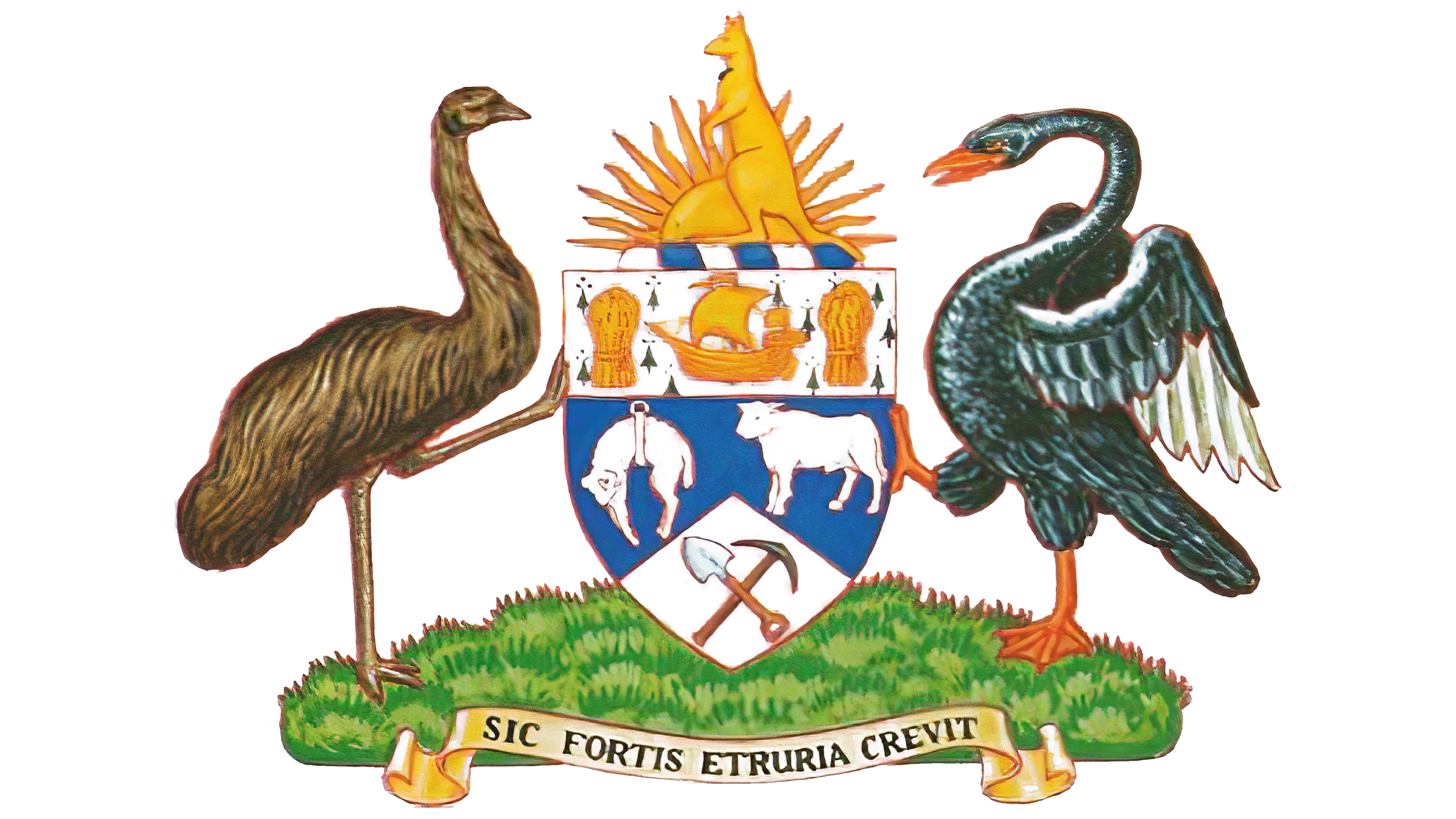
Initially, management approved a custom-made monochrome heraldic coat of arms. It is not a symbol of any kind or dynasty, but specially designed paraphernalia. The logo depicts a classic shield, narrow at the bottom and wide at the top. National talismans surround it: an emu (left), a swan (right), and a kangaroo (above). On the shield itself, tools and other elements emphasize the bank’s close connection to the state’s heritage and roots.
1974 – 1982

The modern BNSW identity era began in 1974, with the institution’s full name in orange-and-sand on canvas. The white horizontal stripe inside the rectangle bears the inscription “Bank of New South Wales.” It consists of black sans-serif characters. The initial letters in words are uppercase; the rest are lowercase. To the left of the text is the original icon – a stylized “W.” The symbol has three wide petals: one straight (a vertical rectangle) and two oblique (two lateral parallelograms).
1982 – 2003

In 1982, the Bank of New South Wales merged with the Commercial Bank of Australia to create the Westpac Business Corporation. The new name was first used in the emblem, formed by merging “western” and “pacific.” There are no other verbal designations. The graphic element is a “W,” a single red character with three wide stripes. Here, it replaces the capital letter. The other characters are lowercase, squat, and slightly elongated horizontally.
2003 – today

In this version, the developers corrected the font: they removed letter elongation and replaced black with dark gray. They also increased the icon’s brightness, making it a rich red. This logo has not been canceled, and the bank still uses it.
2010 – today

Alongside the existing emblem, they approved another: the same, but simplified. Designers removed the word “Westpac” because, by early 2010, banking symbols were already recognizable without it. This minimalistic “W” version is primarily intended for advertising materials; therefore, it is available in several samples: white on red, black on white, and a volumetric (3D) format.
Font and Colors

The Australian bank’s visual identity moved from complex forms to simple ones. While the debut logo featured many local talismans and heraldry, the current logo uses only a single stylized letter. The “W” looks like a blossoming flower with three petals: a straight central one and two oblique lateral ones. They are made of geometric shapes, a rectangle and a parallelepiped, which do not touch at the bottom.
The first lettering uses a typeface reminiscent of Urbano Bold Expanded, with an elongated “f” hook. The next version of the logo contains the bank’s name with a font close to the commercial version of Foundation Sans Bold Extended and the free “FunZone Regular.” The letter “t” with an elongated right-hand part is beaten individually. The current emblem consists of the word “Westpac” in the Lucida Sans Demi typeface. The design studio Charles Bigelow & Kris Holmes created it, and it was first published in URW++.

The color palette is more stable. It has always consisted of bright shades of red with a bias toward orange or scarlet. They have now added dark gray and black. The background is usually white, but black-background versions are also available.