


 Zelle Logo PNG
The emblem demonstrates simplicity and ease of use. The Zelle logo demonstrates the service’s integration into banking payment systems, which speeds up payments. The sign indicates readiness to serve customers from different countries.
By 2010, US banks faced growing pressure from Venmo and PayPal, which offered fast peer-to-peer transfers. Traditional ACH systems remained slow and fragmented. In April 2011, Bank of America, JPMorgan Chase, and Wells Fargo launched ClearXchange. The platform enabled direct bank-to-bank transfers using phone numbers or email, without a separate wallet.
Early growth was limited. Transfers were primarily handled within partner banks, which limited adoption. In 2015, US Bank and Capital One joined. The same year, real-time transfers were introduced, addressing a core limitation. By 2015, ClearXchange reported over 20 million users across more than 7,500 financial institutions, though only a small group had direct integration. In 2016, MasterCard and Visa partnered to expand debit card access.
Later in 2016, Early Warning Services acquired ClearXchange. Owned by a consortium including Bank of America, Capital One, and JPMorgan Chase, it reworked the platform and introduced the new brand, Zelle. Zelle launched in June 2017 with 30 partner banks. In its first year, transaction volume exceeded $75 billion. Earlier that year, under ClearXchange, 51 million transfers worth $16 billion had already been processed.
By the end of 2017, ClearXchange shut down P2P services, and users migrated to Zelle. Cash App and Venmo competed from outside bank systems. From 2018, regional banks and credit unions joined. Zelle’s model relied on integration into banking apps rather than standalone software. By 2022, it reached over 56 million users and $1.5 trillion in total transfers. In April 2025, Early Warning Services discontinued the standalone Zelle app, limiting access to partner bank applications.
Meaning and History
The service logo is associated with money because all its services are financially oriented. Zelle is a payment network that transfers electronic money directly between bank accounts. In most cases, transactions are free, and no commission is charged. The main point is that both the sender and the recipient are registered on a P2P platform and have open accounts with a partner bank.
Users have repeatedly noted the similarity between the letter “Z” in the Zelle logo and the dollar sign in the table of typographic symbols, because “$” is often depicted as “S” with two short lines at the top and bottom. “Z,” in this case, could represent “$,” rotated 180 degrees. Still, the designers deliberately emphasized the letter’s angularity. They made it different from the smooth, rounded “S.” So the connection between them is unclear, though it exists at the level of association.
The electronic payment service uses a simple logo with a single word, “Zelle.” No other elements appear besides the Registered (Trademark) sign, a capital “R” in a circle. The ® symbol usually appears in the upper-right corner and indicates that the brand has already completed the official registration process.
The designers chose this minimalism to focus on the first letter, “Z.” They even detached it from the lettering and placed it in a separate purple square with rounded corners. The short, iconic version of the logo is used as the app icon and is often seen on the website, so it is as familiar to users as the full logo with the service name. In this case, in the basic version, the letter “Z” is part of the word and is not separated by anything.
The “Z” has one short vertical bar at the top and bottom, just like a dollar sign. The developers specifically chose this association so that, at first glance, it would be clear where Zelle was headed and what its services were. This emblem is an example of successful marketing, as its visual identity does not look like a collection of random elements and can convey more than it seems.
What is Zelle?
Zelle is an online payment system. It lets users transfer funds electronically between registered users’ bank accounts. Transaction cancellations are not possible. The service is available to US citizens and is owned by several credit and financial institutions: Wells Fargo, U.S. Bank, Truist, PNC Bank, JPMorgan Chase, Capital One, and Bank of America. Zelle’s main competitor is PayPal’s Venmo.
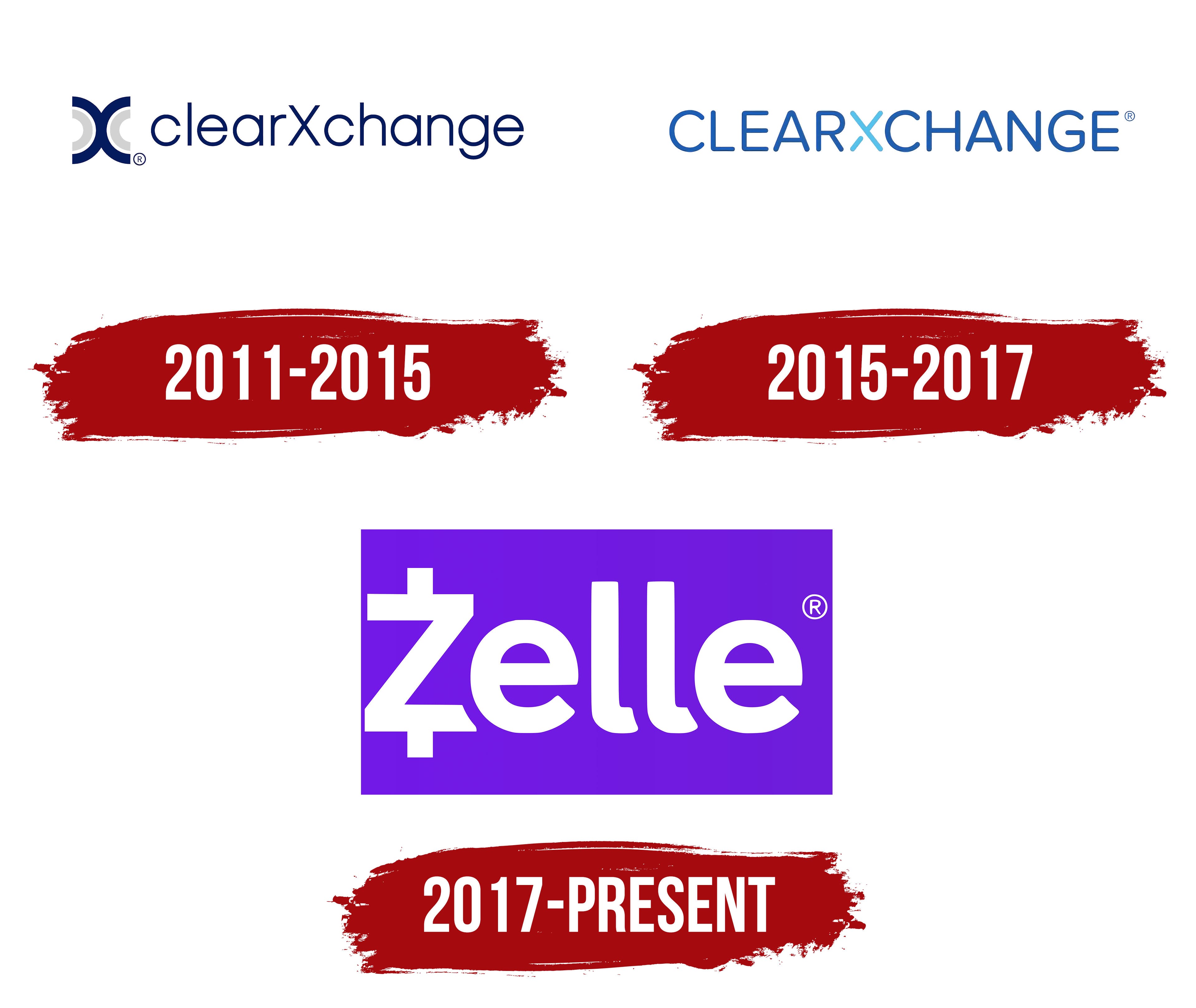
2011 – 2015

In its early years, the online instant payments service displayed the name on the Zelle logo alongside the original sign. The most striking element was the unified spelling of “clearXchange.” This design made the emblem distinctive, supported the financial services concept, and attracted potential clients’ attention. The font was thin, rounded, and grotesque. All letters (except “X”) were in lowercase. This structure immediately hinted at the glyph and suggested an electronic money transfer system. To the left of the inscription was a small icon with an “X” on it. It consisted of two dark blue arches, duplicated by smaller light gray arches.
2015 – 2017

During this period, the company used a completely transformed logo. As a result of the redesign, only the digital payment network’s name remained. It was converted to uppercase and typed in bold. The emphasis on “X” was made with color: the letter was painted in light emerald, so it instantly stood out among the monotonous blue symbols. There was no graphic sign.
2017 – today
After the rebranding, they created a purple rectangle with the electronic money transfer system’s current name. White letters are large and bold. Lowercase signs are rounded, but capital signs are not. Designers made it look like the dollar sign ($) while maintaining its individuality. The glyph is written in a standard way with the characteristic “Z” angles. The vertical line appears only at the top and bottom, missing in the middle. Even without it, it is clear that the platform it represents is connected to financial issues.
Font and Colors

Given that the logo contains only the service’s name, the designers sought to make the inscription attractive. To do this, they chose a non-standard sans-serif font. The bottom edges of the two’s and both’s are cut at different angles, making the letters appear disproportionate. The imbalance is only balanced out by the fact that all lines are approximately the same thickness.

zelle logo small
Only two colors are used for decoration: white and purple. They can alternate depending on the visual context. If the inscription is dark, the background is light, and vice versa. In the short iconic version, the “Z” is white, and the rounded square is purple.