


 Advance Auto Parts Logo PNG
The car will be ready for any race with spare parts from the company. The Advance Auto Parts logo takes the user to the track’s grandstand, where high-speed competitions take place. And, of course, those who use brand details are the first to cross the finish line.
Advance Auto Parts is the second-largest auto parts company in the U.S., with a net annual profit of $500 million. The company serves 5,000 stores and acquired chains operating under its brands (Worldpac and CARQUEST). Provides a large selection of products from 1,100 suppliers, along with a range of value-added services (battery charging, car electrical system checks, etc.). Its largest shareholders are Freeman Spogli & Co and Vanguard Group, Inc.
The successful auto parts business began in 1932, when Arthur Taubman, the son of Austrian immigrants with only an elementary education, bought his first three stores. His company, Advance Stores, gradually expanded to 54 stores and traded a range of goods alongside car service and repair. Advance Auto Parts took its current form largely because of Nicholas Taubman’s son. Starting in 1969, he changed the business’s direction by focusing on parts and expanding the chain. Over the next 30 years, until the sale of Freeman Spogli & Co. in 1998, the company grew to 600 stores and annual revenues of 800 million.
Meaning and History
Advance Auto Parts inherited its name from the retail chain Advance Stores, which American businessman Arthur Taubman bought in April 1932. Until 1953, it had no standard logo, but that didn’t stop it from expanding: by the end of World War II, the network already had 54 stores selling auto parts.
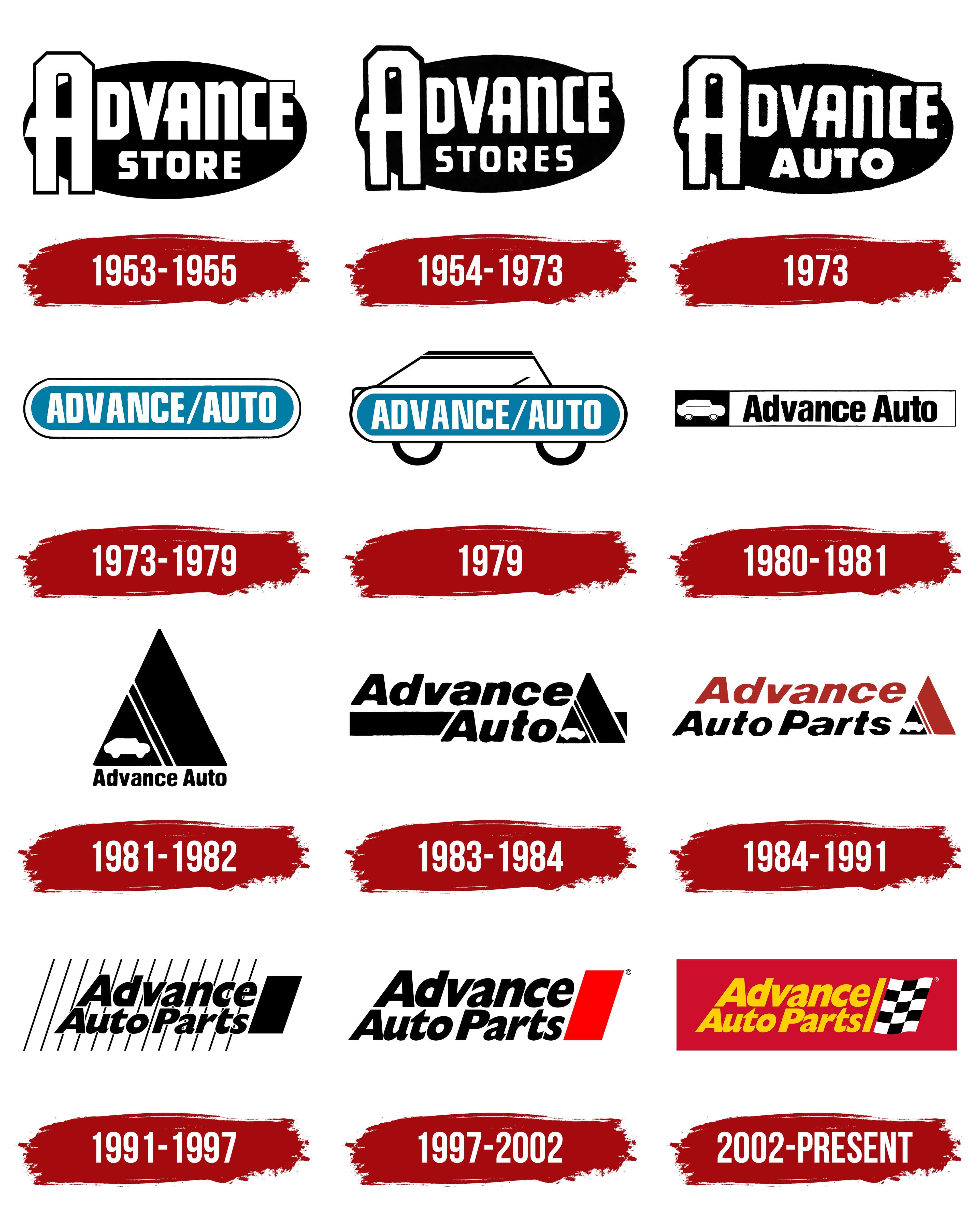
The earliest brand emblems featured the name in bold, angled lettering, set inside a large dark oval. Over time, the base transformed into an elongated blue rectangle with rounded edges, and a modified Eurostile Heavy Condensed font replaced non-standard glyphs with individual designs.
Designers later experimented with different triangular shapes and car silhouettes and began using slanted fonts to create a sense of speed. By 1984, the logo had been filled with red, harmonizing well with black and white. After 1991, the triangle was replaced with a parallelogram. At the beginning of the new millennium, it became a checkered flag, symbolizing the finish line, and was passed to the race winner as a trophy.
What is Advance Auto Parts?
Advance Auto Parts is a large American company that specializes in selling auto parts for trucks, vans, SUVs, and cars. The Taubman family founded it in 1932. The brand operates 5,000 stores in North America and supplies parts to its Carquest chain stores and Worldpac wholesalers. The company had more than $10 billion in revenue in 2020.
1953 – 1955
In 1953, Advance Store (the former name of Advance Auto Parts) introduced a standard logo for use in advertising. Designers focused on the company name, presenting it in white inside a horizontal black ellipse. They developed individual bold glyphs with cut edges to enhance contrast. The letters are shaped like complex polygons: even the “O” has no curves. The most unusual are the two “A’s,” with the horizontal stroke protruding from the left side and cut off at a sharp angle. The first “A” extends beyond the base, as it is almost three times larger than all other glyphs.
1954 – 1973
When the auto parts company was renamed Advance Stores, it had to update its logo. Designers slightly softened the lettering by rounding the edges. This is a subtle psychological trick: emblems with smooth curves are thought to evoke consumers’ subconscious trust. The glyphs themselves became thinner, so the spacing between them widened. The increased interletter spacing improved readability.
January-May 1973
1973 – 1979
After taking over the business from his father, Nicholas began modernizing the stores. He gave the firm a more appropriate name, Advance Auto, which shaped the business’s subsequent development. The first logo belonged to a transitional period and had only a partial connection to automobiles.
The logo’s shape resembled a license plate, an oval blue plate with Advance Auto inscribed on it. A white border around the edges and a thin black line around the entire composition complete it. The oval shape also suggests completeness, since Advance stores offered everything you needed.
The vertical slash between the words “Advance” and “Auto” separated the two directions of the company’s work. After the war, the company not only serviced cars but also sold a wide variety of goods from toys to furniture to stay afloat.
The logo’s light colors conveyed a positive mood. It showed that the outlets sold goods for the whole family, including children. The blue background evoked the sky and dreams. It indicated a thriving business, consumer satisfaction, and a cloudless future for the company. The white lettering and white protective trim represented an honest reputation and reliability, which were the company’s foundation.
Nicholas’ father taught him the key principles of building a business: bringing value to people, maintaining a reputation for integrity, treating employees like family, and serving customers so well they come back. These four pillars were the foundation of Advance Auto’s business and are reflected in the choice of color scheme and logo shape.
The black exterior line summed it up, bringing all of the company’s goals together.
May-December 1979
1980 – 1981
1981 – 1982
1983 – 1984
1984 – 1991
Nicholas Taubman decided to focus the company’s work solely on auto parts. So the name was refined to Advance Auto Parts. The credit line was closed, consumer products were removed from the shelves, and auto repair and service were abandoned. The company brought many parts into its 100 stores and focused on expansion by opening new outlets.
The logo was also completely revamped. The color scheme was red and black. This contrasting design attracted attention and was easy to read from the road. As a result, motorists quickly learned about the new store. The black-and-red combination conveyed energy and an aggressive image (the number of stores doubled in a few years). Red was associated with a problem, a breakdown, urgent measures needed to restore the car, while black was associated with oil, fuel oil, road repairs, and asphalt.
The company name was placed on two levels. On the top line, in red letters, it read “Advance”. It signified advancement and progress. In black, the words “Auto Parts” were written under it. To the right, a large triangular sign framed the logo. In the lower-left corner, a moving car was shown in black. The rest of the triangle was red. The triangle echoed the road sign “Caution. Repair Work.” The sign and lettering showed how a breakdown stopped the car’s movement. The parts of the logo that symbolized traffic obstructions were marked in red. The solution to the problem, in the form of the parts needed for the trip, was highlighted in black.
1991 – 1997
By ’91, the company ranked 8th in the country in auto parts sales. Its main goal was to expand as much as possible and buy smaller firms. The logo was changed to one of stability and confidence. The red “stop color” was removed, leaving only black. It resonated with roads, repairs, and cars.
The entire field of the logo was lined with oblique black lines. They symbolized the multilane roads. It showed the company’s many outlets along major highways nationwide and its expansion into other states.
The two-tiered placement of the name was retained, but instead of a triangle, a black vertical rectangle bounded the inscription. It resembled the road’s marking strip.
The entire logo sloped to the right, in tune with the road traffic.
1997 – 2002
By 1997, Taubman decided to retire. He hired an agency to sell the firm because none of the children wanted to continue their father’s business. In 1998, Freeman Spogli & Co. bought 86% of the company. The new owner adjusted the company’s visual sign.
They removed the vertical stripes, which interfered with reading the name. They replaced the black rectangle with a red one to create contrast; it displayed the words “Stop! Attention!” and attracted motorists.
2002 – today
Taubman and his loyal associate Smith left the company entirely, retiring (Nicholas had previously remained on the board of directors). The company was renewed, got a new head, and changed its logo.
The new logo was placed on a red background. The company’s name remained two-tier but was executed in a single yellow color. A fluttering chess flag replaced the red rectangle. This marks a new start for the company, without its founders, who swore there at the beginning. In addition, Advance Auto Parts actively sponsors races at various levels, including NASCAR and Monster Jam.
Font and Colors
The main logo colors are red, black, and yellow.
- Red symbolizes the words “Attention! Stop!”, evoking the pressure the company exerted to conquer the market, and increased the number of stores by 2-2.5 times every couple of years.
- Black represents roads and machine oil. A symbol of experience and reliability.
- Yellow represents the joy and satisfaction that the stores must evoke in customers, thanks to quick service and the availability of all necessary spare parts.
The logo’s font has not changed over the last three versions. It is italicized Humanist 521.