


 InterSport Logo PNG
The modern InterSport logo is stylish and reflects the key characteristic shared by all its products. A sign symbolizes its direction, dynamism, and balance, curved like a ramp, with a red ball resting at the top.
In the late 1960s, Western Europe saw rapid growth in sports participation, while retail remained fragmented and weak in negotiations. In 1968, ten national purchasing groups from countries including Germany, France, and Sweden founded INTERSPORT International Corporation in Bern to strengthen their market position.
The cooperative model allowed local retailers to stay independent while sharing procurement, branding, and marketing. Finland and Canada soon joined, expanding the structure beyond the initial group.
In 1972, INTERSPORT became the official retailer of the Munich Olympics, followed by the Innsbruck 1976 and Moscow 1980 Olympics. These partnerships strengthened its ties to international sport and increased its visibility.
During the 1980s, the company shifted toward private labels, launching McKINLEY in 1984, followed by etirel and TECNOpro. This reduced reliance on external suppliers, unlike Decathlon’s vertically integrated model.
After 1989, expansion into Eastern Europe accelerated, with entry into Poland, Hungary, and the Czech Republic. By the early 1990s, the network exceeded 3,000 stores, supported by partnerships with Nike and Adidas.
In the 2000s, INTERSPORT strengthened its role in football through its official retail operations at UEFA EURO 2008, 2012, and 2016, as well as at the 2014 FIFA World Cup.
In 2012, the group acquired The Athlete’s Foot, expanding into North and Latin America, but sold it in 2021 to refocus on core operations.
By the 2010s, annual revenue exceeded €10 billion, with expansion into South Korea in 2010 and China in 2013. Growth continued through regional consolidation, including the 2026 acquisition of INTERSPORT Slovenia Group.
Meaning and History
The first InterSport lottery logo appeared in 1971 and was immediately displayed in 1,000 stores nationwide. The international corporation developed it for marketing purposes. It sought to establish a unique corporate style for the franchising network, distinguishing it from competitors.
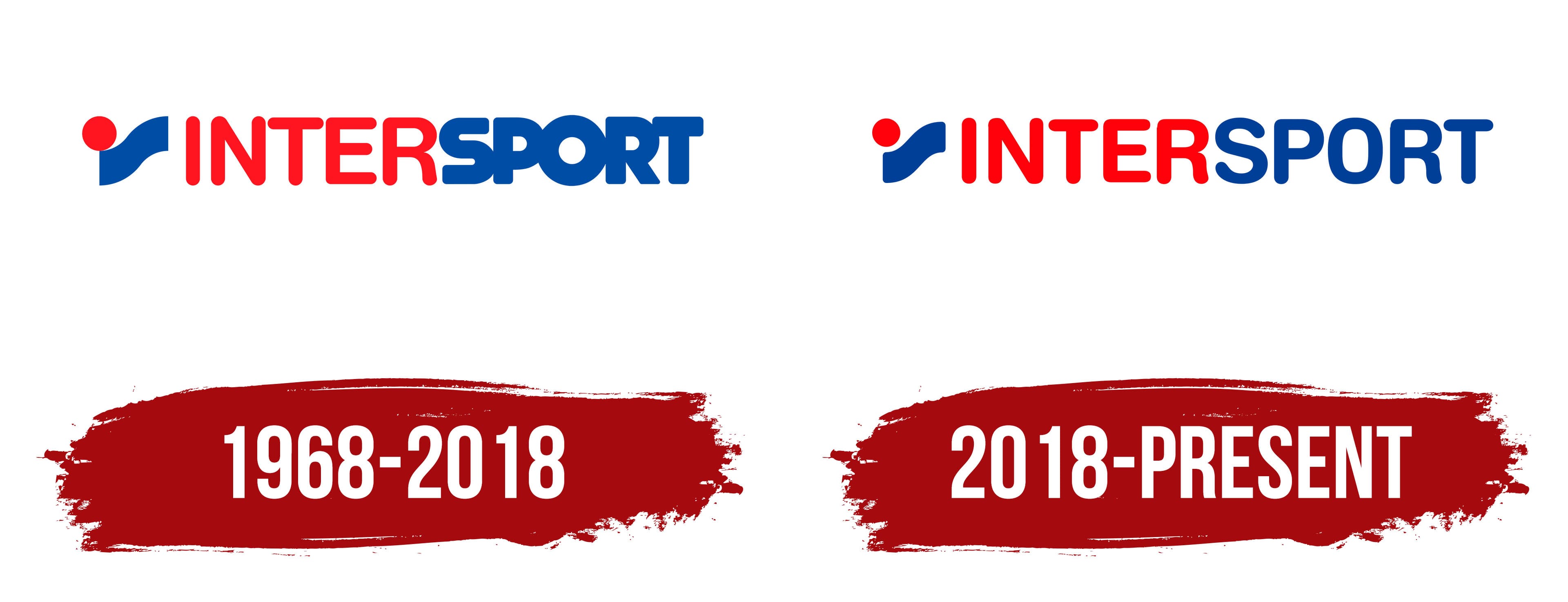
In 1979, the company redesigned the logo. The new version reflected an improved brand image. The overall concept changed, but the color scheme remained the same: blue and red on an all-white background. In 2009, the logo received minor changes, affecting only the typography.
What is InterSport?
Intersport is an international chain of stores specializing in sports equipment for activities such as swimming, running, and football. It was founded in France in 1968 and gradually expanded, opening retail outlets in more than 60 countries worldwide. The product range includes accessories, footwear, and clothing specially designed for physically active people. The company sponsors numerous sporting events, including large-scale ones such as the Olympic Games, Tour de France, and FIFA World Cup.
1968 – 2018

Initially, the logo was a harmonious combination of text and graphics. The colors and style were balanced. On the left was a miniature icon with two elements: the so-called ramp (a short curved stripe) and a ball. They convey movement and the concept of being on the edge; one can either soar upwards or fall. On the right was the word “INTERSPORT,” divided into two segments by color: red “INTER” and blue “SPORT.” The second segment is highlighted with wide letters.
2018 – today
The central part of the Intersport label is a curved rectangle with a circle in it. The rectangular shape is like a steep ramp. A small ball has stopped at its edge. It is either rolling down or trying to climb to the top.
The image has frozen dynamics. Balance is also important because the circle balances on the edge and does not fall. This idea aligns with a retail conglomerate specializing in sporting goods.
The second part of the logo is the inscription “InterSport.” The brand name is in two colors: red (“Inter”) and blue (“Sport”). The font is sans-serif with rounded corners. Until 2018, the letters were bold and merged in the second half of the word. This is not the case in the latest version of the logo; everything looks harmonious and corresponds to the idea of balance.
Font and Colors

The inscription on the emblem is set in a grotesque uppercase font. The words have no serifs; they are simple, smooth symbols that were once wide and have now become narrow. All external ends of the letters are rounded.
A combination of red and blue colors on a white background dominates the logo. No other official palette exists. Moreover, the colors are striking, vivid, and saturated.