


 Macys Logo PNG
The company’s department stores have a stellar position in the US market. It offers the widest assortment, the best goods, and many outlets. Macy’s logo conveys leadership and signals that the brand is well-known and popular.
The University of Notre Dame was founded in 1842, when French priest Edward Sorin and seven brothers from the Congregation of Holy Cross arrived on 524 acres near South Bend, Indiana. The site had previously served as a Potawatomi mission and contained little beyond a log chapel. Indiana granted the university charter in 1844, while the first degrees were issued in 1849.
The school struggled through its early decades. During the Civil War, students left for military service, and Congregation members served as Union chaplains. In 1879, a fire destroyed the Main Building and a library containing 10,000 books. Reconstruction started almost immediately, with workers laying 4.3 million bricks before the next semester. The rebuilt structure introduced the golden dome that later became the university’s main symbol.
At the turn of the 20th century, Notre Dame expanded its academic programs while competing with Georgetown University. Football drew national attention after Knute Rockne led Notre Dame to a 1913 victory over West Point with an aggressive passing game. As head coach from 1918, Rockne won national championships in 1924, 1929, and 1930. His “Four Horsemen” lineup became part of American sports culture. At the same time, the 1940 film “Knute Rockne, All American” starred Ronald Reagan as George Gipp.
Father Theodore Hesburgh served as president from 1952 to 1987. During his tenure, Notre Dame expanded research programs, increased its endowment, and, in 1967, restructured governance through a mixed board of clergy and lay members. In 1972, the university admitted its first female undergraduates.
Meaning and History
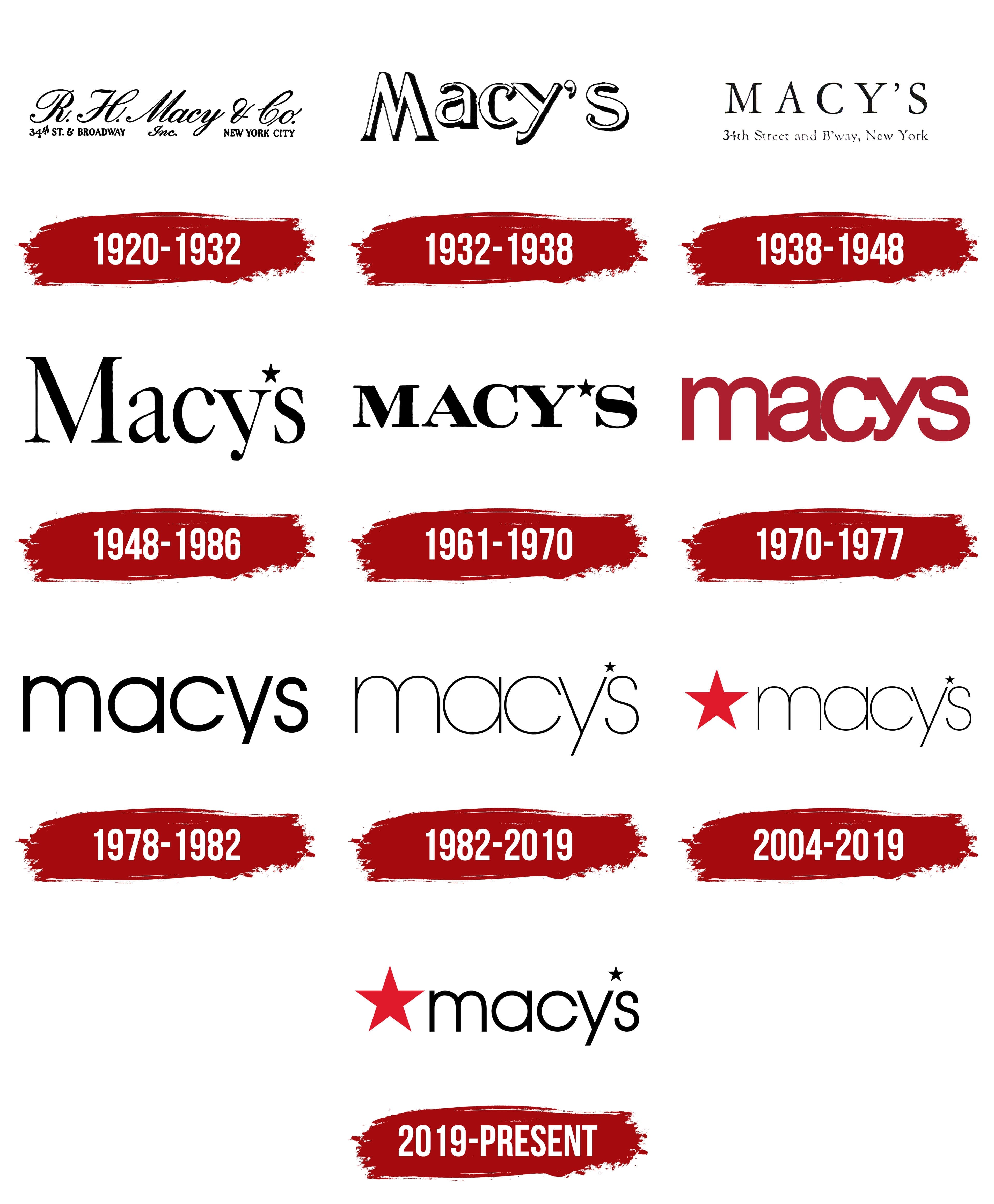
When hundreds of retail outlets across the United States became Macy’s, the company launched a large-scale rebranding effort as part of Project Star. It was called that because the star became a new element of the identity of all the renamed stores. It began appearing in advertising and signage; before that, it appeared in almost all old Macy’s logos, where it replaced the apostrophe before the “S.”
There are legends about its origins. According to the most common version, Rowland Hussey Macy got a tattoo with a red five-pointed star on a whaling expedition. This story is considered the most likely. Rumors also suggest he worked as a navigator, and the star helped him find his way in heavy fog. But skeptics argue Rowland was too young: he was 15 and could not have held such a responsible position. In any case, he had a tattoo, which influenced the department store chain’s identity.
The Macy’s logo replaced the regional symbols on stores across the chain. This didn’t appeal to regular customers, but the star meant it all started with a clean slate. However, no one noticed it while it was used as part of a word instead of an apostrophe. Only later, when they widened the star and moved it to the beginning of the inscription, did they give it special meaning.
Now, it is associated with holidays and the old traditions that the company introduced. As far as we know, Macy’s has organized the Thanksgiving Day Parade for almost a century and sponsored the Miracle on 34th Street fireworks for half a century, so Americans are very familiar with its flagship store, Macy’s Herald Square, and know who owns the red star symbol. In addition, the retail chain actively uses its logo for advertising, linking it to sales.
What is Macy’s?
Macy’s is a company that owns several hundred department stores across the United States. It offers a wide range of products, including home goods, furniture, jewelry, cosmetics, clothing, and appliances. Macy’s stores are associated with holidays because the retail chain hosts grand shows and sales during these times. The brand is owned by the namesake conglomerate, formerly called Federated Department Stores.
1920 – 1932

In 1858, the first RH Macy & Co. department store opened, with a rooster on its sign. Four years later, it received another emblem, a red star. Logos with inscriptions came much later. One of the earliest versions to reach us dates back to 1920. As far as we know, it featured beautifully handwritten text: “R. H. Macy & Co. Inc.,” a sample of old calligraphy. Below is the address of the outlet: “34TH ST. & BROADWAY “(left) and “NEW YORK CITY “(right). The company moved there in 1902 after the Straus brothers bought it. This place is now listed in the National Register of Historic Places and recognized as a landmark.
1932 – 1938

Over time, the design changed: the logo became only the white word “MACY’S.” It seemed three-dimensional because of the gray outlines of varying thickness. The developers used a stylized antique font, with the first “M” larger than the rest and extending beyond the line.
1938 – 1948
The creators of the new logo made the inscription black and changed it to uppercase. The typography used thin characters with long serifs. The main store address reappeared below: 34th Street and B’way, New York City.
1948 – 1986

In the mid-20th century, designers removed the address to emphasize the department store chain’s name. The word “Macy’s” was as black as before. The four letters after the “M” became lowercase, and the apostrophe became a small five-pointed star above the “y.”
1961 – 1970

Over time, the line thickness has changed slightly. Until 1970, the company used a logo that contained bold, flattened lettering. All letters were capital and serif.
1970 – 1977

The 1970 emblem shared nothing with the previous ones except the brand name. The font was round and grotesque; it had no apostrophe, and the letters were repainted dark red and converted to lowercase.
1978 – 1982

To make the inscription easier to read, the designers reduced the stroke thickness and returned to black. A small spacing appeared between characters that was not present in the previous version.
1982 – 2019

In the early 1980s, the lines became even thinner, but the font changed little. A subtle five-pointed asterisk has been added in the upper right corner of the “y.”
2004 – 2019

In the 21st century, the Macy’s chain of stores added its iconic red star to its logo. The new item was to the left of the word.
2019 – today
The 2019 redesign aimed to make the lettering symmetrical. The designers changed the font and adjusted the line positions so that the large star now matches the stylized apostrophe in height. In addition, its two diagonals (from the top to the legs) run parallel to the strokes of the letter “y.” This alignment creates the illusion that all characters are the same size. This is not the case: the difference is significant, especially in the “s.”
Font and Colors

For Rowland Hussey Macy, the red star was a powerful talisman. But under the Soviet regime, it took on a new meaning, so the company could not use it in the logo without evoking unwanted associations. She also could not eliminate her iconic symbol, so after the Second World War, she replaced the apostrophe in “Macy’s ” with a small black asterisk. When communism fell and was forgotten, the retail chain happily affixed a large red star to its emblem. It has become the main hallmark of hundreds of brand stores worldwide.
The logo’s typeface matches Avant Garde Gothic Extra Light, a round sans serif designed by Tom Carnase and Herb Lubalin. But in the latest version, the designers changed the shapes of some lines to make the letters appear symmetrical and align with the star’s diagonals.

Red (# E11A2B) has become Macy’s main color relatively recently. It is combined with black, making the image bright and visible on any light background.