


 A&E Logo PNG
The A&E logo is concise and full of contrasts. It represents the TV channel as universal, capable of presenting different perspectives on every issue. The emblem has a mesmerizing solemnity, a play of light and shadow.
A&E began on February 1, 1984, as The Arts & Entertainment Network after Telcom Entertainment, operator of RCTV, merged with ABC Video Enterprises. ABC and Hearst Corporation became the main shareholders, and NBC later joined them. The channel emerged as major U.S. broadcasters sought to enter the fast-growing cable market and reach audiences beyond traditional network television.
At first, Arts & Entertainment had a high-culture format built around opera, ballet, theater productions, and classic cinema. The channel competed in a field already associated with PBS, and cable viewers in the late 1980s treated this type of programming as narrow. Its position began to change in the late 1980s and early 1990s, when A&E moved toward documentary storytelling.
Biography became the key format in that shift. Each episode focused on one public figure, from politicians and actors to athletes and historical personalities. The series aired several times a week, built a large archive, and helped turn A&E from a niche arts channel into a broader cable brand. In 1996, the name was shortened to A&E, reflecting the move away from its original arts schedule.
That same year, A&E Networks acquired a stake in the History Channel, separating historical documentaries into a distinct brand. In the 2000s, A&E leaned further into crime and reality programming with The First 48 and Dog the Bounty Hunter. In 2012, Duck Dynasty launched, reaching about 11.8 million viewers at its 2013 peak. The channel also developed scripted drama with Bates Motel. In 2016, Lifetime moved into separate management within A&E Networks, while Disney and Hearst remained co-owners.
Meaning and History
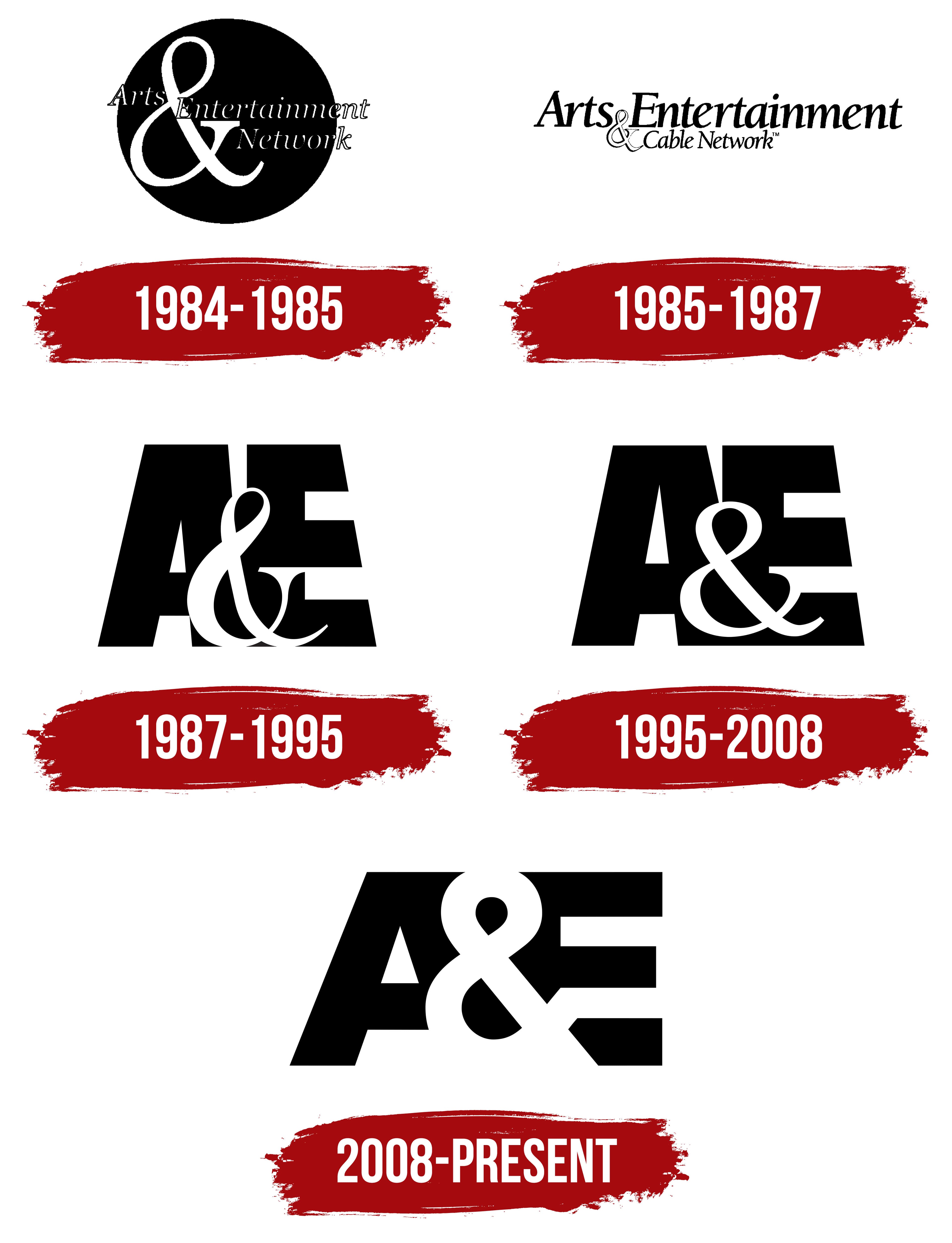
The company spent a long time refining the emblem to make it concise and memorable. The first versions of the signs were unsuccessful due to their long name and incorrect color choices. However, A&E managed to find an original version of the emblem that best fit the cable channel’s theme. Therefore, the rebranding after 1987 includes only minor edits, leaving the overall composition unchanged.
What is A&E?
A cable channel operates across feature films, documentaries, and series. It has produced and broadcast notable films such as Law and Order, Pride and Prejudice, The Lost World, and Emma.
1984 – 1985

The company’s first logo was a black circle with a large & sign. In front of it was the word “Arts,” and after it was the “Entertainment Network” in two levels. A circle was depicted:
- The globe of the Earth. Initially, broadcasting began in North America, but plans were also made for other continents.
- Broadcast area. The propagation of waves from the signal source.
- Point. The channel provides viewers with comprehensive and detailed information.
- Purpose. Each channel report hits the target: the most relevant topics, the most interesting questions, and the most useful programs.
The company’s name was derived by combining elements of the names of two founding companies: ABC Alpha (ARTS) and The Entertainment Channel. The emphasis on ‘and’ indicates the merger process.
Thin, small letters made the inscription almost invisible against the background of a huge &, which became a disadvantage of the sign.
1985 – 1987

A year later, they tried to correct the flaws with a new logo. They removed the dark background, and the first part of the name was presented in large black letters. On the right side of the sign, under the word Entertainment, they placed a small indication that it was a cable network.
However, the lettering turned out to be too bulky and long. Therefore, the second sign did not last long either.
1987 – 1995

Two years later, an original interpretation of the inscription emerged, forming the basis for further emblems. Black letters A and E, above which in the center is a white symbol &. Glyph E is tilted to balance the first element, A, which is tilted. Therefore, the design resembles a rocket soaring into the sky. The method indicates a desire for growth and development. An attempt to reach out to other areas and directions to introduce new programs. At this point, the company acquired the rights and began producing episodes of the documentary Biography, which took center stage on the airwaves.
1995 – 2008

In 1995, the channel’s name was officially shortened to A&E Network. The change reflected a shift in focus from art to shows and documentaries. The change was timed to coincide with the launch of The History Channel and the company’s tenth anniversary.
The new sign is now slightly wider, reflecting the expanded audience and list of shows. The appearance of the ampersand also changed – it became smoother.
2008 – today

The 2008 changes were timed to coincide with the release of the movie “The Andromeda Strain,” which was planned as a TV series. Loyalkaspar Studios worked on the character. The idea was for the new sign to represent the channel as progressive, created with modern programming languages.
All elements of the emblem are presented as equal in size. Therefore, the ampersand closed the A and E parts, completely separating them. This technique demonstrates versatility, clarity of image and sound, and the beauty of the picture on the screen.
Font and Colors
The emblem is built on the interplay of black and white. The company works in the fields of history, art, and documentary film. Therefore, black-and-white motifs indicate antiquity and past events. They reflect bright, solemn art and music premieres, with artists and musicians in white shirts and tails.
- Black conveys distribution, broad audience reach, and network broadcasting.
- White speaks to the coverage of new and interesting facts, constant variety, and the addition of new shows and series.
The letters of the inscription are straight and large. Straight glyphs indicate the channel’s accessibility, ease of customization, and clarity. The size and boldness of the characters indicate a wide audience reach.