


 Allison Transmission Logo PNG
Allison Transmission traces its history to 1915, when James A. Allison founded Allison Engineering Company. Allison was an inventor and engineer with a strong interest in automobiles. The company began with racing-car technology and introduced a transmission for race cars. This product gained recognition among racing teams and helped establish its name in the automotive industry.
In 1934, General Motors acquired Allison Engineering Company and renamed it Allison Transmission Division. Under GM, the division supplied transmissions for General Motors vehicles and became part of the group’s transport engineering base. After World War II, Allison expanded its range beyond racing and passenger vehicles, developing transmissions for heavy-duty transport, including city buses and trucks.
In 1947, Allison introduced the first automatic transmission for city buses. In 1956, it presented the world’s first fully automatic transmission for trucks. During the 1960s, the company developed transmissions for military equipment, including vehicles ranging from tanks to helicopters. In the 1970s, Allison entered the mining and construction sectors, broadening the industrial use of its transmission systems.
In the 1980s, Allison created the world’s first electronically controlled transmission. In the 1990s, it expanded into European and Asian markets, adding to its international presence. In the early 2000s, the company introduced the world’s first hybrid-electric transmission. By 2023, Allison Transmission operated in 15 countries and employed over 10,000 people. It produced transmissions for city buses, trucks, military vehicles, mining equipment, and construction machinery.
Meaning and History
What is Allison Transmission?
This is a manufacturer of automatic transmissions and hybrid power systems. The company’s products are used in construction and mining equipment, military vehicles, and urban buses. Its technological solutions are known for their reliability and are engineered to perform in demanding, heavy-duty environments.
1930 – 1956

1956 – 1999
1999 – 2021
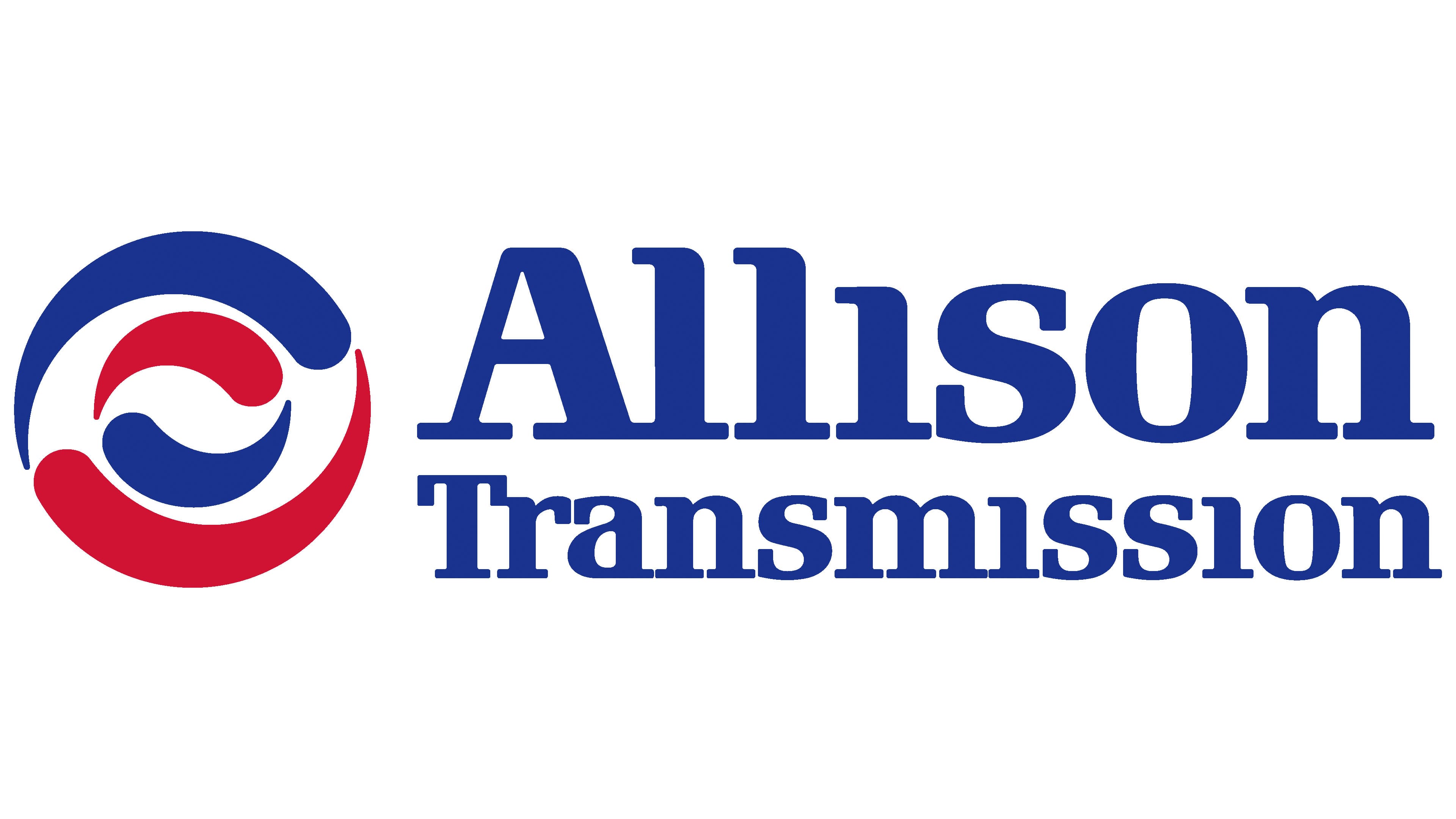
The Allison Transmission logo features two interlocking circles in red and blue, representing the cyclical components found in automotive transmission systems. Their intertwined design visually recalls the yin-yang symbol, signifying rotational balance and the controlled energy flow required to transfer torque from the engine to the vehicle’s wheels.
The choice of color reinforces the brand’s core values: blue symbolizes stability, reliability, and confidence, while red conveys strength and mechanical energy. The colors highlight the harmony between power and precision, key traits of the company’s products.
Next to the circles, the company name “Allison Transmission” is displayed in two stacked lines. The text is set in a bold serif font with heavy rectangular serifs, projecting confidence and professional authority. The typeface gives the impression: “This is Allison Transmission, an expert in its field.”
The circles resemble rotating gears or miniature racetracks, invoking ideas of speed, motion, and mechanical force. They suggest the continuous rotation and dynamic function essential to vehicle drivetrains. The company name references the founder’s surname, adding a personal narrative and honoring a legacy of engineering excellence.
The emblem’s design combines simplicity, geometric precision, and meaningful symbolism tied to drivetrain technology. Through its visual elements, the logo tells a concise story about the company’s focus: mechanical reliability, rotational force, and the critical connection between the engine and the wheels.