


 AOL Mail Logo PNG
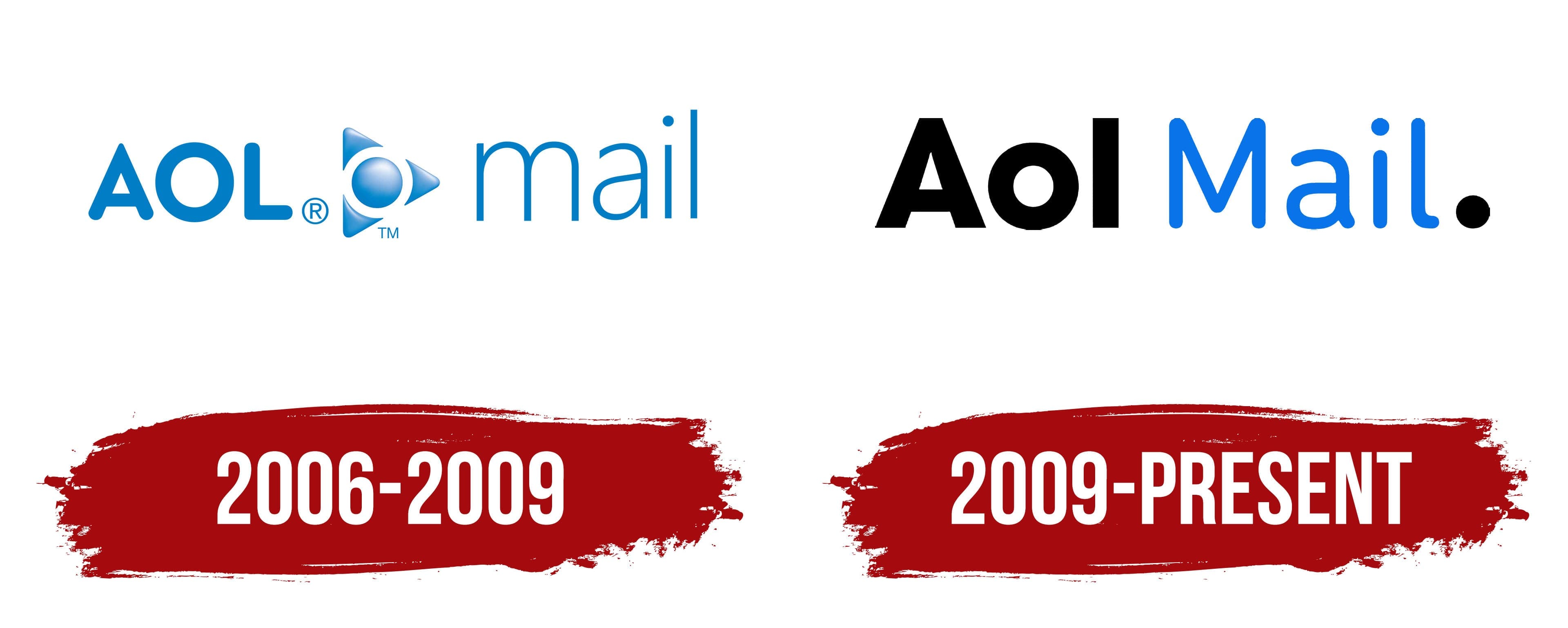
The free email service AOL Mail uses a simple logo. It consists only of the name with a bold dot at the end. To prevent the two parts of the name from merging, the designers painted them in different colors and used different fonts. The AOL Mail logo’s style clearly suggests it is a correspondence service.
AOL Mail grew out of America Online, one of the companies that brought internet access to a mass U.S. audience. In 1983, Steve Case joined Control Video Corporation, which sold an online gaming service for the Atari 2600 over phone lines. After it failed, Case and his partners built Quantum Computer Services in 1985. The company launched Q-Link for Commodore 64, then AppleLink Personal Edition in 1988 and PC Link in 1989.
In 1989, Quantum became America Online and hired voice actor Elwood Edwards to record several system phrases at home, including “You’ve Got Mail.” In 1991, the company officially became America Online, and in 1992, it listed on Nasdaq. In 1993, AOL introduced full email addresses for subscribers, turning its mail alert into a symbol of dial-up internet culture. In 1998, the phrase entered the cinema through the film “You’ve Got Mail,” starring Tom Hanks and Meg Ryan.
AOL grew through an aggressive disk-and-CD-ROM campaign that offered trial access through magazines, mail, newspapers, and consumer packaging. By 1995, it had more than 1 million subscribers, and by 1999, it reached 18 million. Its main email rivals included Hotmail, launched in 1996, and Microsoft Outlook Express. In 1997, AOL developers created AIM, one of the first mass real-time messaging platforms.
In 2000, America Online announced a $350 billion merger with Time Warner. Still, the deal collapsed in value after the Internet bubble burst, and the companies split in 2009. AOL launched AIM Mail in 2005 as a free webmail service. Verizon bought AOL for $4.4 billion in 2015, then sold AOL and Yahoo to Apollo Global Management in 2021 for $5 billion. In 2025, Bending Spoons acquired AOL from Apollo.
Meaning and History
This service began its global march in 1993, when AOL and Delphi connected their email services to the Internet. As a result, AOL Mail had 9 million subscribers by 1997 and became the largest email provider. At the same time, America Online kept introducing new tools, features, and services to refine the service. It offered spam and virus protection, spell-checking, links to accounts at other email sites, built-in widgets, a friends list panel, and more.
In 2004, AOL introduced MailBlocks technology, and in 2006, it made the service free for all broadband users. At the same time, it adopted a custom mark, an emblem with a graphically stylized name. It changed only once, in 2009. AOL Mail’s history took a major turn in 2012, when the service made the biggest change in its last five years. At that time, it changed its interface to improve user interaction and communication between subscribers.
What is AOL Mail?
AOL Mail is an American email service. It was created by the media conglomerate AOL. AOL developed its algorithm in 1993 and launched it in 1997. It is now a popular free email messaging platform with several domain names covering different topics.
2006 – 2009

The debut logo features a light, white-and-blue design. It has three parts: two verbal (on the sides) and one graphic (between them). The central element is a triangular symbol made up of three miniature triangles and a circle. They are colored blue and complemented by light highlights that form a gradient.
On the left is the company acronym for the service that launched it: AOL (America Online). This part is much darker than the others. On the right side is the word “Mail.” A central play button indicates it. Both inscriptions are grotesque, but the first uses rounded uppercase letters, and the second uses lowercase filigree letters.
2009 – today

After the redesign, the logo became simpler and clearer. The authors lowercase “AOL” to match the rest of the name. The lettering is now more balanced. The bold “Mail” also adds balance. At the end, a bold black dot serves as a final sign of the service’s completeness. The parent company’s name is colored the same way, making the text easy to read and understand. The triangle previously used in the middle is gone.
Font and Colors

The logo transformation did not bring significant changes. It still contains the name typed in grotesque. The only highlight of the logo is that the first and second parts of the inscription use opposing styles. If there are wide characters on the left and narrow characters on the right, and if the first is a geometric letter with evenly spaced legs, then a word composed of characters with rounded lines follows. This contrast adds dynamics to the logo.

The lettering in the debut logo is set in fonts close to Adira Display SSi Regular (the initial part of the name) and Suit Sans Pro Light (its ending). The second emblem also uses two types, resembling Axiforma Black and Core Sans DS 45 Medium. AOL Mail’s official emblem palette is monotonous, consisting of black and blue in several shades.