


 Back To The Future Logo PNG
The Back To The Future logo shows an unusual event: the ability to travel to the future and back. The sign is filled with the energy necessary for this and the desire to experience an incredible scientific discovery. The emblem guarantees that you won’t be able to take your eyes off the screen.
Robert Zemeckis and Bob Gale met at USC film school in the early 1970s. After working with Steven Spielberg and John Milius, they made I Wanna Hold Your Hand (1978) and Used Cars (1980). Both drew good reviews but failed at the box office.
The idea for Back to the Future came in 1980, when Gale saw his father’s old school album and wondered whether they would have been friends as teenagers. Zemeckis added a twist by having Marty’s mother fall for him. The first draft was ready in February 1981. Still, Columbia Pictures rejected it, Disney disliked the mother-son angle, and the script was turned down more than 40 times.
The project moved forward after Romancing the Stone, released in 1984, earned about $76 million on a $9 million budget. Spielberg backed the film through Amblin Entertainment at Universal Pictures. Universal president Sid Sheinberg wanted to change the title to The Man from Pluto. Michael J. Fox was the first choice for Marty, but Eric Stoltz filmed 34 days before Fox replaced him.
Back to the Future opened on July 3, 1985. It led the U.S. box office for 11 weeks, earned about $210 million in the U.S. and over $380 million worldwide, and won an Oscar for sound effects editing. Universal then ordered sequels. Part II came out in 1989, Part III in 1990, and the trilogy earned about $960 million worldwide. Later came the 1991 CBS animated series, Universal Studios rides, Telltale Games’ 2011 game, and the 2020 musical.
Meaning and History
Bob Gale and Robert Zemeckis created Back to the Future. They pitched the idea to various studios, but it was rejected more than 40 times. They insisted on their vision, and in 1985, the sci-fi comedy hit screens. It was so successful that it needed a sequel. But two sequels didn’t bring the expected revenue. However, they also influenced pop culture by launching a global franchise.
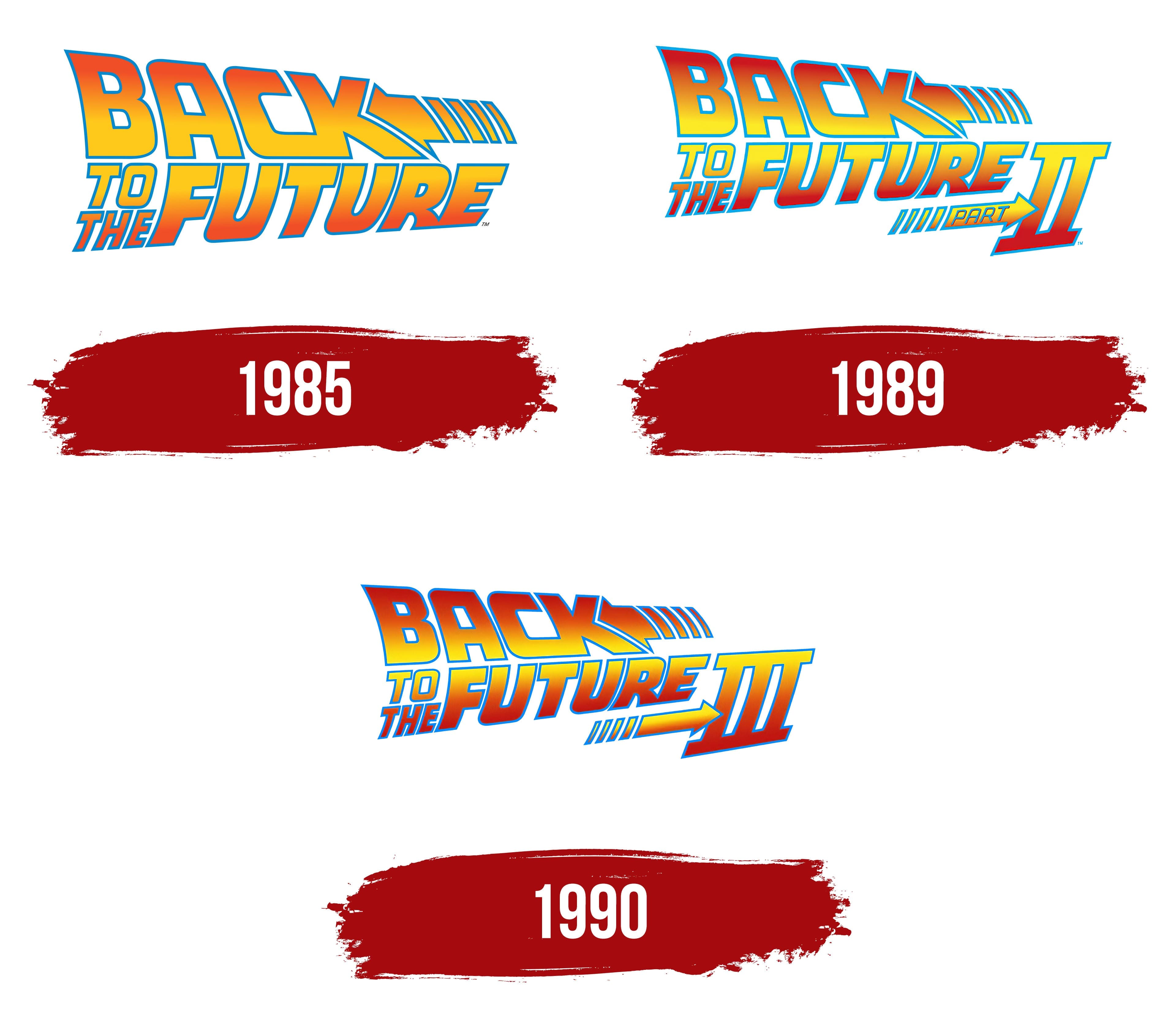
The Back To The Future media product line shares a common logo. It looks just like the one on the poster for the first movie: raised orange-and-blue lettering with an arrow. The sequel decals have a similar structure, but they include the part number.
1985

In 1985, the legendary film debuted, telling the story of a high school student and an eccentric scientist who traveled back in time in a time machine. At the same time, a multi-part logo featuring the film’s name appeared. The first line read “BACK,” the second “TO THE” (split into two rows), and the last FUTURE.”
The design used a linear gradient: the top and bottom of the inscription were red-orange, and the middle smoothly transitioned to yellow. All elements had a blue outline. The letters “C” and “K,” as well as “R” and “E,” merged at the edges. On the right side of the word “BACK” was an arrow pointing left, matching the shape of the notch inside the “K.” She looked unusual because of the broken line.
1989
A similar logo was created for the second part of the trilogy, with a few additions. The biggest innovation was the Roman numeral “II” in the lower-right corner. An additional arrow pointed to it, inside which was written the blue word “PART.” The blue outlines turned blue, the dark orange turned red, and the yellow took on a cold lemon tint.
1990
The third film’s hallmark was nearly identical to the second. The developers removed only the “PART” inscription and slightly raised the right side of the text to create a diagonal line arrangement.
Font and Colors
The Back To The Future emblem is highly symbolic. The letters in the word “BACK” are laid back to the left. The arrow next to it points in the same direction. On the contrary, the phrase “TO THE FUTURE” is tilted to the right, as if it is being pulled forward, following the second arrow. Dashed lines represent movement. With simple graphic techniques, the logo’s creators conveyed the trilogy’s dynamics and meaning.
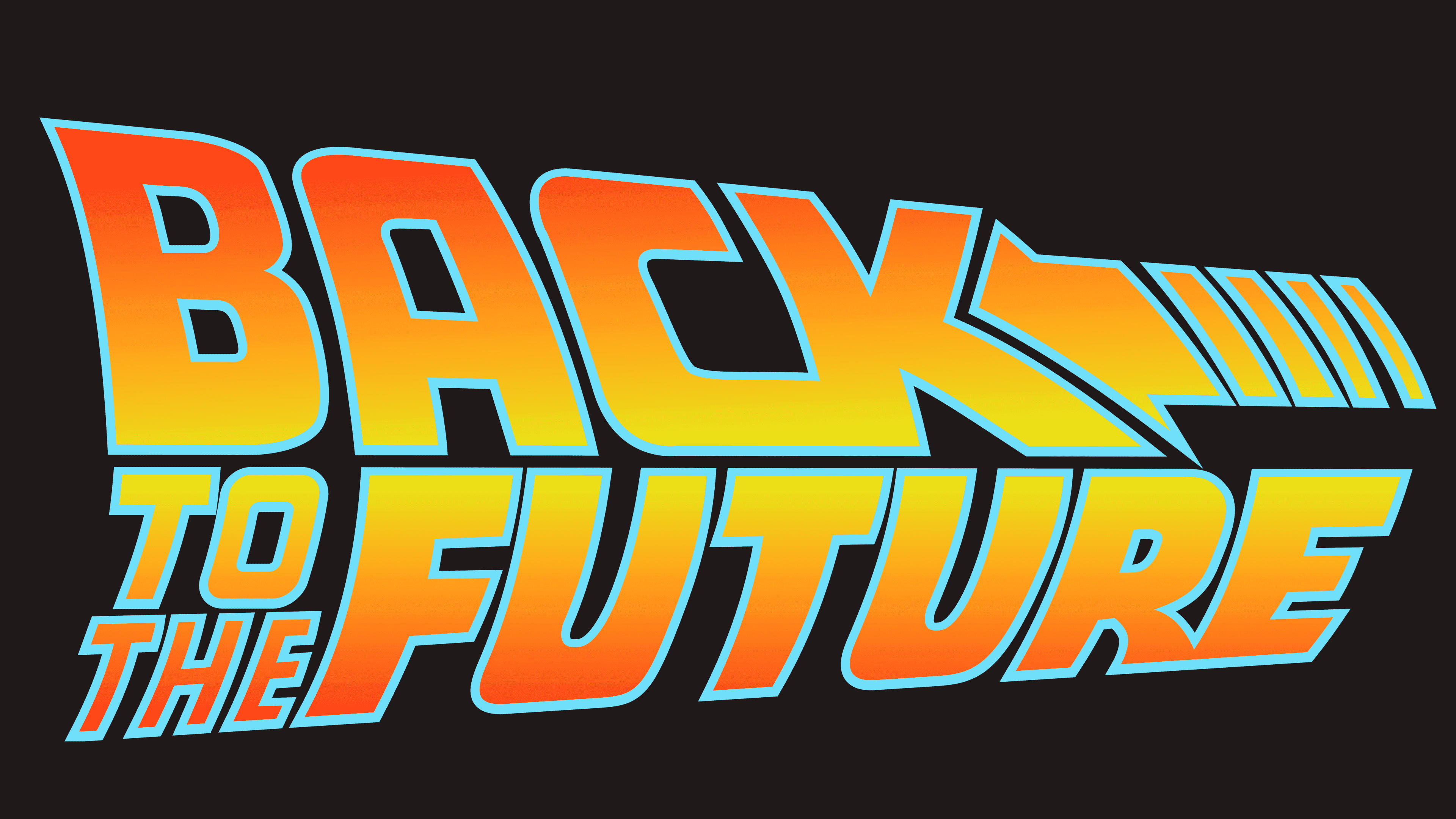
Cyril Bourreau designed the Back To The Future typeface based on the lettering, a bold sans serif with “falling” letters. It was introduced in 2002. The color schemes of all three emblems in the trilogy differ slightly. If the first film’s palette is based on a combination of red-orange and blue, the other two feature dark red (almost burgundy), pale yellow, and blue.