


 Belmont Bruins Logo PNG
The Belmont University Athletic Association chose a bear as its symbol, placing the bear’s muzzle in the Belmont Bruins emblem. The emblem indicates affiliation with the organization and symbolizes readiness to defend and fight for victory.
Belmont University athletics dates back to 1890 in Nashville, with organized competition beginning in the NAIA as the “Rebels”.
In 1995, President William Troutt led a renaming process. The term “Rebels” was removed due to Confederate associations, and “Bruins” was adopted, linked to a bear once seen on campus.
Men’s basketball shifted direction in 1986 when Rick Byrd became head coach. Belmont had no NAIA tournament history before him, but reached the semifinals in 1995 and 1996 and held a No. 1 ranking. Byrd earned NAIA Coach of the Year in 1995 and was inducted into the Hall of Fame in 2004.
In 1999, Belmont joined NCAA Division I and entered the Atlantic Sun Conference in 2001. The team won four regular-season titles and five tournaments, reaching the NCAA Tournament in 2006 after beating the Lipscomb Bisons in the “Battle of the Boulevard”.
Belmont returned to the NCAA Tournament in 2007 against Georgetown and in 2008 against the Duke Blue Devils, losing by one point in both. In 2011, the team went 30–4, and Byrd received the Hugh Durham Award.
The move to the Ohio Valley Conference came in 2012–2013, with an immediate title. Rivalry with Murray State Racers shaped the next decade, including three finals from 2018 to 2020.
In 2019, Belmont earned an at-large NCAA bid and beat Temple. Byrd retired with 805 wins, and in 2022, the program joined the Missouri Valley Conference under Casey Alexander.
Meaning and History
What is Belmont Bruins?
Belmont Bruins is a sports division based in Nashville, Tennessee, affiliated with Belmont University. It includes 17 student teams that compete in NCAA Division I and are part of the Missouri Valley Conference. The organization received its current name in 1995; before that, it was known as the Rebels.
1995 – 2003
The bear in the Belmont Bruins emblem had roots in local history. Long before it appeared in the athletic identity, Adelicia Acklen kept a bear on the estate she owned with Joseph Acklen and built an octagonal pavilion for it called the Bear House. After the estate was sold, the structure became part of the school grounds. The university later named a new residence hall Bear House, linking the pavilion to the Bruin mascot.
The estate also gave Belmont University in Nashville, Tennessee, its name. Its original name, Belle Monte, meant “beautiful mountain” in Italian. A women’s college opened on the property in 1890. Belmont College became a university in 1991, and the Bruins athletic nickname followed later. “Bruin” is a term for a bear, derived from a Middle Dutch word meaning “brown.” It entered English literary tradition through the bear’s name in the tales of Reynard the Fox.
The team’s name change accompanied the athletic program’s transition from the NAIA to NCAA Division I. Previously, the men’s teams were called the Rebels and the women’s teams the Rebelettes. In the history of the American South, Rebels carries associations with the Confederacy. In 1995, university president William E. Troutt led the effort to replace the previous identity. As Belmont prepared to compete nationally, it sought to shed those Confederate associations. That fall, the teams adopted the Bruins name and a bear emblem.
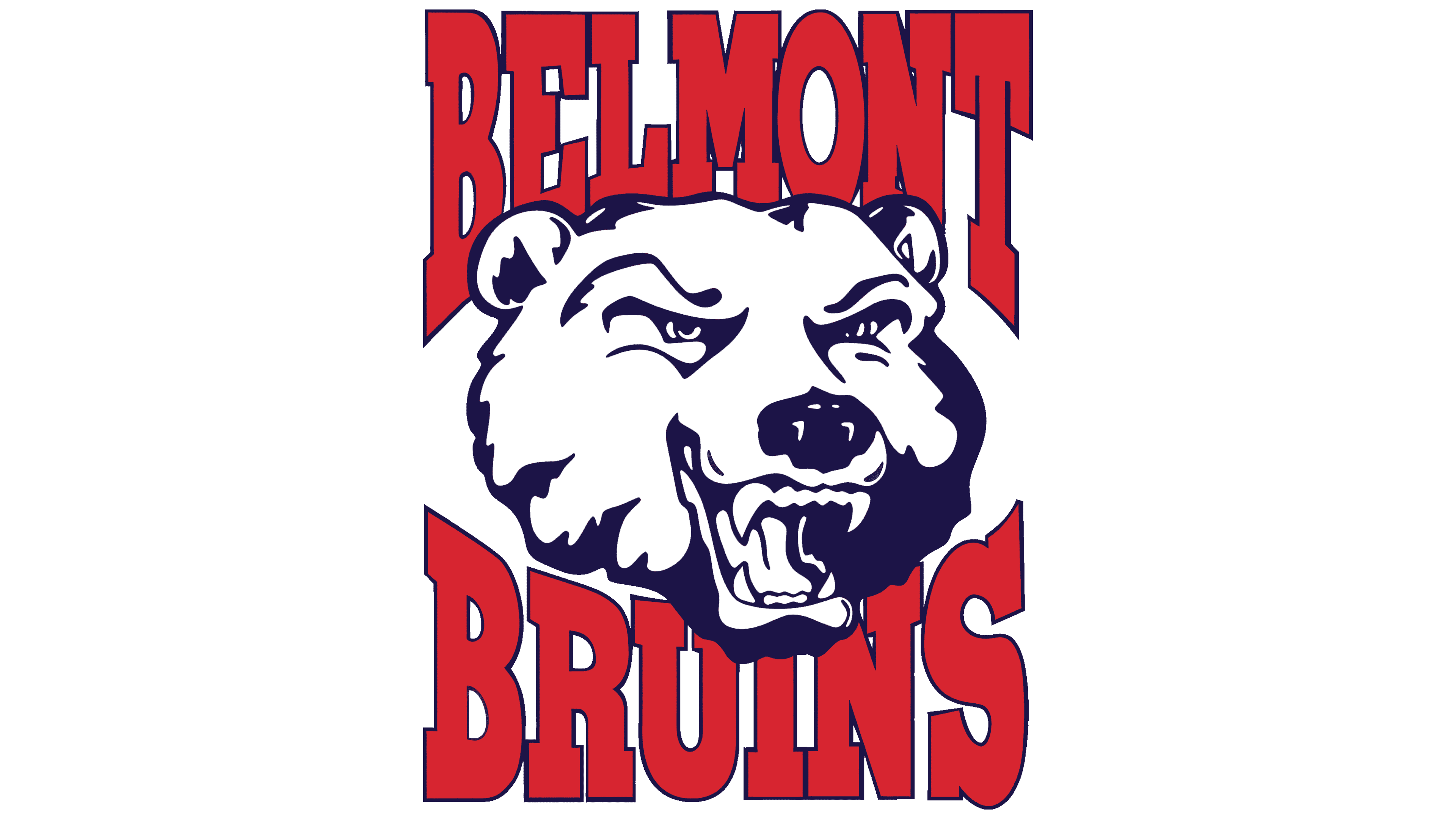
In the primary version used from 1995 to 2003, the animal’s head sat between red BELMONT and BRUINS lettering. The university name appeared above and the athletic nickname below, with both given comparable space. Tall, narrow uppercase letters with heavy rectangular serifs and thin navy outlines gave the emblem a vertical emphasis. The edges of the two lines curved around the head, with portions of the letters hidden behind it.
The bear’s head turned slightly to the right. Its rounded contours contrasted with a snarling mouth and projecting fangs. Curved brow lines arched over the eye sockets. Most of the face remained white, while navy defined the nose, ears, eye sockets, mouth, and cheek shadows. A thin blue line outlined the image. Red was reserved for the lettering, leaving the animal in two colors. A standalone version of the head served as a secondary emblem during the same period.
In 1996, the bear appeared as a costumed mascot. Costume designer Henry Gomez created and built a navy character wearing a No. 1 basketball jersey and oversized high-top sneakers. The blue fur echoed the university color in the emblem, while the outfit connected the mascot to athletics. The first costume remained in use until the 2003 update.
2003 – today
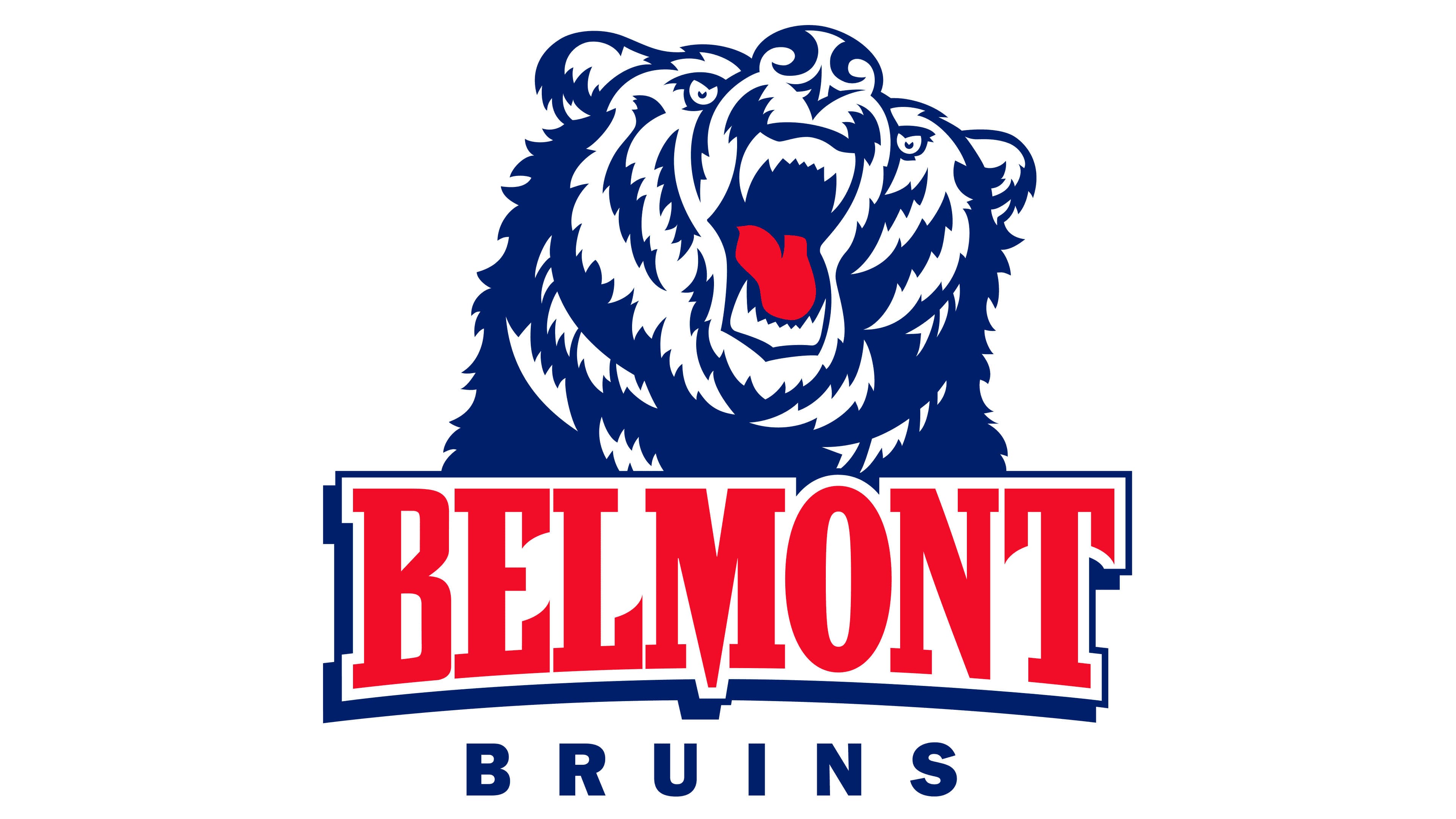
The opening of the Curb Event Center provided an opportunity to reintroduce the Belmont Bruins to Nashville. The upcoming arena opening was tied to the unveiling of the primary emblem on July 15, 2003. Development took nearly six months. Nashville agency Dye, Van Mol and Lawrence, which had updated the university-wide logo earlier that year, handled the project. President Robert Fisher and assistant athletic director for marketing Eric Jones viewed it as part of introducing residents to the revamped athletic program. Plans called for the bear image to appear at center court in the Curb Event Center, at other athletic facilities, and on team uniforms.
The new emblem changed the balance between the image and text. The bear moved from between the two lines to a position above the university name. Large red BELMONT lettering became the dominant text, with white edging and a navy outer outline. A blue band below created a shadow effect. Heavy serifs combined with angular notches and varied stroke endings, while the pointed lower tip of the “M” extended below the baseline. Smaller BRUINS lettering appeared beneath it in widely spaced navy uppercase sans-serif letters. The university name now took priority, with the athletic nickname in a supporting role.
An angular illustration of the head and upper neck replaced the rounded head, with jagged tufts defining the fur. The muzzle points upward, and the open mouth occupies nearly the entire lower half of the face. White fangs and a red area inside the mouth stand out against the navy background, giving the roaring bear an aggressive appearance. Thick blue lines form the contours and shadows. Dark fills cover the neck and large portions of the head, while white bands separate the fur, cheeks, and brows. The fur is more detailed than in the earlier version.
Red, navy, and white remained the athletic colors. Missouri Valley Conference standards specify Belmont’s red as Pantone 186 C (#C8102E) and navy as Pantone 281 (#00205 B). White fills interior areas and separates outlines. The 2003 emblem remains in use alongside a standalone bear head, a wordmark, and a BU monogram. Sport-specific versions include the sport’s name. The guidelines require Bruins for both men’s and women’s teams, replacing Lady Bruins.
The costumed mascot was updated as well. The navy costume gave way to a brown bear with a broad torso and muscular shoulders. A naming contest held during new-student events produced the name Bruiser. The bear remained the mascot, though its fur now differed in color from the blue animal in the emblem.
The BU monogram had a separate history. Interlocking Belmont University initials had been in use since 1997. In 2018, their resemblance to Baylor University’s monogram and questions about usage rights became the subject of negotiations. The parties agreed to phase out Belmont’s existing lettering. Current athletes were allowed to keep equipment already produced, and the store was given time to sell its remaining merchandise. As a result, the old initials still appeared on baseball caps during the 2019 season. The revision applied to the lettermark, while the bear illustration remained unchanged.
The new BU debuted in fall 2019. A stepped diagonal arrangement replaced the interlocking letters, with the “B” at the upper left and the “U” at the lower right. White edging and a shared navy outline with an offset shadow surrounded the red fill. The “B” retained heavy serifs and angular interior openings. At the same time, the long vertical strokes of the “U” joined at a rounded base. The monogram became part of the Belmont Bruins’ official collection of secondary athletic marks.