


 BFGoodrich Logo PNG
BFGoodrich traces its history to 1870, when Benjamin Franklin Goodrich founded the company in Akron, Ohio. The firm began with rubber goods, including hoses and other industrial products, before the rise of the automobile industry shifted its work toward tires.
In 1896, BFGoodrich produced pneumatic tires for cars, placing the company among the early American tire manufacturers. In 1903, BFGoodrich tires were used on the Ford Model T, linking the brand to one of the most influential mass-produced vehicles and to Ford’s early automotive expansion.
During the 20th century, BFGoodrich continued to develop tire technology for changing road conditions. In 1913, the company introduced an all-weather tire, aimed at improving control in rain, mud, and mixed surfaces. In 1947, BFGoodrich presented a radial tire, a construction method later associated with new standards in tire manufacturing for passenger vehicles, trucks, and commercial transport.
Motorsport formed another part of the brand’s public record. BFGoodrich tires were fitted to the winning car at the 1976 Indianapolis 500, one of the key races in American motorsport. In 1981, vehicles equipped with BFGoodrich tires won the Paris-Dakar Rally, linking the brand to long-distance off-road competition over demanding terrain.
The company’s corporate structure changed in 1990, when Michelin acquired the Uniroyal Goodrich Tire Company. After the deal, BFGoodrich became part of the Michelin group. At the same time, its name remained tied to American tire manufacturing, off-road applications, and racing history.
Meaning and History
What is BFGoodrich?
This tire manufacturer produces many products, including passenger cars, trucks, SUVs, and aircraft. In addition to tires, the company manufactures components for the aerospace and defense industries. It is known for the high quality and broad applicability of its products.
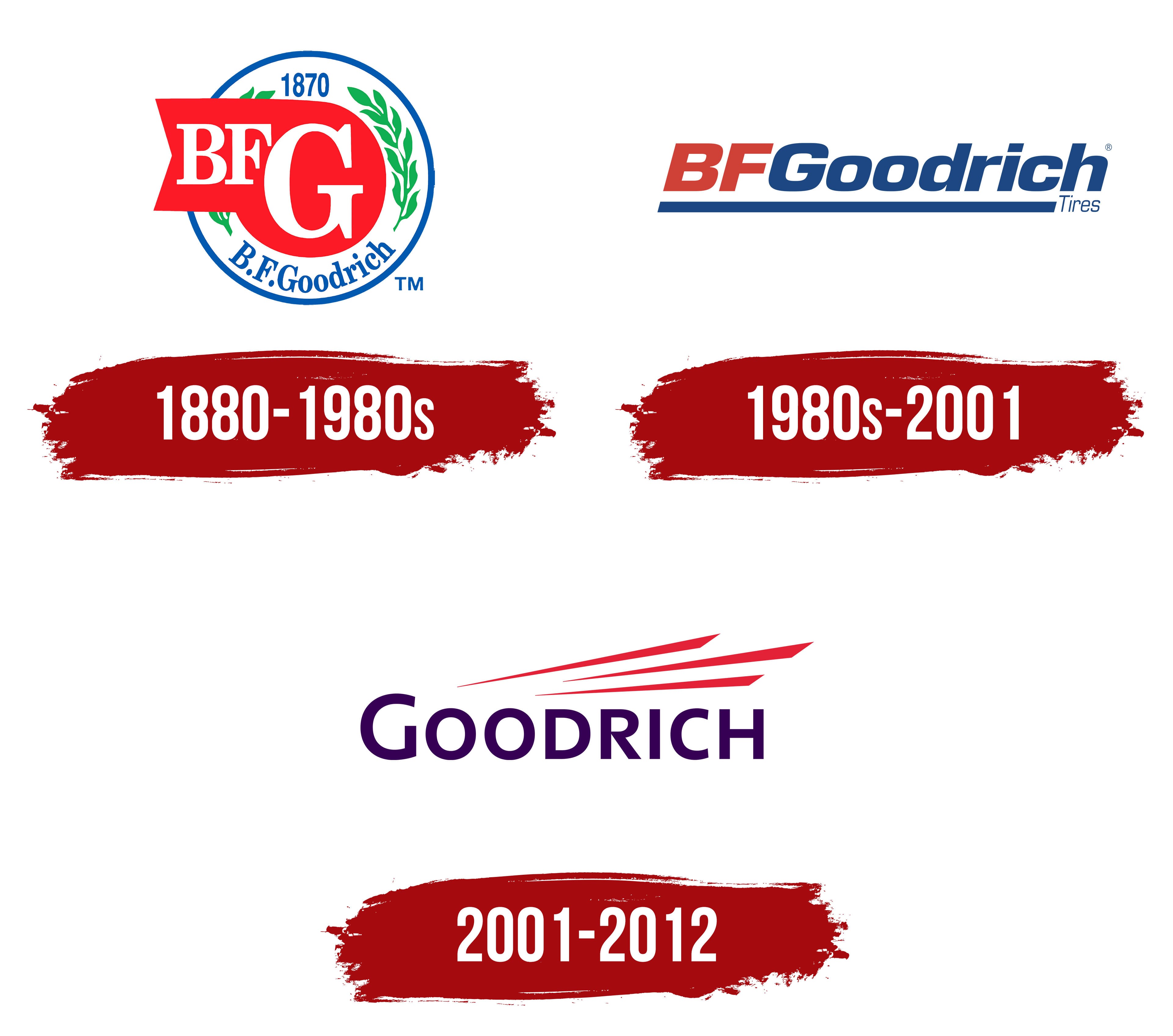
1880s – 1980s

1980s – 2001
.
2001 – 2012

The BFGoodrich logo conveys power, aggression, and motion. The red lines beside the brand name resemble claw marks from a powerful beast rather than simple tire tracks. This design choice highlights speed, toughness, and BFGoodrich tires’ ability to handle any challenge on or off the road, including extreme racing conditions. These marks represent raw energy and a readiness to overcome obstacles.
The color palette includes vivid red and deep violet tones. Red evokes action, passion, and driving force, symbolizing the high-performance nature of the brand’s products at top speeds. Violet, used in the word “GOODRICH,” adds a unique, almost mystical quality, setting the logo apart from competitors and emphasizing rarity and distinction.
The brand name is set in small caps, capital-style letters, sized uniformly, which balances seriousness with compact visual clarity. The sans-serif typeface and uniform line weight reinforce a sense of modernity, precision, and technical excellence in tire manufacturing.
Aggressive forms and bold colors balance rugged strength and trusted reliability. The brand name carries the legacy of its founder, a pioneer in the tire industry, and has become a symbol of consistent quality and dependability. Altogether, the elements of the BFGoodrich logo create a cohesive image of a company built to deliver confidence and performance in any driving condition.