


 Bombardier Logo PNG
Bombardier Inc. was founded in Montreal, Quebec, in 1942 by Joseph-Armand Bombardier. The company began with snow vehicles, stemming from its founder’s work on winter transport and the need for machines capable of operating in the difficult northern conditions. Its first products were modest snowmobiles, but the company gradually moved from a specialized winter-transport business toward a broader transport and aerospace group.
In 1959, Bombardier introduced the Ski-Doo, which the source history describes as the first mass-produced snowmobile. The model scaled up the company’s operations and made the brand closely associated with personal winter mobility. By the 1960s, Bombardier had begun moving into aviation, rail, and other transport areas, adding new types of vehicles to its original snow-machine base.
In 1967, the brand presented the Canadair CL-415, described in the provided history as the first mass-produced jet passenger aircraft. In 1974, it introduced the Canadair Challenger 600, which it listed as the first regional jet passenger aircraft. In 1986, Bombardier entered the high-speed rail market with the LRC train, expanding its operations beyond aircraft and snowmobiles into large-scale public transport systems.
In 1993, the company launched the MBTA Orange Line metro train, and in 2005, it presented the Flexity Outlook tram. By the 2000s, Bombardier’s portfolio included trains, metros, trams, aircraft, and helicopters, and it had an international distribution network. The company was described as operating in 50 countries and employing more than 65,000 people. In 2017, it introduced the e-Series, which the story describes as the first commercial electric aircraft.
Meaning and History
What is Bombardier?
It is a Canadian multinational company known for contributing to the transportation industry, particularly in the aerospace and rail sectors. The company manufactures various products, including business jets, commercial aircraft, and rail transportation equipment such as trains and trams.
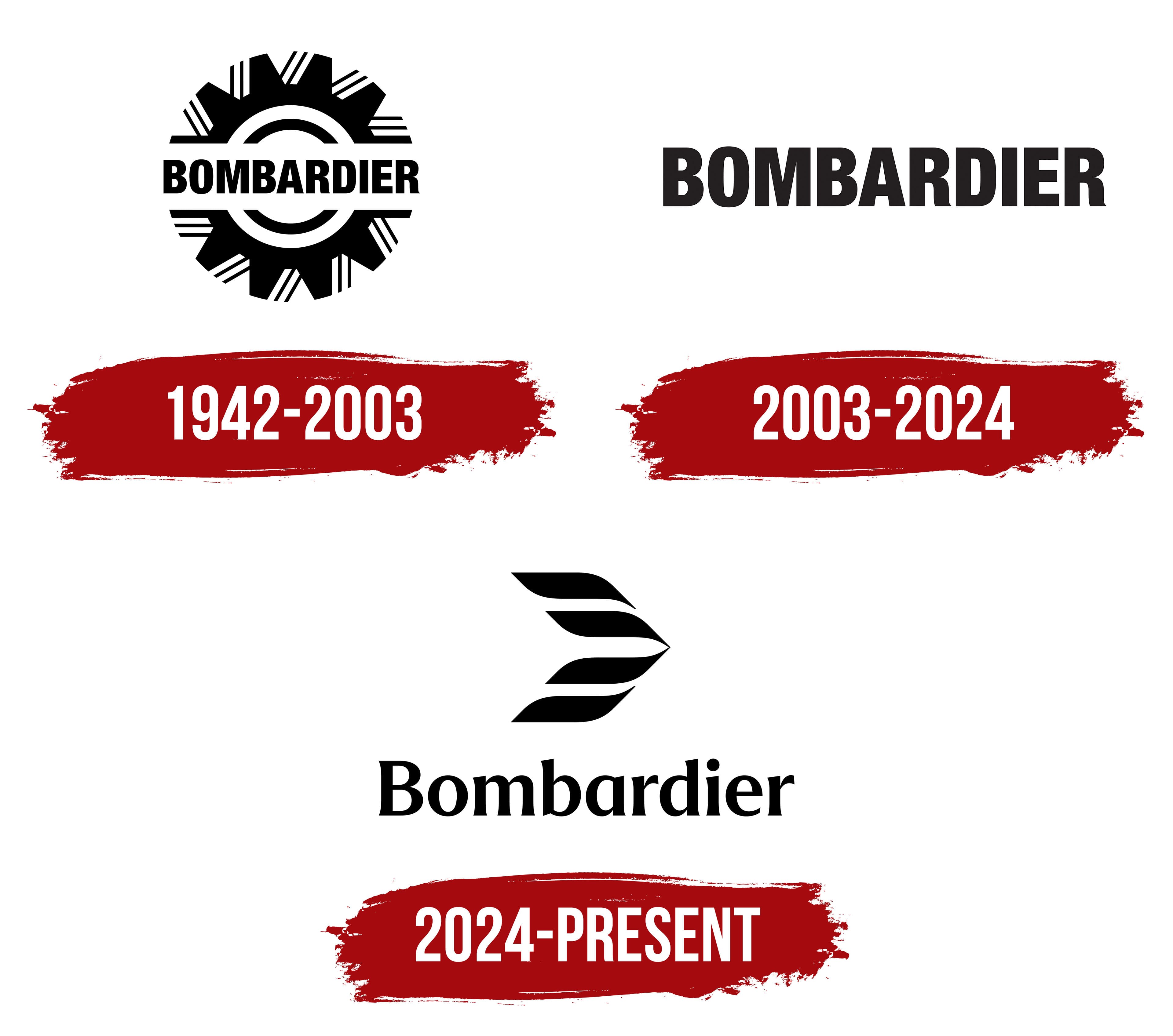
1942 – 2003

2003 – 2024
The “Bombardier” logo serves two purposes: it identifies the company and honors its founder’s last name. The logo uses a simple, bold sans-serif font in all caps. These letters have uniform thickness and are stretched vertically, giving them a sleek look without appearing too heavy. The logo’s primary color is black, which conveys a professional and businesslike approach.
The tall capital letters in the logo resemble small skyscrapers, symbolizing growth, ambition, and progress. This architectural design aligns with the company’s forward-thinking vision. The color black adds a sense of formality and readiness to face any challenge, enhancing the logo’s authoritative and professional appearance.
The vertical elongation of the letters suggests upward movement, reinforcing ideas of progress and development. The consistent stroke thickness ensures the logo remains clear and impactful.
2024 – today

The Bombardier logo reflects the company’s commitment to innovation and historical legacy. The design is inspired by Learjet’s legacy, evident in the aircraft’s silhouette as it breaks the sound barrier. This symbolizes Bombardier’s innovative spirit and achievements in aviation.
The logo’s visual elements include dynamic wind strokes over the aircraft, nodding to the Learjet brand. This reflects precision in manufacturing and a customer-focused experience, creating a sense of hospitality and trust.
The wordmark uses the Trust 3A Bold typeface, designed by MCKL. It differs from the previous logo by moving away from all-caps. The logo now features proper-noun capitalization, with a more grounded “d” and a single-story “a,” giving it a more modern and friendly appearance.
The logomark replaces the previous gear symbol. The new symbol represents a plane, an arrow, or a feather, emphasizing lightness, speed, and goal orientation. This design element also ties into the company’s history when Bombardier actively expanded its innovative aviation projects and strengthened its position in the international market.