


 Boots Logo PNG
Everything in the company’s work is so well coordinated and accurate that it has continued to grow and develop for many years. The Boots logo embodies beauty and elegance. The emblem’s smooth symbols calm and instill trust in the buyer.
John Boot opened his first shop in 1849 on Goose Gate in Nottingham, selling herbal remedies to working-class customers who could not afford conventional medicine. After he died in 1860, his widow, Mary, kept the shop running with help from their son Jesse, who left school in 1863 and later became her partner under the name M&J Boot, Herbalists.
Around 1874, Jesse Boot shifted the business toward selling patent medicines at below-market prices. He bought in bulk, paid cash, avoided middlemen, and kept margins low. In 1877, the “Health for a shilling” campaign made him Nottingham’s largest patent-medicine seller within months. In 1883, the company became Boot and Co. Ltd., hired pharmacist Edwin Waring, and opened its first store outside Nottingham in Sheffield.
In 1888, the company became Boots Pure Drug Company Ltd. Florence Row, whom Jesse married in 1886, expanded the stores with books, stationery, art supplies, sweets, and perfume. In 1891, Boots opened a major store on Pelham Street in Nottingham, featuring electric lighting and the city’s first hydraulic lift. In 1898, Florence launched Boots Booklovers’ Library, which lasted until 1966.
By 1900, Boots had 250 stores, rising to 560 by 1913. Jesse was knighted in 1909, sold the company to United Drug Company in 1920, and died in 1932. A British investor group bought Boots back in 1933. Later rivals included Superdrug and Lloyds Pharmacy. In 2006, Boots merged with Alliance UniChem, and in 2007, KKR and Stefano Pessina bought Alliance Boots. Walgreens took a 45% stake in 2012 and completed its merger with Boots Alliance in 2014.
Meaning and History
At first glance, the company’s name doesn’t seem to fit its profile. The fact is that the name is associated not with boots but with the founder of pharmacies – the pharmacist Boot (Boot), who opened the first stall in 1849. His heirs registered the company and gave it a name in 1883. After the death of Boot’s grandson, the company changed owners, gradually expanding the scope of activities from drugs to shoes, toys, and spare parts. In 2006, it merged with Alliance UniChem. In 2014, Walgreens acquired it, making it a subsidiary. Today, Boots’ main divisions are Boots The Chemists (pharmacies), Halfords (auto parts), Do It All (home products), Boots Opticians (optics), Boots Contract Manufacturing (contract manufacturing), Boots Healthcare International (over-the-counter drugs), and Boots Properties (shopping centers).
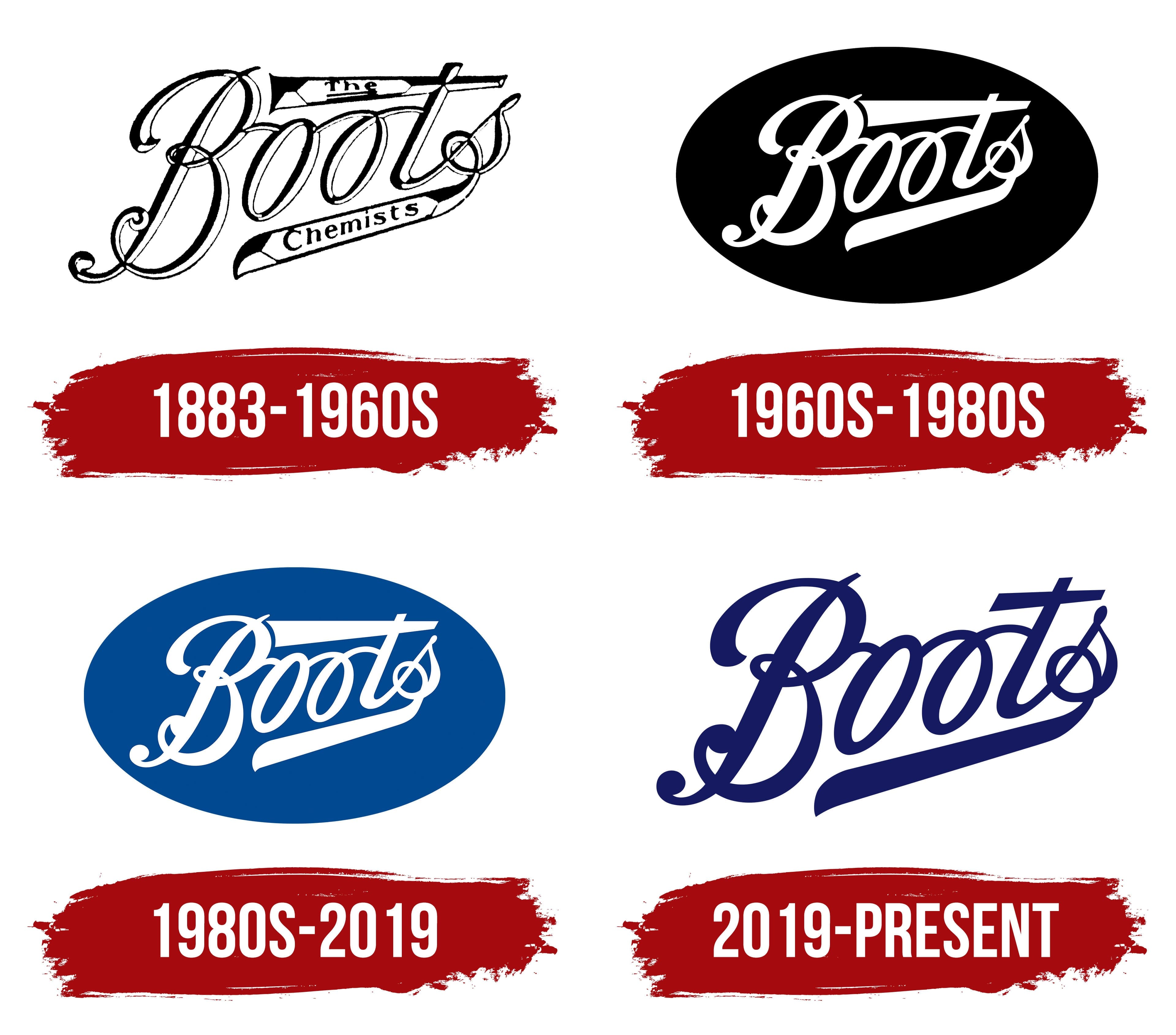
Despite several revisions, the company’s overall visual mark is very consistent. The main lettering, style, and slant have been the same for 150 years. The main adjustments were in the background and color composition.
What is Boots?
A British company that sells medicines, personal care, cosmetics, and medical services, founded in 1849. It is part of the U.S. corporation Walgreens Boots Alliance. Sales are 6.3 billion dollars.
1883 – 1960
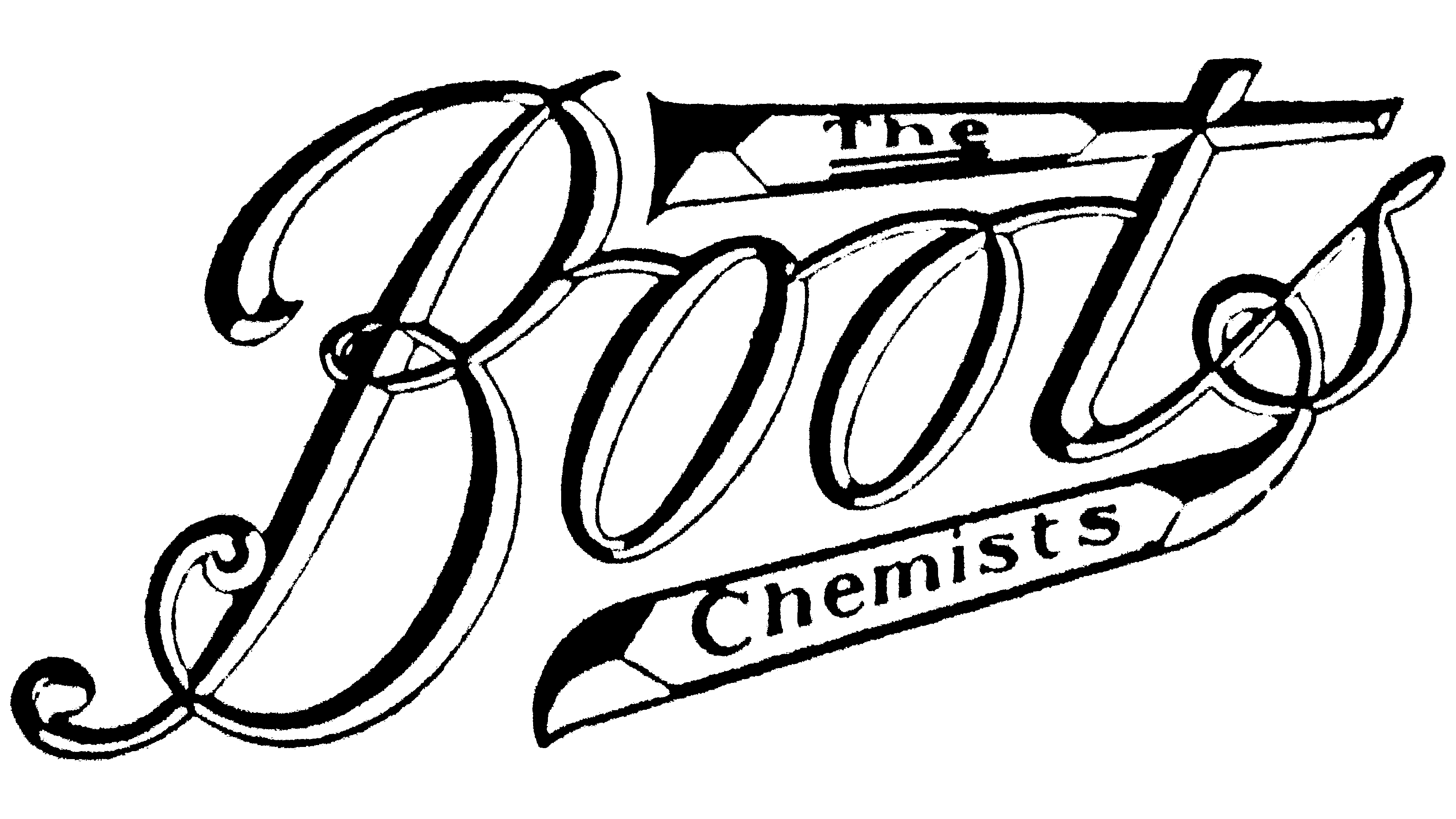
The exact time of the logo is unknown. When the company was registered in ’83, it already existed. We chose an ornate ancient font with an unusual shape of three of five letters for visual representation:
- The crossbar of the letter T widened and lengthened backward, reminiscent of a mixture sticking out from under a cork. In a special frame resembling chemical reagent labels, the company’s name was inscribed, starting with the prefix “the”.
- The S’s end was also an elongated ribbon, curling backward and underlining the word Boots. The word Chemists was placed within it. Thus, the logo conveyed the company’s full name: Boots the Chemists.
- One of the letters, O, is inscribed as a loop.
The elongated, widened stripes on the T and S were shaped differently. The upper one remotely resembled a patient listening tube, and the lower one a spatula or scalpel. The company offered potions and powders for cures. Pharmacies were located in poor neighborhoods and, for many locals, were the only “healer.” Hence, the use of medical paraphernalia.
Because the letters intertwined, the name resembled a curly plant, matching the phyto products sold in the apothecary.
Special shadows on the letters made them look pointed and voluminous, as if they were forged of metal. The monograms were part of the era’s graphics and a brand feature. Displaying the name in this aristocratic style, it aligned well with the two baronial titles of Booth’s son.
The two stripes bounded the name above and below, creating a “road,” and the oblique writing suggested striving for heights. The composition showed a smooth path toward the future, growth, and development.
1960 – 1980
In 1956, the company founder’s grandson and head of the business, Baron John Booth, passed away. After his death, Boots reoriented itself and started developing medicines. In particular, Boots helped bring the well-known worldwide analgesic and antipyretic ibuprofen to life. The company’s pharmacists developed it in 1961, and it won the Queen’s Awards for Enterprise.
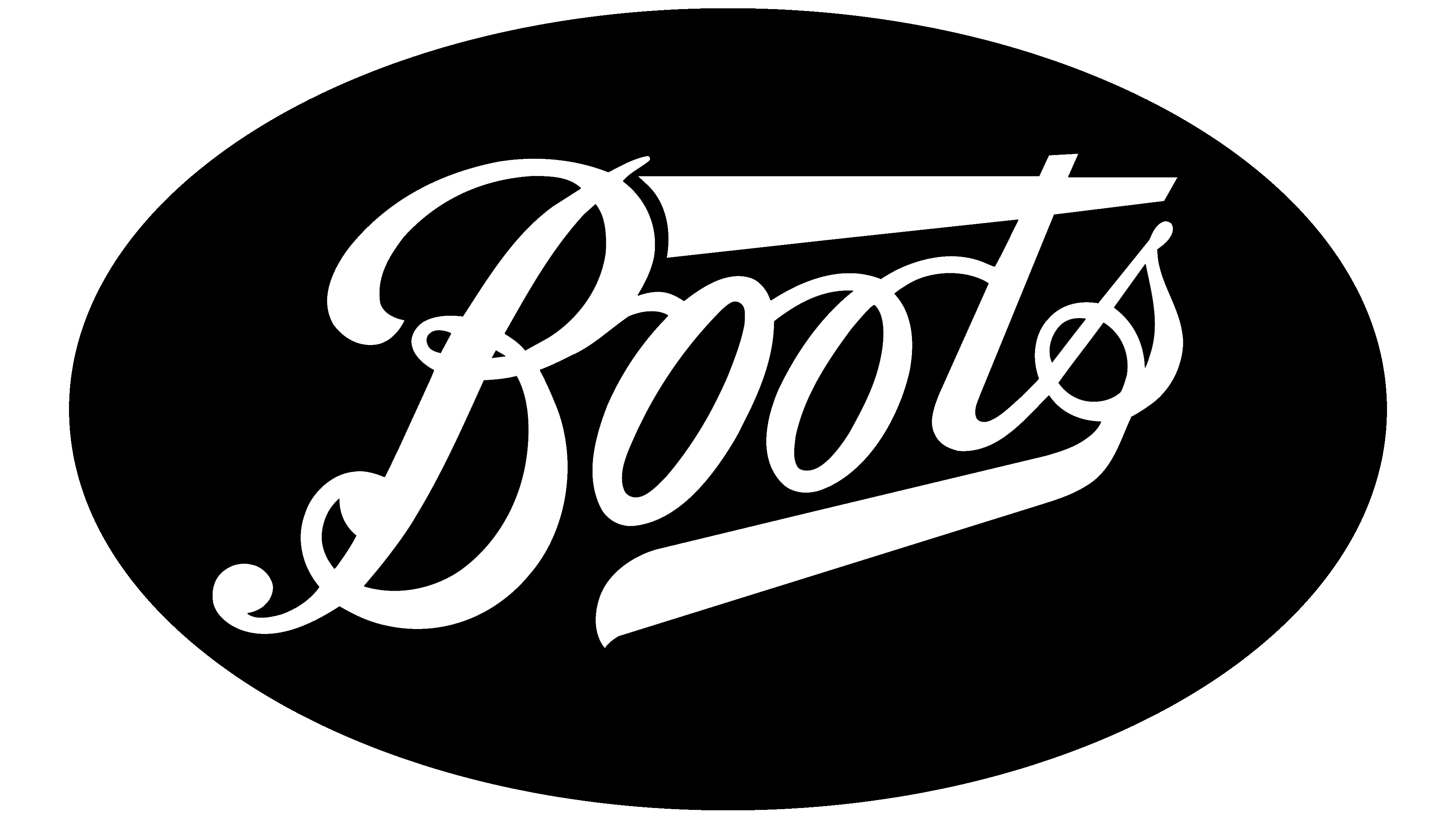
With the new direction and new owners (Booth’s assistant J.P. Savage took the helm), the logo changed. The name was placed on an oval black background. The logo now looked more like a sign nailed at the entrance to a business. The white inscription was associated with white chemical powders and reagents. The white-and-black contrast indicated the sickness and recovery that came from Boots’ medicines. As a symbol of the pill, the logo’s oval shape reflected the new line of business.
The volumetric lettering disappeared. The words “the Chemists” were removed from the ribbons of the letters T and S as the company changed its name to Boots Company Limited. The top ribbon was extended almost to the capital letter, and the edge of the T now seemed to hide under the B. This further strengthened the association with the road the name was taking.
1980 – 2019
Boots expanded aggressively, acquiring companies in various areas and pharmacy chains in other countries. Four divisions were opened to manage various offshoots and subsidiaries. In 1985, the parent company was renamed The Boots Company PLC.
One of the “non-medical” enterprises we invested in was selling goods for infants and young children in large shopping centers. This business change required a logo update.
To better connect with younger customers, a pleasant blue shade replaced the black background. This made the logo brighter and more joyful, which aligns better with children’s themes. The new visual identity also suited other destinations.
2019 – today
By 2019, Boots was in the wholesale drug business, selling shoes, drugs, hygiene products, and providing medical services. There were seven operating divisions. In 2018, Sebastian James became president and managing director. The new leadership and updated policies led to a change in the visual sign.
The emblem’s background was removed, and attention shifted to the lettering, which took on a stylish dark blue that conveys solidity and reliability. The T’s crossbar was shortened, leaving only the bottom band. This made the logo less massive. The lettering retained the upward rise. The underlying became a symbol of reliance on the past, while the upward motion demonstrates the aspiration for the future.
Font and Colors
The main colors used for the visual sign are black, blue, navy blue, and white.
Black represents the company’s stability, powerful developments brought to light by Boots scientists, and a hint of the diseases the company’s drugs help cure.
- Blue represents childhood and the sky. It symbolizes the company’s expansion and the sale of children’s products.
- White represents health, chemical reagents, and the drugs the company offers. It also signifies renovation and new beginnings.
- Dark blue signifies experience, stability, and large scale. It is supposed to inspire confidence and calmness.
The company logo was originally handwritten. Therefore, it doesn’t have a modern font that matches it; the closest match is Neville Regular and Almibar Swash 1.