


 Brigham Young Cougars Logo PNG
The blue oval adorns the Brigham Young Cougars logo and is shaped like a ball. And there is a hidden dynamic in the big white “Y” because its parts vary in length and thickness. Such an emblem is great for athletes’ uniforms and souvenirs because it immediately catches the eye.
Brigham Young University’s athletic program dates back to the late 19th century. The school was founded in 1875 in Provo, Utah, as Brigham Young Academy, an institution of The Church of Jesus Christ of Latter-day Saints. It became a university in 1903, while football and basketball developed during the early decades of campus athletics.
The Cougars’ nickname became firmly associated with BYU in the mid-20th century, drawing on the mountain lion native to Utah’s highlands. The program’s major shift came in 1972, when LaVell Edwards became head football coach. Over 29 seasons, he built BYU around a pass-heavy offense. He won 257 games, turning the Cougars into a national-level football program.
The peak came in 1984, when BYU finished 13-0 and won the national championship after beating Michigan in the Holiday Bowl. The title was debated because of BYU’s schedule, but major selectors officially recognized it. Edwards’ era also produced quarterbacks Jim McMahon, Steve Young, and Ty Detmer, who won the Heisman Trophy in 1990 after a record-setting season.
Beyond football, BYU developed notable athletes such as Danny Ainge, later a Boston Celtics player and NBA executive. The Cougars spent years in the Western Athletic Conference and Mountain West Conference, with the University of Utah as their main rival in the “Holy War.” BYU became independent in football in 2011, then joined the Big 12 in 2023, entering regular competition with major programs from Texas, Oklahoma, and other football states.
Meaning and History
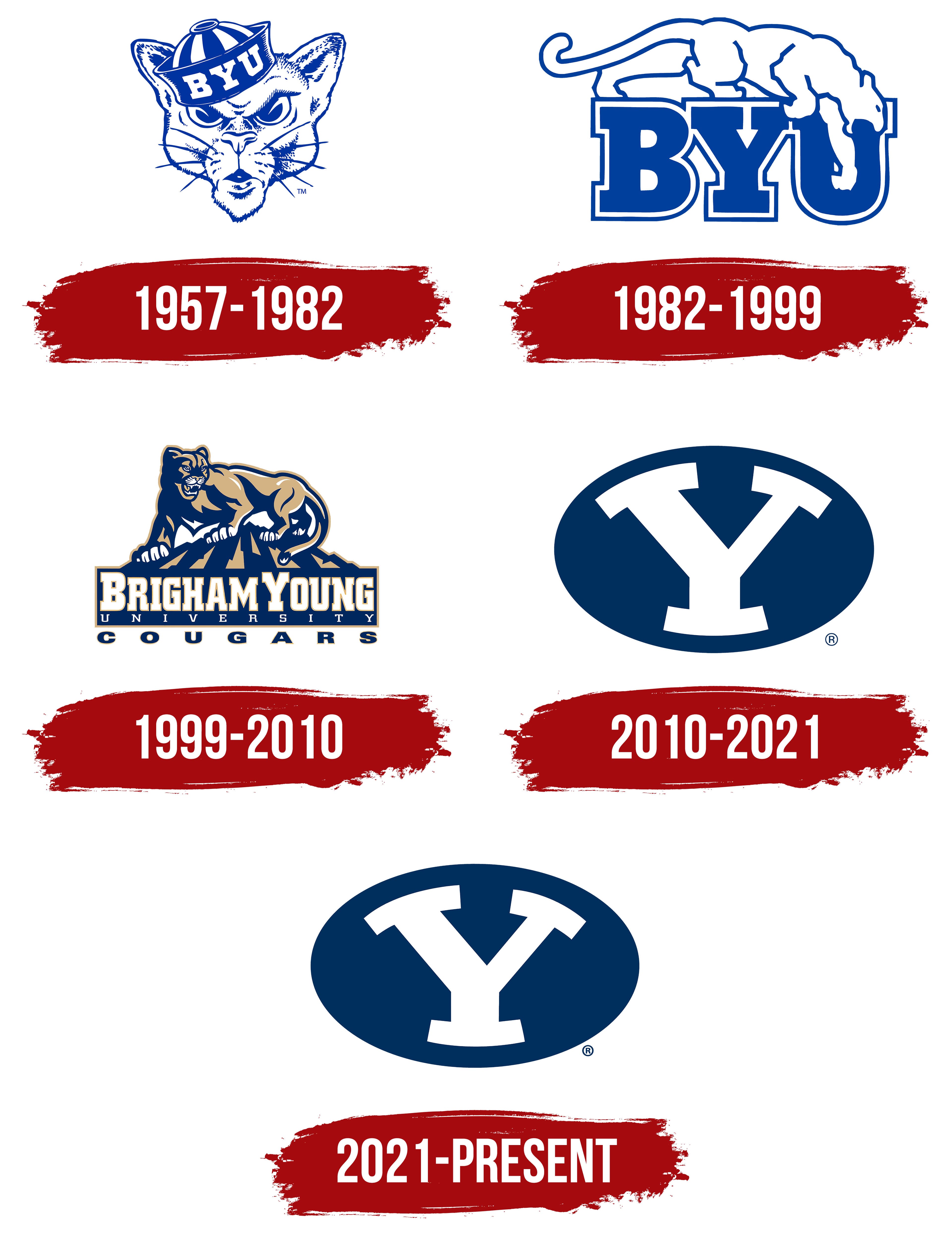
The sports department logos belonging to Brigham Young University share one element: text. The first version is presented as an abbreviation, the second as a detailed and informative fragment, and the third as a single letter. In addition, the emblems can be divided into two categories: those with a puma and those without. In the current version of the logo, the university mascot is not used due to the complex graphic features.
1957 – 1982
Previously, the Brigham Young Cougars logo featured a front-facing cougar head. When creating it, the artists adhered to a cartoon style, and the drawing resembled a good-natured caricature that highlighted the animal’s main features. In particular, the sports teams’ emblems depicted a long mustache, a half-open, disgruntled mouth, furrowed eyebrows, a menacing look, and alertly raised ears. The cougar’s head was adorned with a peakless cap with the inscription “BYU.”
1982 – 1999
The Cougars sports club’s emblem depicts a puma, the university’s mascot. The animal is drawn in contour: the outlines are solid blue stripes without inner coloration; therefore, the predator is white. She sneaks up on the abbreviated name of the higher education institution, carefully rearranging her paws: one leg is on “B,” two on “Y,” and one more forms a depression in “U.” The head of the wild cat is down. The mouth is open. The long tail is laid back. Ears are flattened. The letters also have contour outlines, but with the central part filled, they have bold lines only on the outside, forming a solid frame. The image of the animal is a contour. Symbols, on the other hand, are fully colored and have a double border.
1999 – 2010

After the redesign, the cougar’s drawing style has changed: it has become more realistic. The animal stands in the highlands, depicted as sharp triangles and multi-structured peaks. The body of the wild beast is muscular and almost pressed to the ground, as if it is preparing for an attack jump. An open mouth with sharp fangs, a frowning forehead, raised ears, and a gaze also speak of the readiness to rush at the enemy. Her eyes are focused on one point, and her ears are raised. It can be seen that behind the creeping movements are hidden tremendous power, endurance, strength, and will. Below is the sports team’s name “Brigham Young University Cougars,” ungrouped into three lines. Each part has its font: Brigham Young high serif and edging, university thin white, Cougars wide chopped.
2010 – 2021

The modern logo is very minimalist: no mountains, no cougars, and no name. The department received it after a redesign aimed at simplifying personal symbolism. It is adequately readable on any medium and looks good as a print on clothing or sports attributes. The entire blue oval is occupied by the letter “Y.” She, too, is a kind of mascot for the educational institution, since her giant prototype is built into a mountain near one of the campuses. This symbol denotes the name of the university’s founder, Young. The top serifs are positioned so that they form a downward-pointing arrow in negative space.
2021 – today

In 2021, Brigham Young University updated its sports teams’ logo once again, but no significant changes were made. The designers only slightly reduced the block letter “Y,” which is nearly invisible, and moved the registered trademark sign closer to the ellipse.
Font and Colors
The blocky “Y” on the Brigham Young Cougars’ emblem was created from scratch and did not fit any standard typeface. It is formed by a negative white space inside a dark blue ellipse (shade #002E5D). This palette echoes the official colors of sports teams.