


 Burlington Logo PNG
The Burlington logo makes it clear that the brand’s stores are more than places to shop. These stores offer comfort and care for staff and customers alike. The emblem promises attentive service and a pleasant shopping experience for every visitor.
Burlington’s roots go back to 1924, when Monroe Milstein’s grandfather, Ab Milstein, opened a wholesale outerwear business. Monroe joined the family trade around 1946 and learned to work with factories, buy surplus stock, and negotiate terms that regular retailers rarely secured.
In 1972, Monroe’s wife, Henrietta Milstein, persuaded him to buy a former factory store in Burlington, New Jersey, for $675,050. She paid the $75,000 down payment from her savings as a librarian. The first Burlington store sold winter coats at discounts of up to 60% compared with department-store prices, and first-year sales reached $1.5 million.
The coat business depended heavily on the weather, so Burlington began expanding its assortment. A second store opened in Copiague, Long Island, in 1975, led by Monroe’s son, Lazer. By the late 1970s, the chain had added women’s sportswear, men’s clothing, children’s items, bedding, gifts, and shoes. Henrietta later pushed for Baby Depot, a baby department with furniture, clothing, and toys. In 1982, Monroe closed its wholesale business and focused on retail, with annual sales already exceeding $130 million.
In June 1983, Burlington Coat Factory Warehouse Corp. went public on the New York Stock Exchange with 31 stores. Sales passed $1 billion in 1993. By 1998, coats made up only 20% of revenue, while competitors TJX Companies and Ross Stores had already moved deeper into off-price retail. Bain Capital Partners bought Burlington Coat Factory for $2.06 billion in 2006. In 2009, the company became Burlington Stores, dropping “Coat” from its name, and returned to the stock market in 2013.
Meaning and History
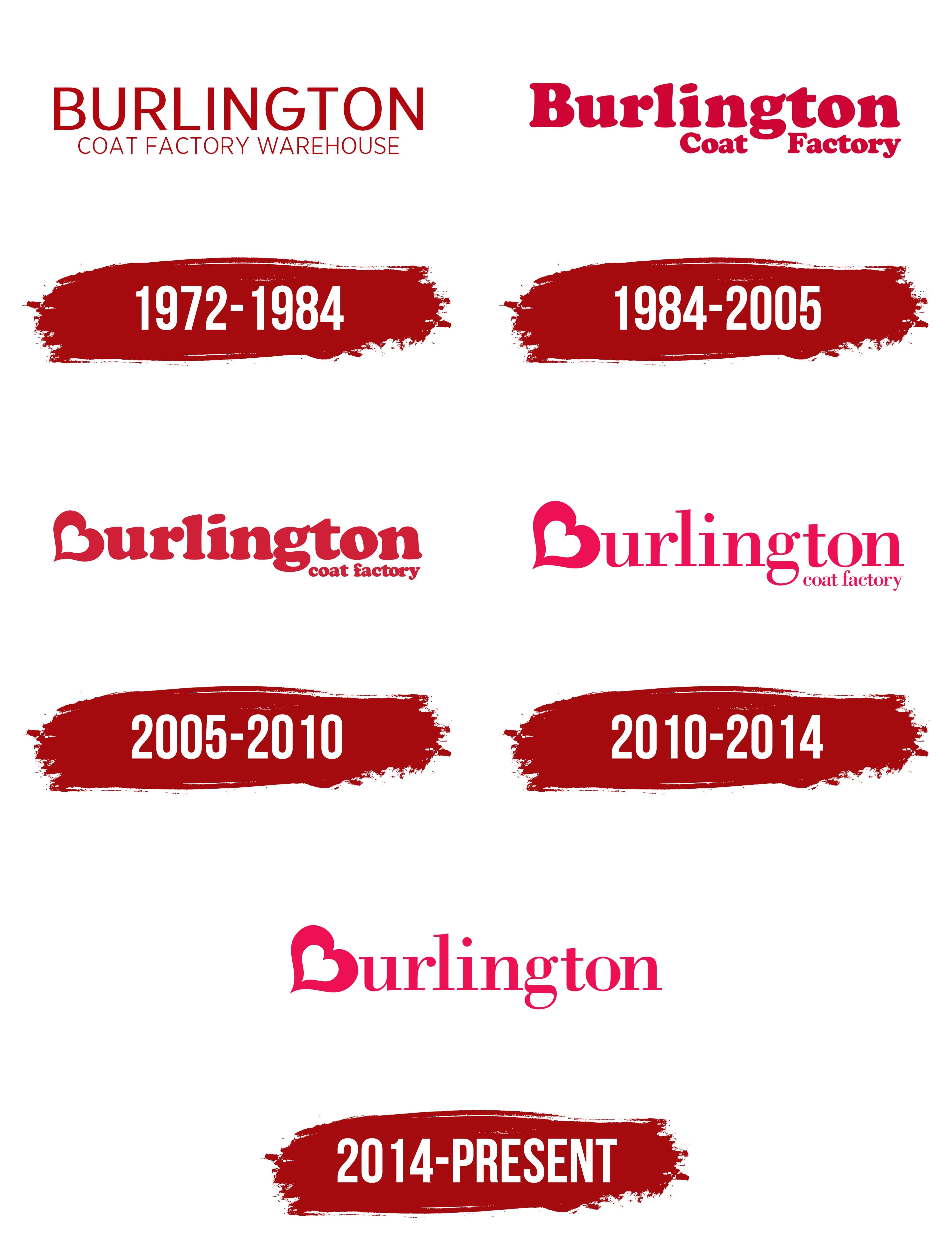
The journey from factory to clothing department stores took Burlington over 100 years. It began in 1923, right in the middle of a cornfield, when a young Spencer Love convinced the Burlington Chamber of Commerce to sponsor the construction of a factory in their town. In 1972, the Milstein family of Jewish immigrants, who traded in clothing, bought the factory premises (Love’s Burlington Industries had by then greatly expanded and no longer needed the space). Placing merchandise in the large hall gave the Milsteins’ business a strong footing. Wholesale and retail sales of coats and jackets grew into a wide range of clothing and an entire chain of stores. By 1983, Burlington Coat Factory Warehouse Corporation had 31 outlets; in 2013, it had 503.
Despite four updates to the visual sign, it always used only text and shades of red and white.
What is Burlington?
It is a major American department store chain with a presence in 40 states. It offers clothing and footwear for the whole family, plus bedding, toys, baby products, and haberdashery. It opened 740 stores and brought in about $6 billion in revenue.
1972 – 1984
The first emblem was simple. It included a large factory name: Burlington. Below that, it listed what the company offered: Coat Factory Warehouse.
The burgundy name reflected the new owners’ pride in this major acquisition. After all, they were now a major enterprise. As a vintage color, the hue pointed to the store in the historic building and the Milsteins’ substantial business history (Monroe’s father started the wholesale trade in 1923).
The slim, stark letters hinted at the sale of outerwear and at the company’s display of clothes in simple spaces, without salon trimmings. This policy extended to the firm’s future stores, allowing lower merchandise prices.
1984 – 2005
In 1983, the company’s stock began trading on the stock exchange, and Burlington Coat Factory Warehouse Corporation had its first shareholders. The influx of capital allowed the firm to grow further. By 1984, the company had 31 retail stores, and by 2003, it had 335. Burlington actively added a variety of brands to its assortment, moved away from coats, and offered good discounts. The new pretensions were reflected in an updated logo.
The company was no longer associated with a warehouse; it had many rooms, so the word “warehouse” was removed from the logo, leaving only “Coat Factory”. The austere letters became rounded, with graceful curls, and took on a fresher, brighter crimson color. They showcased a range of fashionable, smart clothes for the whole family. The letters also grew thicker, hinting at growth and expansion.
2005 – 2010
The company is being prepared for sale. In 2006, Bain Capital Partners, an investment company, acquired it. The new buyer transformed Burlington into Burlington Coat Factory Holdings, making it the parent holding for all other offshoots (Baby Depot, MJM). With the creation of the Burlington “family” of companies, love and togetherness became central to the period’s logo.
The heart appears in the name as a symbol of love, family ties, and the stores’ benevolent attitude toward their customers. The first letter, B, slanted backward, is stylized under the sign. The heart’s capitalized position indicates that love and friendliness are at the forefront of the company. As part of its new policy, Burlington began fundraising in 2006 to sew coats for those in need.
The rich red lettering also conveys love. It symbolizes blood and blood ties. It shows that Burlington cares about the whole family, delivers the best to customers, and offers the right products at low prices.
The Coat Factory lettering is no longer accentuated. It has been made much smaller and placed at the bottom-right, after the loop of the letter G.
2010 – 2014

The main change during this period was replacing the bright red hue with fuchsia and the bold serif font with a more subtle one. This made the emblem more fashionable, as did the firm’s range itself. The holding adds more and more brands and stores to its “piggy bank. Among them is Cohoes Fashions.
2014 – today
In 2013, the new holding company put its stock up for sale and entered into a partnership with its shareholders. This entailed expanding the company’s scope and rebranding. Burlington’s main message today is embracing difference.
The company’s customers are diverse, with different views, skin colors, beliefs, and lifestyles. The company welcomes diversity and tries to cater to all tastes. The logo reflects benevolence, tolerance, and care through its lighter inscription. Support for diversity is evident in removing the “coat factory” inscription from the logo, allowing the company to leave its history behind and enter a new stage of development. After all, Burlington has long offered customers much more.
Font and Colors
Different shades of red have been used for the visual sign.
- Burgundy represents greatness, strength, elegance, resilience, and the ability to achieve one’s desires (Monroe’s wife saved 75,000 from her salary at the library). That was only enough for a down payment. The factory was worth 675,000. However, the Milsteins wanted their business so badly that they took the risk.
- Bright crimson – individuality, developing one’s style, forming a new assortment.
- Amaranth red – the color of love, life, caring, family, department store, charity.
- Fuchsia – determination, cheerfulness, happiness, moving forward.

Burlington found his perfect font. That is why it hasn’t changed in recent logo editions. Bodoni is a subtle serif font. It suits a company with a rich history of offering fashionable products.