


 BuzzFeed Logo PNG
The BuzzFeed logo represents a global news portal. The symbols represent many of the topics the publication covers. The information is always fresh and posted in response to current events.
BuzzFeed’s story began before the site existed. In January 2001, MIT Media Lab student Jonah Peretti asked Nike to customize sneakers with the word “sweatshop.” His email exchange with the company spread through thousands of inboxes, giving him an early view of how online sharing works.
In 2005, Peretti co-founded The Huffington Post with Arianna Huffington and Kenneth Lerer. At the same time, he kept testing viral media through Contagious Media at Eyebeam in New York. On November 1, 2006, he launched BuzzFeed Laboratories with John S. Johnson III, who provided $500,000 in seed funding. Kenneth Lerer was also an early investor. At first, BuzzFeed had no newsroom. An algorithm tracked fast-spreading content, and Peggy Wang became its first employee.
After The Huffington Post was sold to AOL for $315 million in 2011, Peretti focused on BuzzFeed. The platform moved from tracking viral content to creating it. BuzzFeed News launched in December 2011, and in 2013, Pulitzer Prize winner Mark Schoofs joined to lead investigative journalism. In 2012, BuzzFeed raised $15.5 million from New Enterprise Associates, Lerer Ventures, Hearst Interactive Media, SoftBank, and RRE Capital.
BuzzFeed’s business model relied on native ads in the form of lists, quizzes, and videos. It competed with Vice Media, Vox Media, and other digital publishers. In 2014, the company raised $50 million and reached a $1 billion valuation. NBCUniversal invested $200 million in 2015 and again in 2016. BuzzFeed bought HuffPost from Verizon Media in 2020, went public through a SPAC in 2021, added Complex Networks in 2022, closed BuzzFeed News in May 2023, and sold Complex to NTWRK in February 2024.
Meaning and History
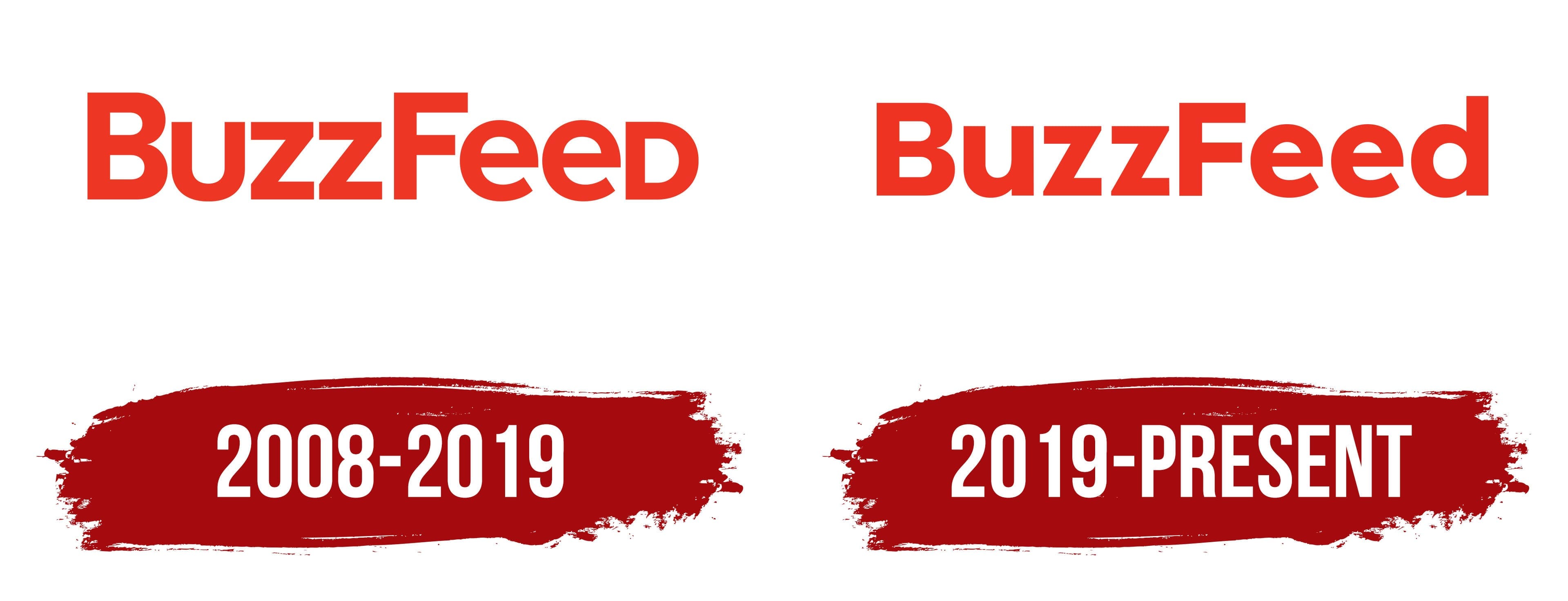
Peggy Wang wrote BuzzFeed’s first story in 2006. Since then, it has expanded considerably, with new investors, a new concept, and a new logo that is virtually indistinguishable from the old one. The company became profitable, and despite the high-profile plagiarism scandal in which Benny Johnson was caught, it proved itself as a successful online media company. Its web portal has many sections, not only for news but also for entertainment content, including day-to-day life, quizzes, and videos.
BuzzFeed’s 2019 redesign marks its evolution, showing it is ready to change and improve while staying true to its usual style. The online publication uses a specific font system for headlines and doesn’t deviate from its traditional color scheme. The update primarily aimed to optimize mobile adaptation so photos, text, and illustrative material would display well on small screens. To the same end, BuzzFeed’s wordmark was made easier to read.
2008 – 2019

The logo adopted at the beginning of the media company featured its name in red lettering, “BUZZFEED.” Judging by the distinctive shape of the “U” and “D,” the letters were capitalized (all but two “e’s”). Still, the “B” and “F” stood out for their size, elevated above the line, making the text look sloppy. At first glance, the typeface was very simple: a bold grotesque with equal line widths. But unusual cuts appeared at the ends of both “e’s,” and the upper horizontal stroke of the “F” was longer than the lower one.
2019 – today
The wordmark was changed as part of a global brand refresh when the news site adopted a glossy magazine look. BuzzFeed’s in-house staff responsible for the portal’s visual identity was involved in the process.
The redesigned logo maintained its structure. The designers tweaked only a few letters, particularly by moving the “U” and “D” to lowercase, so they looked harmonious. Both horizontal “F” strokes now have the same length. These changes made it possible to increase the letter spacing, which was necessary to improve the inscription’s readability.
Font and Colors
After the redesign, BuzzFeed’s wordmark has become more standard. The company avoided playing with letter case and slight asymmetry, focusing on visual harmony. This way, it tried to express the seriousness of the news published on the site.
Mark Simonson designed the original font used for the media portal’s logos. This bold, severe, sans-serif typeface was created to bridge Akzidenz Grotesk and Futura. It is now known as Proxima Nova SemiBold (since 2005), and previously as Proxima Sans (since 1994). Since mid-2010. Proxima Nova is considered the most widely used paid font on the Internet, as seen on hundreds of websites, including BuzzFeed.

The logo’s basic color has not changed despite design updates. It was red (#EE3322), reflecting a creative identity and setting BuzzFeed apart from other media portals.