


 Central Perk Logo PNG
The Central Perk logo invites you to have a cup of coffee in a pleasant atmosphere with friends. Hot steam creates a feeling of comfort and warmth. “There will definitely be a companion in a cafe, no one will be alone,” the emblem guarantees.
Central Perk began in 1994 as a fictional café, not a real business. It appeared in the first episode of Friends on NBC on September 22, 1994, as the main meeting place for six young New Yorkers in Greenwich Village. Its timing matched the rise of U.S. coffee culture, as independent cafés grew and Starbucks expanded nationwide.
Production designer “John Shaffner” shaped the set after The Insomniac Café in Los Angeles, using mismatched furniture to create a warm, lived-in space. The orange sofa, later the main symbol of Central Perk, came from Warner Bros. storage. Burton Morris’s pop-art coffee images and New York references adorned the walls. Meanwhile, the furniture layout remained mostly unchanged for 10 seasons.
The café appeared in all 236 episodes from 1994 to 2004. Gunther, played by James Michael Tyler, appeared in 185 episodes, in part because he knew how to use an espresso machine. Rachel Green worked there in the first two seasons, and Joey briefly worked as a waiter in season six. While Seinfeld and Will & Grace also used New York settings, Friends made the coffeehouse its daily headquarters.
After the 2004 finale, Warner Bros. preserved the set. Replica cafés and pop-ups followed in London, New York, Singapore, Beijing, and other cities. The Friends Experience later built permanent installations with Central Perk replicas. LEGO released set #21319 in 2019, and on November 14, 2023, the first permanent official Central Perk coffeehouse opened in Boston, with another version launched in Dubai.
Meaning and History
The film’s writers and director sometimes moved the plot to a nearby cafe to diversify the sitcom Friends’ scenes. Several main characters also worked there for a time. For example, Rachel worked as a waitress there from 1994 to 1997. But she wasn’t interested in the work; she waited it out and earned a living while looking for a job in the fashion industry. In the third season, Greene enters the fashion industry and quits her job as a waitress at Central Perk.
It also worked for Joey, who appeared after those six seasons. He was also a waiter, but he didn’t know much about the job. He just needed money to live on as his acting career went downhill. As a result, he stayed to work at a cafe so he wouldn’t have to pay for coffee. But at the end of the season, Joey Tribbiani got lucky: he was cast in the lead role in Mac & Cheese, so he quietly quit without telling Rachel.
Buffay also occasionally performed at Central Perk, presenting their songs to a stunned audience. For example, they performed the song ” Melly Cat ” there. At one point, Phoebe even replaced Stephanie Schiffer, a professional Terry hired. This cafe is a very significant location in the series, and it has its logo, a sign that was almost constantly in the frame. It was placed on the display glass.
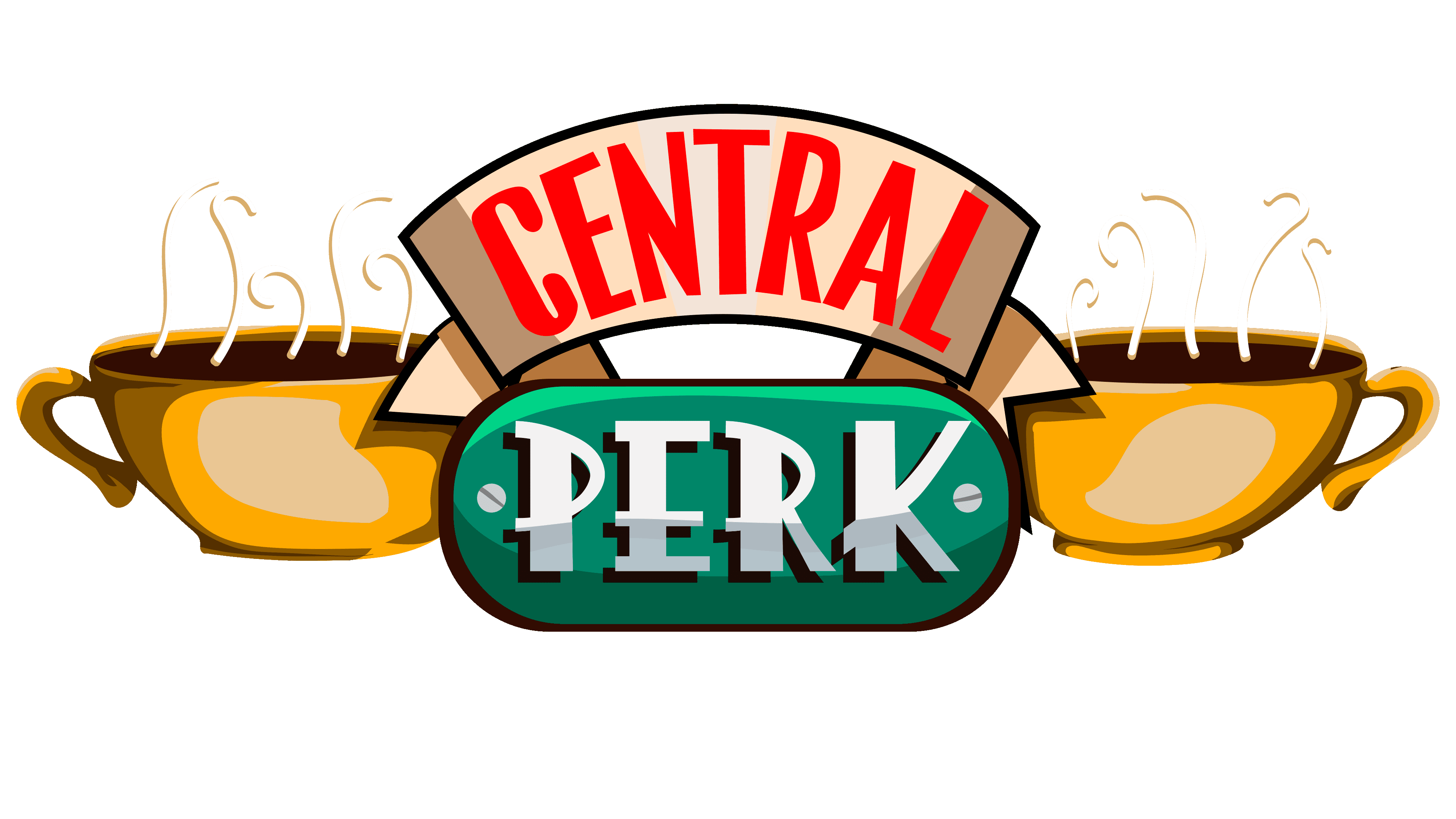
The logo’s image is thematically related to the coffee served at Central Perk. It also hinted that this is a cozy place for friends and interlocutors, as the sign depicts two steaming cups. In the sitcom, they were brown with a white sheen in the middle. Each is outlined with a dark stripe, so the dish outlines don’t blur on the display glass in the light.
Inside the cups, you can see dark hot coffee, as shown by the steam rising from it. It is presented as separate white jets of various shapes, five above each. Between them is an informative text element of the logo: the cafe’s name, set on two lines. The first one says “Central.” The word is placed on a wide white ribbon with forked ends. The second part contains the rest of “Perk.” The lower zone is a green horizontal oval with two painted screws, like a plate fixed to the glass.
Font and Colors
The official Central Perk logo, used from 1994 to 2004 (the series’ release date), used the same elements as the television sign. The difference was that the emblem was two-dimensional. Cups placed on the sides were white with a gray shadow. More coffee was poured into the right one than into the left. This added a dynamic logo – the feeling that they are drinking from cups. The number and shape of the steam jets emanating from the poured drink remained the same, as did the font chosen for the establishment’s name. The screw heads were rendered as two miniature dots.
For the word “Central,” the designers used an elongated sans-serif typeface. The letters are tall, narrow, and without contours. In contrast, the inscription “Perk” is set in wide characters with original serifs, formed by elongated strokes that make up the letters.

The emblem’s color scheme, although not rich, is distinct. It contains white, grey, beige, red, green, and dark brown.