


 Danish Air Transport Logo PNG
The Danish Air Transport logo is a visual touchpoint that conveys the airline’s energetic spirit and commitment to service excellence. It captures the essence of speed, efficiency, and modernity. This airline understands the pulse of today’s global traveler, a person who wants safety, efficiency, boldness, and flair.
Danish Air Transport, known as DAT, was founded in 1989 in Denmark by Jesper Rungholm. The company began as a small cargo airline based in Vamdrup, in Kolding Municipality, southern Jutland. Its early business was built around specialized freight at a time when this niche had little direct competition in the Danish market.
One of the most unusual parts of DAT’s first years was the transport of live horses. This type of cargo requires experience with animal handling during flights and aircraft prepared for non-standard freight. For these operations, along with other cargo services, the airline used older piston aircraft, including the Convair 440 and Curtiss C-46 Commando, both valued by small freight operators for capacity and durable construction.
In 1994, DAT entered passenger charter flights, adding a new revenue stream beyond freight. In 1996, the company launched scheduled passenger routes, changing its profile from a narrow cargo carrier to a regional airline with mixed operations. Over the following years, DAT expanded around smaller airports in Denmark and nearby countries, where major airlines had less presence.
The bankruptcy of Cimber Sterling in 2012-2014 changed the Danish regional market and left several routes open. DAT used this gap to strengthen its position in domestic and Northern European services. The airline also competed with SAS, which dominated many of the larger routes from Denmark. DAT continued to combine scheduled flights, tourist charters, and cargo activity while keeping its base in Vamdrup.
Meaning and History
What is Danish Air Transport?
Danish Air Transport, now known as DAT A/S, is a reputable Danish airline based in Vamdrup, Kolding municipality. Since its foundation, it has been a reliable provider of scheduled and charter passenger and cargo flights, serving mainly Danish airports. The airline’s journey began in 1989 when it was founded as Danish Air Transport. Over the years, it has gradually expanded its operations, showing continuous growth. Starting with cargo flights, the airline moved to scheduled passenger transportation in 1996 and in 2003. The airline moved to charter operations in 2003. The strategic transformation to DAT A/S was an important milestone in the airline’s development, strengthening its brand in the market.
1989 – today

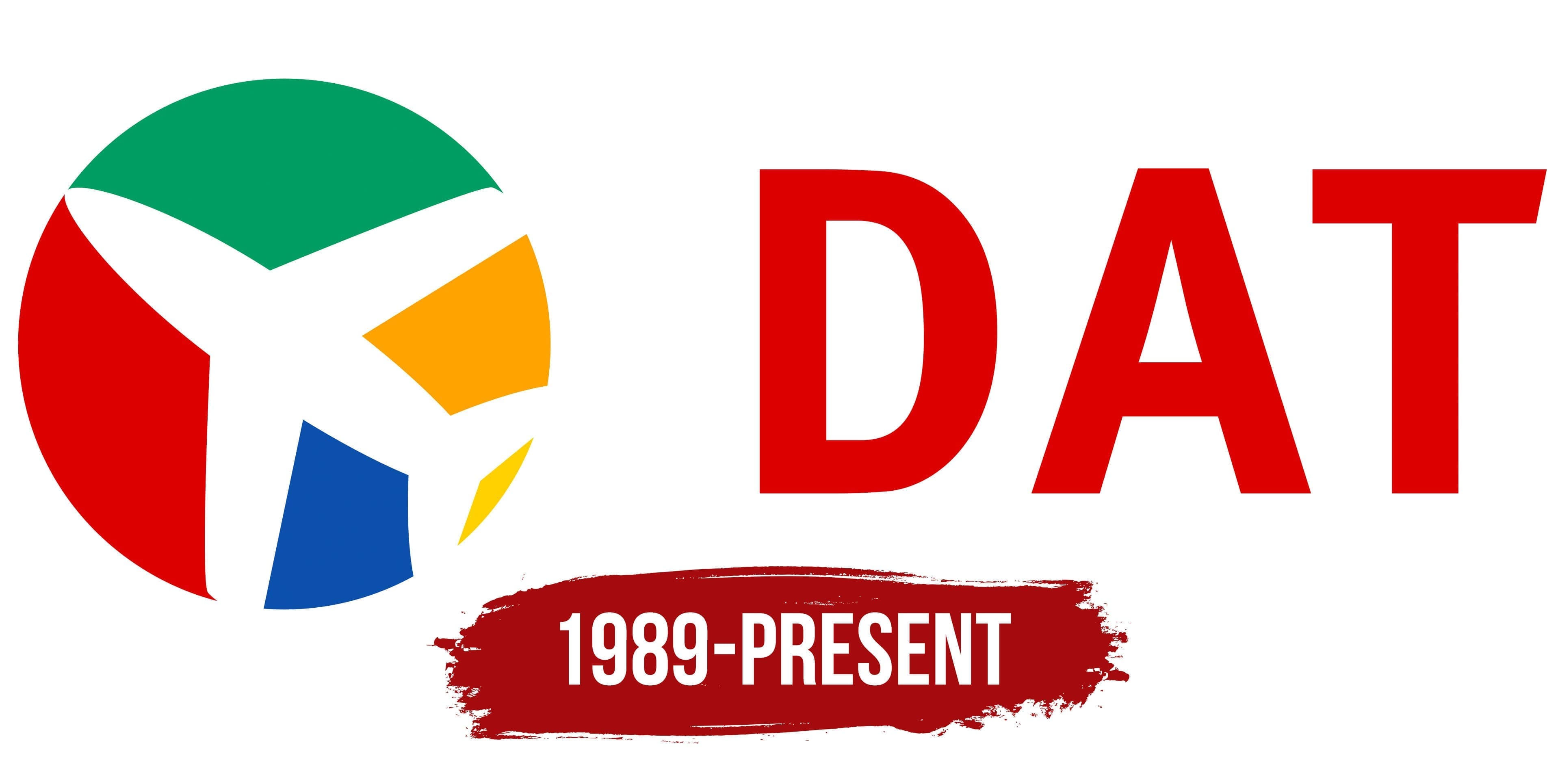
The Danish Air Transport (DAT) logo is minimalist and bold in color. Its foundation is the company name’s abbreviation, DAT, set in large uppercase letters in vibrant red. This shade of red emphasizes the company’s energy and activity, evoking a sense of reliability and strength. The font, with clearly distinguishable letters and increased spacing, ensures visual clarity. The letter “T” adds a distinctive touch, with its upper-right corner cut diagonally, giving the composition a modern, dynamic flair.
The company’s symbol is a circle with an airplane silhouette inside. The white airplane divides the circle into five multicolored segments, each representing the airline’s route diversity and global reach. The segment colors green, red, yellow, blue, and orange reflect optimism and openness. These vibrant colors enhance the logo’s appeal while maintaining harmony within its overall concept.
The circle symbolizes the world, movement, and unity, while the airplane inside highlights the company’s core activity. The segmentation suggests routes and directions intersecting to form a cohesive network.
The emblem illustrates how Danish Air Transport confidently connects different parts of the world, moving forward with energy and optimism. The clear design, well-chosen colors, and dynamic forms convey the company’s core values: reliability, global reach, and innovation.