


 Turkish Airlines Logo PNG
The Turkish Airlines logo visualization highlights the brand’s key advantages, offering a recognizable, memorable identity. The stylized stork silhouette symbolizes flight, speed, and safety.
Turkish Airlines traces its history to May 1933, when it was founded as the State Airlines Administration (Devlet Hava Yolları) under Turkey’s Ministry of National Defense. Its first fleet was modest, comprising two King Bird aircraft, three Junkers F-13s, and two Junkers W-33s, but it marked an early stage in the country’s aviation development.
In 1935, the carrier opened its first international route from Istanbul to Athens, marking the start of its expansion beyond Turkey. By 1947, it had added Beirut and Cairo, extending its reach into the Middle East and strengthening links with nearby markets.
A major change came in 1956, when the airline was reorganized and renamed Türk Hava Yolları AO. In 1967, it entered the jet age with the DC-9, which helped expand its network. Throughout the 1970s, Turkish Airlines continued to expand across Europe, Asia, and North Africa, strengthening its position as an international carrier.
The airline marked its 50th anniversary in 1983, and two years later, it opened a new chapter with its first transatlantic flight to New York. During the 1990s, it renewed its fleet with Airbus and Boeing aircraft and added more major destinations worldwide.
Turkish Airlines joined the Star Alliance in 2006. Between 2008 and 2012, it grew rapidly in both fleet size and route map. In 2013, during its 80th anniversary year, construction began on a new airport in Istanbul. After moving operations there in 2018, the airline gained a larger hub for future growth, and in 2019, it continued to expand with new routes and more frequent flights.
Meaning and History
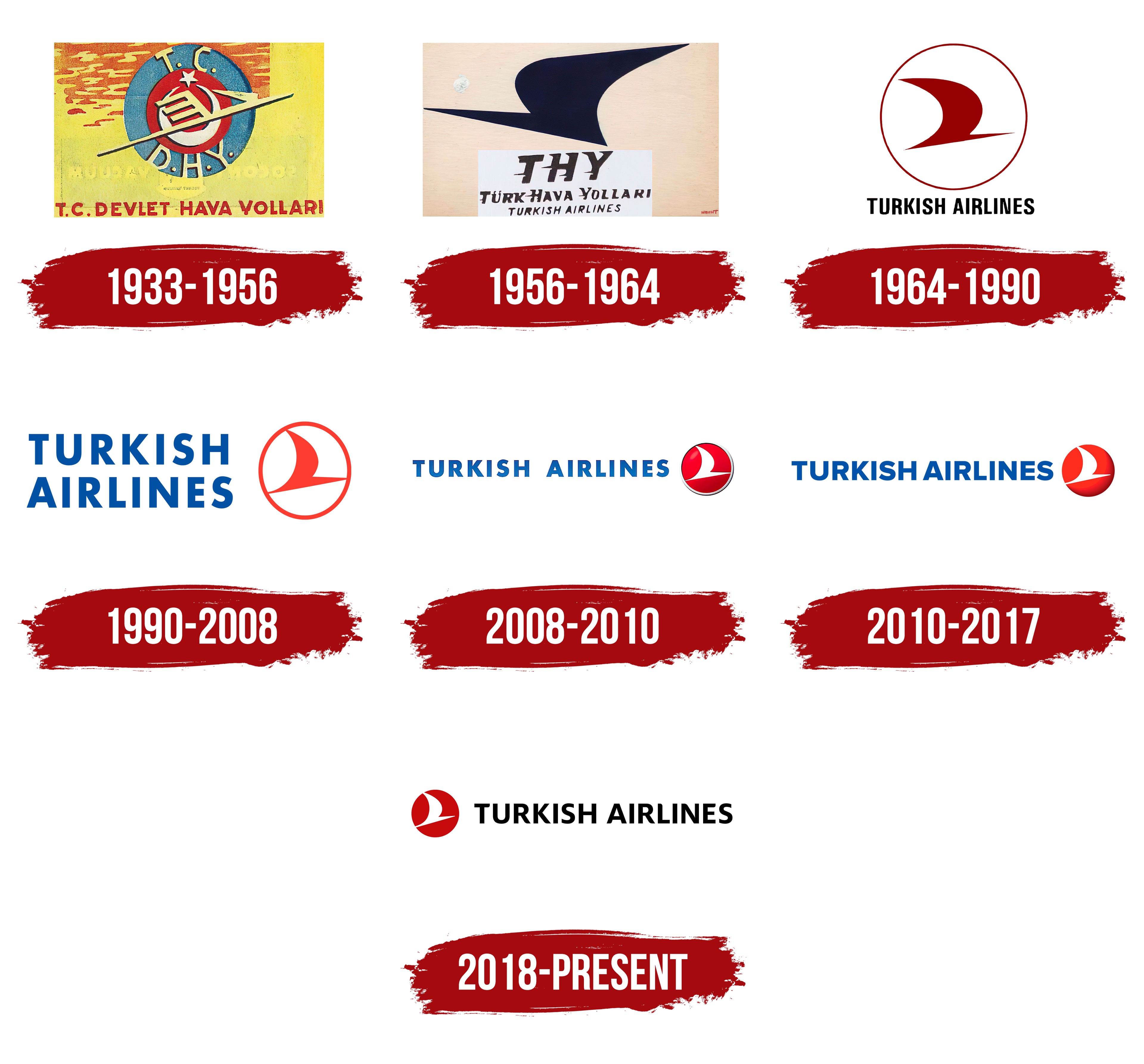
Over its long history, the airline has had eight logos, each featuring an abstract bird resembling a stork. It is depicted as inclined, soaring upwards as a symbol of moving into the future and reaching new heights.
What is Turkish Airlines?
This is Turkey’s national carrier, based in Istanbul. It is known for its extensive global route network, covering more countries than any other airline. It operates a diverse fleet, including Boeing 787 Dreamliner and Airbus A350, serving over 300 destinations. The airline’s unique feature is its stopover program, which allows transit passengers to stay in Istanbul for free. The company is notable for its Miles&Smiles loyalty program, which offers extensive opportunities to earn and redeem miles, and for its innovative marketing campaigns, often featuring world-famous celebrities.
1933 – 1956

The debut logo of Turkish State Airlines, used from 1933 to 1956, features a complex, multi-layered composition that reflects the company’s national identity and ambitions.
The logo consists of several elements. At the center is a stylized bird, symbolizing freedom and flight, set against a red circle that signifies energy and dynamism. Above the bird is a crescent and star, elements of the Turkish state emblem, emphasizing the company’s national affiliation.
A larger blue border surrounds the smaller red circle and bears the abbreviations T.C. (Türkiye Cumhuriyeti) and D.H.Y. (Devlet Hava Yolları), which together translate to Turkish State Airlines. These abbreviations are set in a strict, clear font, underscoring the company’s formality and reliability. At the bottom of the logo is the full name, “T.C. DEVLET HAVA YOLLARI,” written in red capital letters on a light yellow background, creating contrast and making the text easy to read.
The logo’s color palette includes red, white, blue, and yellow. Red and white symbolize Turkey’s national colors, while blue adds depth and professionalism. The light yellow background with red dotted highlights in the upper right corner adds dynamism and brightness to the composition.
The period from 1933 to 1956 was a time of establishment and growth for Turkish State Airlines. During this time, the company actively expanded its route network and improved service quality, striving to become a leading carrier in the region. The logo reflects these ambitions and national pride, emphasizing the connection with the Turkish state and its symbols.
The logo created during this period was rich in elements symbolizing state support and national identity. Using the Turkish emblem highlights the company’s importance to the country and its significance internationally.
1956 – 1964
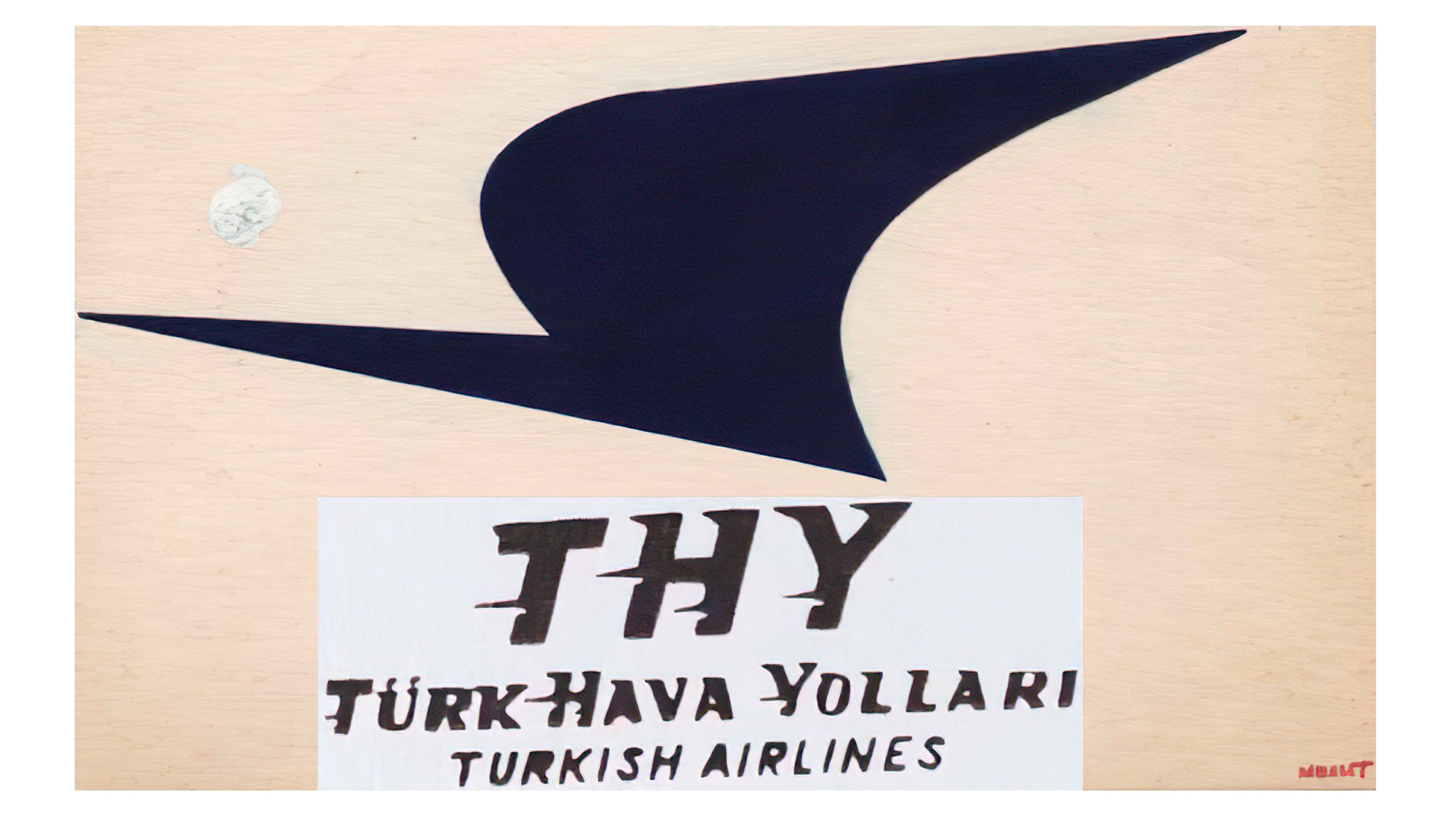
The logo of this period is black and white. The bird’s silhouette is enlarged and turned in the opposite direction, with several Turkish inscriptions added.
1964 – 1990
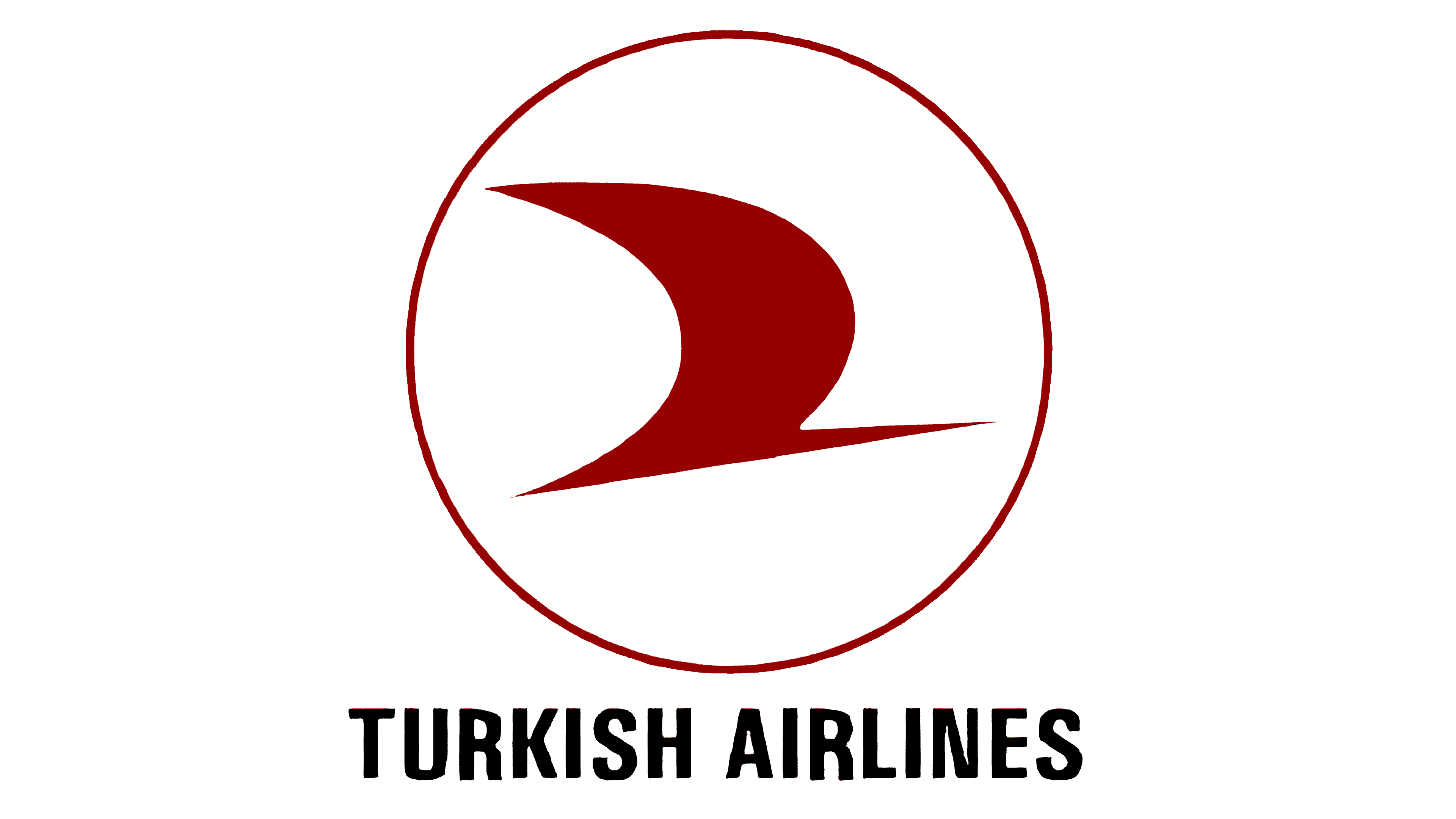
Before 1964, Turkish Airlines used a different logo. With the introduction of the new emblem, the company made a significant step forward in brand visual identity. The red bird in a white circle became iconic for many years, easily recognizable, and associated with Turkish origins and high-quality service. This combination of colors and shapes emphasized the company’s national roots and global ambitions.
The bird symbolizes flight, freedom, and aspiration. The red used for the bird highlights energy and passion, while the circle’s white background symbolizes purity and reliability.
Below the bird image, the name “TURKISH AIRLINES” is written in black capital letters. The sans-serif font is strict and modern, emphasizing the company’s professionalism and reliability. Black symbolizes stability and confidence.
1990 – 2008
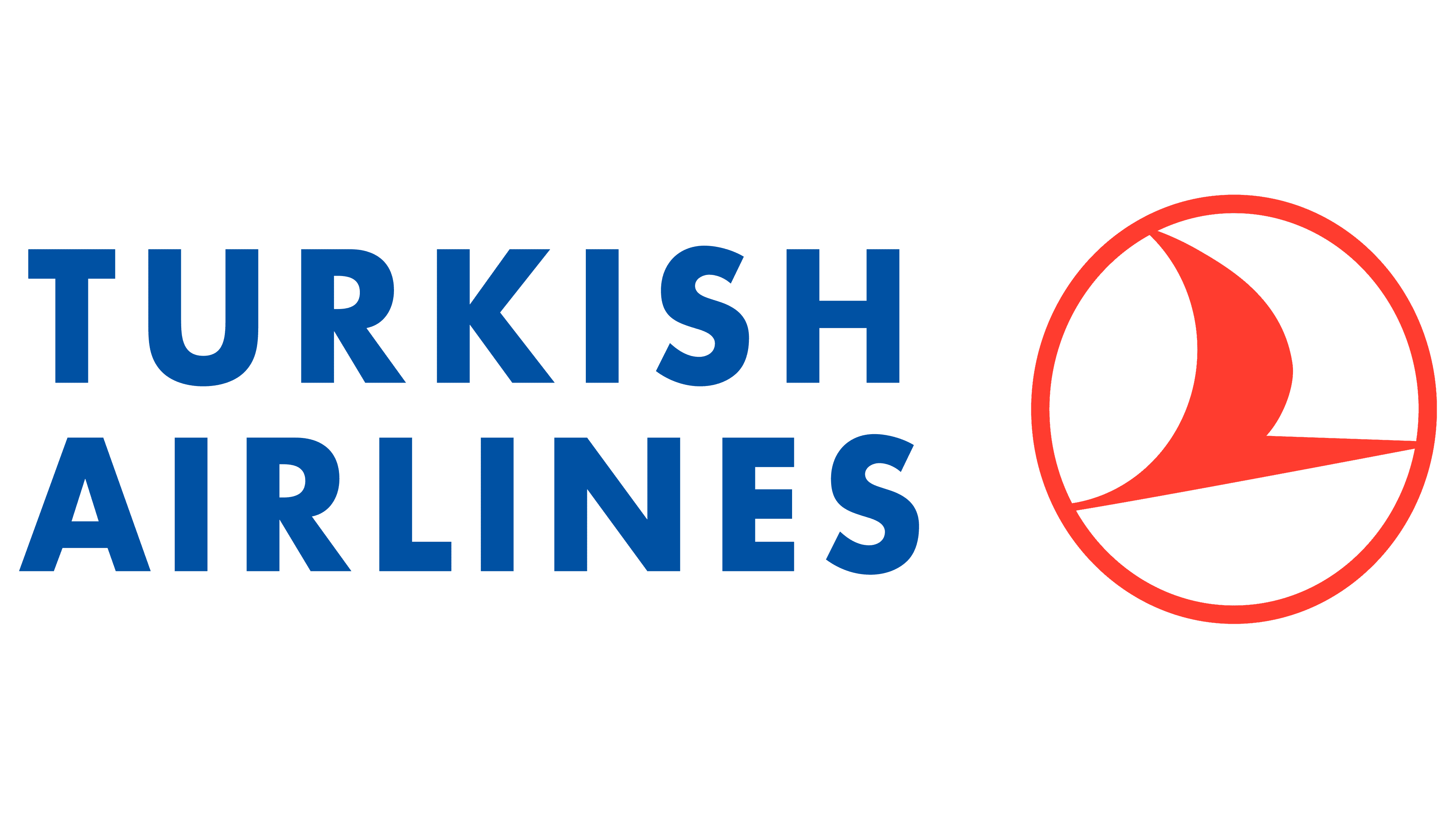
In 1990, designers changed the ratio of graphics and text. As a result, the airline’s name became much larger and occupied two rows: the upper row, “Turkish,” and the lower row, “Airlines.” The authors also corrected the letter color: instead of black, they used sky blue. They placed a round icon with a soaring bird to the right of the inscription. It is painted red, as is the outline.
2008 – 2010
To simplify the logo, developers rearranged the company’s name and placed the words on a single line, leaving a large gap between them. Although the bird icon remained in its previous place, it also received an update. Designers changed their colors: all white was repainted red, and red was repainted white.
2010 – 2017
The changes to the Turkish Airlines logo in 2010 were minimal but significant. The spacing between the words and letters was reduced, making the text more compact and cohesive. The circular frame around the emblem was removed, and the color became less bright and more pastel, giving the logo a more modern and refined look.
The name “TURKISH AIRLINES” is written in capital letters in a darker blue color. The font remains the same: sans-serif, modern, and strict, emphasizing the airline’s professionalism and reliability. The blue color symbolizes trust and stability, which matters to passengers.
2018 – today
Although all elements remain the same, the logo looks different in its current version. Only the flying-bird icon is now to the left of the airline’s name, and the phrase “Turkish Airlines” has again become black instead of sky blue.
The Turkish Airlines logo is an elegant and symbolic image that reflects the airline’s essence and goals in the modern world. A white bird is depicted inside a red circle, symbolizing freedom, movement, and a forward-looking vision. The red circle represents energy, passion, and dynamism, and is associated with Turkey’s national colors.
The name “TURKISH AIRLINES” is written in black capital letters. The sans-serif font is modern and strict, emphasizing the company’s professionalism and reliability. The black color symbolizes stability and confidence, adding contrast and visual clarity to the logo.
When this logo was introduced in 2018, Turkish Airlines was actively expanding its international routes and striving to establish itself as a leading carrier on the global stage. The company implemented new technologies and improved service quality to meet the aviation industry’s high standards.
The logo reflects these ambitions and the pursuit of excellence. The white bird, symbolizing freedom and movement, underscores the company’s aspiration to expand its horizons and deliver the best service to its passengers. The red circle, symbolizing energy and passion, signifies the company’s dynamic growth and commitment to innovation.
Font and Colors
The Turkish airline’s logo has always featured a bird. Over the years, it has evolved from a barely noticeable abstract stroke into a full-fledged winged symbol of flight. The bird points upward at a slight angle, like an airplane taking off. It has a long beak, and its tail and wings touch the edge of the red circle, breaking it at two points. The carrier’s full name is displayed behind the icon. Above the airplane portholes, a white bird adorns the prominently protruding tail.
The company chose a simple, legible, elegant font for its identity. The font is Proxima Nova ExtraBold, a revision of Proxima Sans. It combines geometric shapes with a modern look. Its creator is Mark Simonson. The color palette is also stable: red, blue, and black – the primary options for the Turkish carrier.
FAQ
What does the Turkish Airlines logo mean?
Like many other airlines, Turkish Airlines’ logo depicts a bird, a symbol of flight, but the designers did not specify which bird; instead, they used an abstract drawing to preserve the brand’s tradition. The silhouette points upward, like an airplane taking off.
Is Turkish Airlines a good airline?
Turkish Airlines received three stars for service quality, cleanliness, food, and comfort. Some onboard dishes and drinks earned four stars. The luxurious seats in the Boeing 787 and A350 aircraft were rated five stars.
Is Turkish Airlines a 5-star airline?
In 2019, the Turkish carrier was awarded the “5-star global airline” title in the APEX Official Airline Ratings.
Which country owns Turkish Airlines?
The Republic of Turkey owns 49.12% of Turkish Airlines’ shares, while the remaining shares are publicly traded.