


 DC Logo PNG
The DC Comics logo embodies innovation, showcasing creativity, experience, and professionalism. The logo represented America’s largest publisher of popular comics, whose name later became the brand’s name.
In 1934, Malcolm Wheeler-Nicholson founded National Allied Publications in New York, aiming to publish original comics rather than reprints. In February 1935, New Fun became the first American comic made entirely of new material. Early contributors included Jerry Siegel and Joe Shuster, creators of Doctor Occult.
Financial pressure led to a 1937 partnership with Harry Donenfeld for Detective Comics. By 1938, Donenfeld took control. In June 1938, Siegel and Shuster introduced Superman in Action Comics No. 1, reshaping the industry.
In May 1939, Detective Comics No. 27 presented Batman, developed by Bob Kane and Bill Finger. In 1941, William Moulton Marston introduced Wonder Woman. That same year, related companies merged into National Comics Publications, and by 1940, the DC abbreviation appeared on covers.
The 1950s brought pressure after Fredric Wertham’s Seduction of the Innocent led to hearings and the creation of the Comics Code. DC adapted, while many competitors closed.
In 1956, Julius Schwartz revived superheroes with a new Flash in Showcase No. 4. The Justice League formed in 1960, prompting Marvel to launch Fantastic Four in 1961.
In 1969, Kinney National acquired the company and later renamed it DC Comics. Warner Communications took control in 1984. In 1985, Crisis on Infinite Earths reset continuity, followed in 1986 by Alan Moore and Frank Miller’s Watchmen and The Dark Knight Returns.
In 1992, Batman: The Animated Series set a new standard in animation. In 2011, The New 52 reboot relaunched all titles, and in 2016, DC Rebirth restored parts of the previous continuity.
Meaning and History
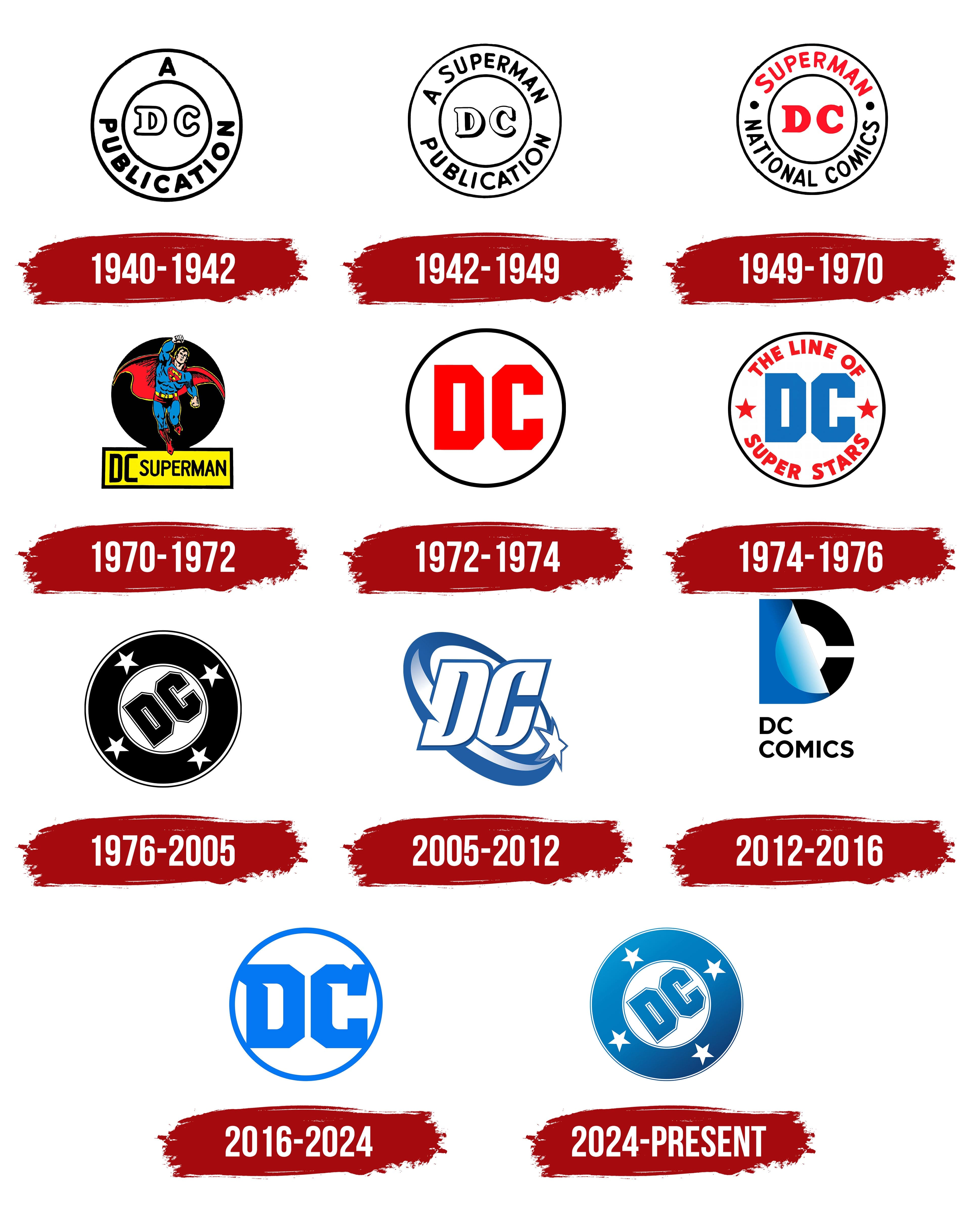
DC Comics had ten logos, different in content but identical in shape. All have circular outlines and appear on magazine covers, in promotional materials, and on souvenirs.
What is DC Comics?
DC Comics is a comic book publisher, a subsidiary of Warner Bros. Discovery, and a division of DC Entertainment. It has been creating comics since 1937, when its publications first featured legendary heroes such as Wonder Woman, Batman, Superman, Green Lantern, and others. The company itself was founded in 1934 as National Comics Publications.
1940 – 1942

DC Comics gets its name from the title of the Detective Comics series. Known for its Batman stories, the series became the company’s flagship publication. Its initials identified the American comic book publisher long before DC Comics became its official name. The company’s history began in 1934, when Malcolm Wheeler-Nicholson founded National Allied Publications. In February 1935, New Fun debuted with original stories created for the magazine.
The circular DC emblem first appeared on covers dated April 1940. That same year, the publisher registered its first trademark. The small logo identified each issue as a DC publication while leaving room on the cover for the individual series title. This shared publisher’s mark connected magazines with different titles, allowing the familiar Detective Comics initials to represent the company beyond that series.
The emblem consisted of 2 concentric circles. The words “A PUBLICATION” appeared between them, with large “DC” initials in the center. Together, they read “A DC Publication.” The outlined serif initials differed from the rounded capital letters around the ring. Black circles and lettering on a white field made the logo look like a publisher’s seal. Placed against the cover artwork, the circle resembled a small printed stamp.
1942 – 1949

Superman’s name joined the DC publisher’s emblem on covers dated November 1941. The words “A Superman” occupied the upper part of the ring, while “Publication” remained at the bottom. Combined with the initials in the center, the wording read “A Superman DC Publication.” Superman’s name complemented the DC initials associated with Batman comics, bringing references to both heroes into a single emblem. As part of the publisher’s shared branding, Superman’s name appeared on the covers of various series. The company began advertising itself as “Superman-DC.”
The logo retained its circular shape but nearly doubled in size. It also gained a white background for the first time. The additional wording filled more of the space around the rim surrounding the outlined “D” and “C.” Black shadows gave the letters depth. The updated logo was first placed in the upper left corner of the cover, where it continued to appear.
1949 – 1970

Lettering artist Ira Schnapp designed a new version of the DC emblem for issues dated November 1949. The wording around the ring now included National Comics, a shortened form of the company name National Comics Publications. These words occupied the lower arc, while Superman’s name remained at the top. A pair of small dark dots separated the hero’s name from the publisher’s name on either side.
Schnapp retained the circular structure and thickened its outline. The enlarged DC initials became solid letters rather than hollow outlines. They used the Cooper typeface, with its rounded shapes and heavy serifs. In the red-and-black version, the central letters and the Superman name appeared in red. At the same time, National Comics, the dividing dots, and the circles remained black.
In the 1960s, the emblem became part of Johnny DC, the publisher’s mascot. The circular logo served as his torso and retained the publisher’s wording and initials.
1970 – 1972

In October 1970, characters from individual series began replacing DC’s standard circular emblem. For a brief period, a rectangular panel containing the publisher’s initials and either the comic’s title or its lead character’s name replaced the previous logo. A drawing of the character appeared above or below the panel. Artist Murphy Anderson created many of the illustrations used in the new treatment.
One variation was the “DC SUPERMAN” emblem, which appeared on many issues of Action Comics. Narrow black sans-serif lettering sat inside a yellow rectangle with a black border. The rounded letters of the previous logo gave way to taller, narrower forms. A common version placed a black circle above the panel, with Superman in his blue suit and red cape extending beyond its edge. Other variations placed the hero below the rectangle.
Other series received emblems featuring their own characters and titles. For anthologies and team comics, including House of Mystery and Justice League of America, the DC initials and publication title were combined into a separate stylized logo. The House of Mystery version took the shape of a bat. Incorporating characters into the publisher’s branding helped establish their images as trademarks. Characters played a similar role on Marvel covers during this period.
1972 – 1974

The circular DC logo returned on covers dated July 1972, replacing the character illustration and rectangular panel. Large red “DC” letters filled nearly all the white space inside a thin black circle. The basic version contained only the 2 initials. On covers, the comic’s title was usually added inside the circle, either above or below the letters.
The block letters featured thick vertical and horizontal strokes, rectangular counters, and clipped corners. This red abbreviation inside a black ring appeared on covers from 1972 to 1974. The typeface remained through subsequent logo updates until 2005, and the publisher returned to it in 2024.
1974 – 1976
The phrase “The Line of DC Super-Stars” appeared in DC’s circular emblem in 1974, presenting the publisher’s lineup as a collection of superstars. The update was developed by Michael Uslan, who would later serve as an executive producer on Batman films beginning in 1989. He added wording around the large initials and 2 small five-pointed stars.
“The Line of” followed the upper arc, while “Super-Stars” ran along the bottom. Stars on either side separated the phrases. The central “DC” letters, set in ITC Machine, completed the wording and remained the emblem’s dominant feature. In the color version, the initials became blue, while the rim text and stars appeared in red against a white background. The star motif continued in later logos. From August 1975 through October 1976, the emblem appeared at the top center of the cover.
1976 – 2005

After DC became a publisher, Jenette Kahn commissioned Milton Glaser to create a new emblem. Glaser completed the design in late 1976, and it first appeared on covers in February 1977. It became known as the DC Bullet. Glaser kept the circular structure and angular ITC Machine lettering, replacing the rim slogan with stars. A thick ring containing 4 white five-pointed stars surrounded a small white center. The tilted “DC” initials gained a thin additional outline.
The emblem’s color was adapted to the cover artwork. Blue and red versions appeared alongside the black version. Its size varied as well. On some issues, the logo extended beyond the cover’s trimmed edge. For a brief period, the entire emblem was rotated 4 degrees. At small sizes, its fine lines and narrow white gaps were difficult to reproduce in print. Misaligned printing inks compounded the problem. In 1983, Todd Klein revised the artwork, widening the gaps between the letters and their outlines, as well as the spaces between the rings. A version with a thicker outer circle later became common.
Glaser’s logo represented the publisher for nearly 3 decades, until it was replaced in 2005. After the redesign, DC used the DC Bullet on the DC Archive Editions series. In 2024, it returned as the logo for print publications.
2005 – 2012

By 2005, DC needed a shared emblem for comics, film, television, and its other businesses. Josh Beatman of Brainchild Studios linked the redesign to the company’s expansion beyond publishing. Working with DC executive Richard Bruning, he developed the DC Spin logo, unveiled on May 8, 2005.
An elongated blue loop replaced the closed ring, wrapping around the initials and ending in a five-pointed star at the lower right. Of the previous emblem’s 4 stars, 1 remained. The curved band suggested rotation around the letters, reflecting the name Spin. The white “DC” initials, outlined in blue, leaned right, while blue gradients gave the image depth.
DC Special: The Return of Donna Troy #1, scheduled for release on May 25, 2005, was intended to be the first print publication to carry the new logo. Other publications were scheduled to adopt it the following week. It debuted on film with Batman Begins, followed by Superman Returns and RED. DC Spin also appeared in the branding for the television series Smallville, the animated series Justice League Unlimited, other screen productions, collectibles, and merchandise featuring DC characters.
2012 – 2016

Superheroes’ double lives inspired the DC identity unveiled on January 19, 2012. Landor Associates used overlapping letters to express the relationship between a character’s everyday identity and hidden superhero persona. A blue “D” covered a black “C,” with its upper right edge peeling back to reveal the layer beneath. The upper letter resembled a sticker. The light-colored underside of the peeled section added depth.
The peeling “D” and “C” replaced the stars, circles, and tilted initials. The company name appeared beneath the emblem. In the DC Comics version, the name occupied 2 lines in uppercase Gotham Bold, a sans-serif typeface. The DC Entertainment version carried its corresponding name. The shared design connected the publisher’s logo with that of its entertainment division.
Landor designed the emblem to accommodate different imagery within the letters. Pictures, textures, and animation could tie the logo to individual characters and storylines. Nicolas Aparicio, executive creative director of Landor’s San Francisco office, explained that this flexibility allowed the identity to adapt to characters, stories, and digital formats.
The logo first appeared in print publications in March 2012. The Dark Knight Rises was the first film to use the new emblem, and Arrow was the first television series to use it.
2016 – 2024

The Rebirth publishing initiative prompted DC’s return to an emblem with letters inside a circle. The new logo debuted on May 17, 2016, and appeared in DC Universe: Rebirth Special #1 on May 25, written by Geoff Johns. A Pentagram team led by Emily Oberman drew on earlier versions of the identity. Both the emblem and Rebirth looked to DC’s heritage, while the initiative called for further development of the brand across different media.
The dimensional peeling effect gave way to a flat image against a white background. Large “DC” initials nearly touched the circular frame. Thick vertical and horizontal strokes were combined with beveled corners, angular notches, and small projecting details. The initials and ring appeared in blue, and the DC Comics name beneath the emblem was removed. Pentagram’s version remained the company’s primary logo until September 2024.
2024 – today
Jim Lee announced the return of the DC Bullet at San Diego Comic-Con on July 26, 2024. DC revisited Milton Glaser’s design, which had represented the publisher from 1977 to 2005. The emblem seen on the covers of the original editions of Watchmen and The Dark Knight Returns became the shared logo for DC Comics and DC Studios, connecting the company’s publishing and screen businesses.
The logo restored the tilted, angular ITC Machine letters, concentric circles, and 4 white five-pointed stars within a thick ring. In the blue version, light-to-dark shading adds depth, while thin white outlines separate the letters from the surrounding rings.
The updated emblem appeared on the official website and social media on the day of the announcement. It began appearing on DC Comics, toys, and other merchandise in October 2024.
Font and Colors
The current publisher’s logo appeared in May 2016. It was announced on the seventeenth and adorned the cover of DC Universe: Rebirth Special #1 within eight days. It appears minimalist, consisting of only two elements: a white circle with a blue outline and the inscription “DC.” There is no hint of a superhero theme.
The abbreviation is made in a geometric font with large serifs and cut corners. Sharp bends inside the letters visually embody innovation. The blue-white palette reflects creativity, experience, and professionalism.