


 Debenhams Logo PNG
The Debenhams logo seems to be made of voluminous plastic parts. The image demonstrates the department store’s ability to adapt to consumer demand. The shelves display a variety of tastefully selected, stylish household goods.
William Clark opened a small fabric shop at 44 Wigmore Street in West London in 1778. In 1813, William Debenham invested in the business and renamed it Clark & Debenham. It sold silk, lace, hosiery, bonnets, gloves, and mourning textiles for wealthy London families.
The company expanded beyond London in 1818 with a branch in Cheltenham, followed by Harrogate. After Clark retired in 1837, Debenham brought in new partners. By 1851, his son William and Clement Freebody had joined the business. The London, Cheltenham, and Harrogate stores issued a single Fashion Book catalog, which helped boost mail-order sales.
In 1905, the company became Debenhams Limited, and in 1908, it completed its new headquarters on Wigmore Street. After World War I, acquisitions accelerated. Debenhams bought Marshall & Snelgrove in 1919 and Harvey Nichols in 1920. It was listed on the London Stock Exchange in 1928. By 1950, it owned 84 companies and 110 stores, becoming Britain’s largest department store group.
The Burton Group acquired Debenhams in 1985. After arson attacks linked to protests against fur sales, the company stopped selling fur. In 1993, “Designers at Debenhams” brought names such as Jasper Conran, John Rocha, and Ted Baker to a mass audience, while Marks & Spencer and John Lewis stayed more conservative. Debenhams returned to the stock market in 1998, was bought by Baroness Retail in 2003, floated again in 2006, and then entered decline under debt and long leases. Boohoo Group bought the brand in January 2021 and closed the remaining stores.
Meaning and History
In its final years, the British retailer’s headquarters were in London. In the same city, in 1778, the company began by opening a small fabric store on a street. It became the forerunner of Debenhams. The name came from William Debenham, who joined the business in 1813.
The department store chain was renamed Debenhams Limited in 1905. At that time, it was actively expanding, absorbing competitors, modernizing old outlets, and opening new ones. At the same time, it had to change its logos, which were hard to notice because they looked the same across all outlets. Reports showed profits dropping as early as 2013. Financial difficulties worsened year by year, and by the time COVID-19 was declared a global pandemic, the company was nearly bankrupt. So it could not recover. The final point in Debenhams’ history came in January 2021, when Boohoo Group bought the chain of stores and began liquidation.
The remaining brand, together with all its assets, including its name and logo, belongs to Boohoo. Debenhams’ sole successor is an online store trademarked Debenhams.com Online Limited.
What is Debenhams?
Debenhams is a defunct department store chain that was closed in May 2021. It once operated hundreds of stores in the UK and several outlets in Ireland and Denmark. It closed after 243 years of operation due to financial difficulties. Boohoo owns the Debenhams name and uses it only for one beauty salon.
1778 – 1972
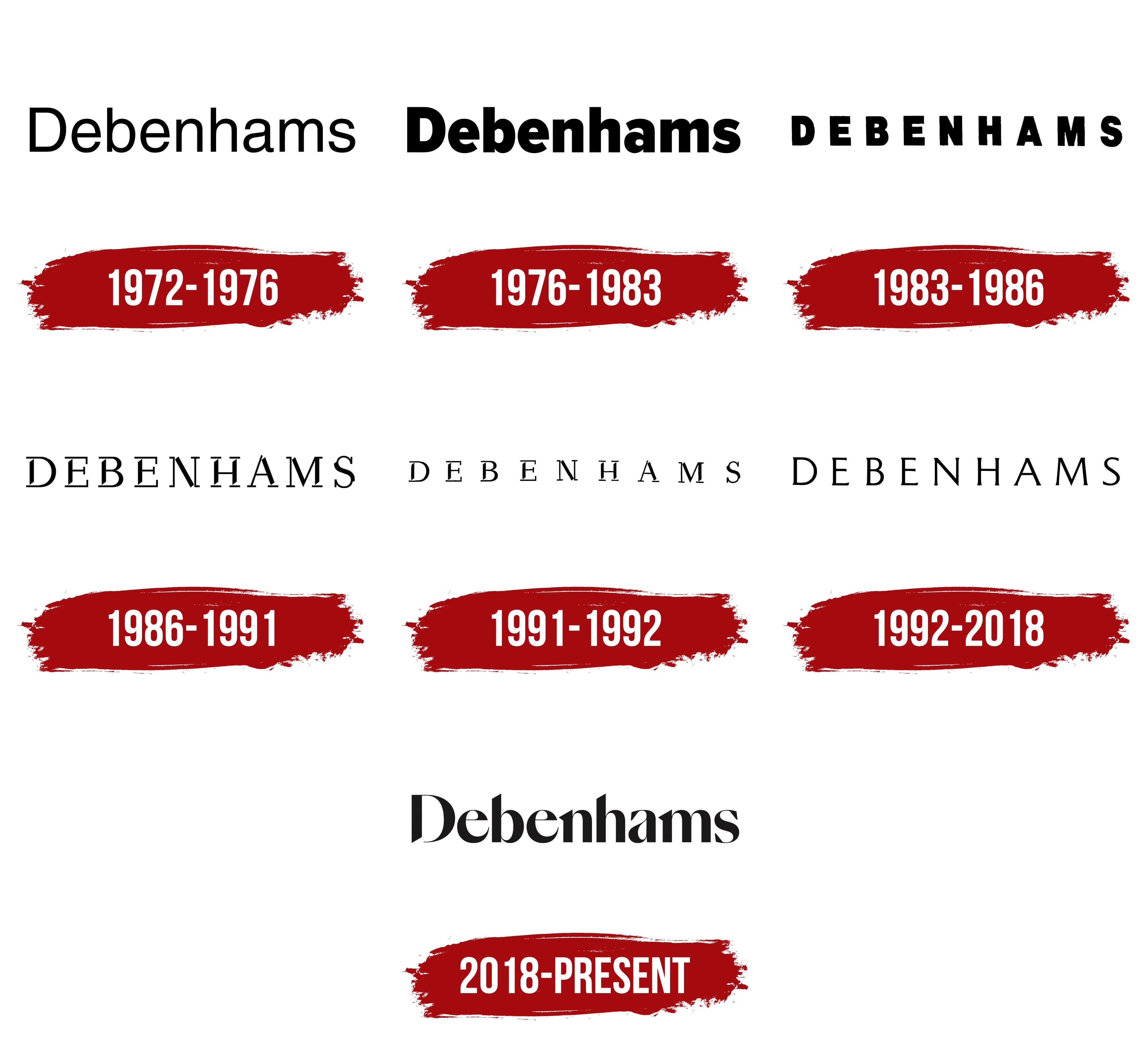
Over two centuries, the British retailer used different logos; the information has not survived. What is known is that it changed its name frequently – hence the signs on the stores alternated as well. The company became Debenhams Limited in 1905 and, after about 15 years, introduced a single corporate image for all its stores.
1972 – 1976
In 1972, the United Drapery Stores retail group almost bought Debenhams, but the deal was never completed. At the same time, the store chain adopted a new logo containing simple black lettering on a white background. Its name was a single word written in crisp, sans-serif geometric letters. The font in use at the time has many equivalents, such as Yoxall Regular by Roger White, Mytupi Regular by Álvaro Thomáz, Sequel Sans Body Book by OGJ Type Design, Protestant – DGL Regular by Digital Graphic Labs, Nimbus Sans L Regular by URW++, or FreeSans Medium by GNU FreeFont.
1976 – 1983
The wordmark, created in the mid-1970s, differed from the previous version in its bolder lettering. Its main feature was the oblique cuts at the ends of the “e,” “a,” and “s.” This typeface most closely resembles Kylo Sans Extra Bold from The Northern Block Ltd. It also shows some similarities to FullerSansDT Black by DTP Types, Fuse V.2 Display Black by W Foundry, and Verb Extra Condensed Ultra by Yellow Design Studio.
1983 – 1986
In the 1980s, designers converted the lettering to uppercase and used a grotesque with narrower, bolder letters. Of the modern fonts, it is roughly similar to Artica Condensed Black by Cretype.
1986 – 1991
In 1986, the design of the word DEBENHAMS changed again. It is based on a high-contrast, fine, long-serif typeface, and the ends of the base strokes are all cut at the same angle, as in stencil typefaces. The closest counterpart to this antiqua is Quisnue Regular by Leandro Ribeiro Machado, designed in 2016.
1991 – 1992
In the early 1990s, the designers made the lettering more readable by increasing the letter spacing. The signs themselves were naturally reduced in size.
1992 – 2018
The 1992 version looked much more elegant than its predecessors. The logo’s authors optimized letter spacing, shortened the serifs, removed pucker, and aligned line thicknesses. This font is similar to Shinntype’s Paradigm Pro Light but with narrower, flatter serifs.
2018 – today
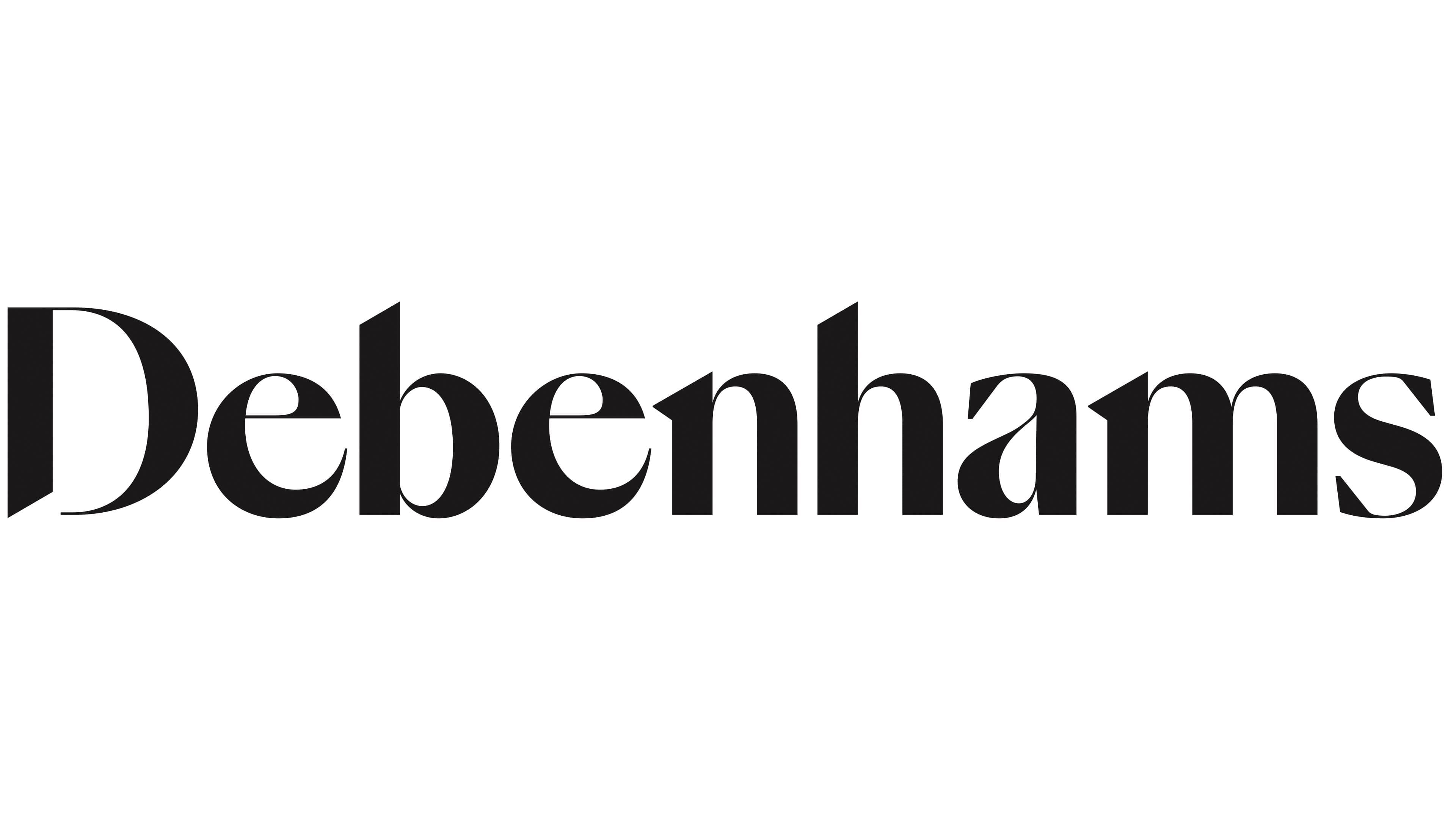
After 20 years in the doldrums, the department store chain launched a marketing campaign that it hoped would attract customers and help it cope financially. Mother Design, a subsidiary of Mother agency, developed the visual identity. They wanted to showcase Debenhams’ dynamic look while retaining its 200-year heritage. They collaborated with the Swiss Typefaces foundry to create the new font.
On September 3, 2018, the wordmark appeared on the website and storefronts, similar to all previous versions, and it, too, featured the company’s name in black on a white background. Almost all letters were lowercase, except the first, as in the pre-1983 versions. Many of the vertical lines had slices, echoing the design of the 1986-1992 logos. The “n”, “a”, “m”, and “s” had large triangular serifs. The contrasting stroke thicknesses and the smooth, rounded shapes created a sense of dynamism.
Font and Colors

For 243 years, the department store chain Debenhams used its signature as its logo, making it recognizable despite its lack of a global reputation. But all attempts to signal change and attract customers’ attention through visuals failed: even the wordmark adopted in 2018 didn’t save the company from liquidation. However, the design team was confident in its winnability and considered the balance of “modernity and classicism” highly successful. The vintage style, harking back to the 1960s and 1970s, was meant to appeal to a core demographic and evoke nostalgia.
The font for the latest Debenhams logo was based on SangBleu and combined characteristics of both grotesque and antique styles. Mother Design and Swiss Typefaces created it to reflect the brand’s long typographic heritage while blending it with modern design. The letter-spacing wasn’t too wide, and the lettering was easy to read thanks to the contrasting stroke thickness and the conical shape of some lines. The unchanged black-and-white palette demonstrated the department store chain’s stability and accessibility.