


 DePaul Blue Demons Logo PNG
Athletes at “Roman Catholic University” use the name and symbolism of a diabolical organization. The DePaul Blue Demons logo distinguishes 15 teams and features a clever, powerful mascot. A play on words gave rise to a mascot whose cunning and strength became the players’ defining traits.
DePaul University’s athletic story in Chicago is closely tied to basketball. Founded in 1898, the program rose under Ray Meyer’s tenure, which began in 1942. In his first season, he led the team to the NCAA Final Four alongside freshman George Mikan, challenging the idea that tall players lacked mobility.
In 1945, DePaul won the NIT title, which was then considered equal to or superior to the NCAA Tournament. Mikan scored 53 points in a semifinal against Rhode Island and finished as MVP. He later became one of the first dominant NBA centers and was inducted into the Hall of Fame.
Meyer coached from 1942 to 1984, attended 1467 consecutive games, and finished with 724 wins. In 1978–79, led by Mark Aguirre, DePaul reached another Final Four, defeating UCLA and USC before losing to Larry Bird’s Indiana State. Aguirre became the No. 1 NBA draft pick in 1981, selected by the Dallas Mavericks.
In the early 1980s, DePaul entered three NCAA Tournaments as a top seed but exited in the first round each time. In 1984, Joey Meyer replaced his father and led the team to multiple NCAA appearances, including a 26:2 season in 1986–87, before losing to LSU.
After the Meyer era, the program moved through conferences, joining the Great Midwest in 1991, Conference USA in 1995, and the Big East Conference in 2005. The last NCAA Tournament appearance came in 2004 under Dave Leitao, ending with a loss to Connecticut. Rivalry with the Marquette Golden Eagles remained a key part of the program’s identity.
Meaning and History
What is DePaul Blue Demons?
The DePaul Blue Demons are an intercollegiate program comprising 15 student-athletes from DePaul University in Chicago, Illinois. The sports team is a member of the Big East Conference and competes in NCAA Division I.
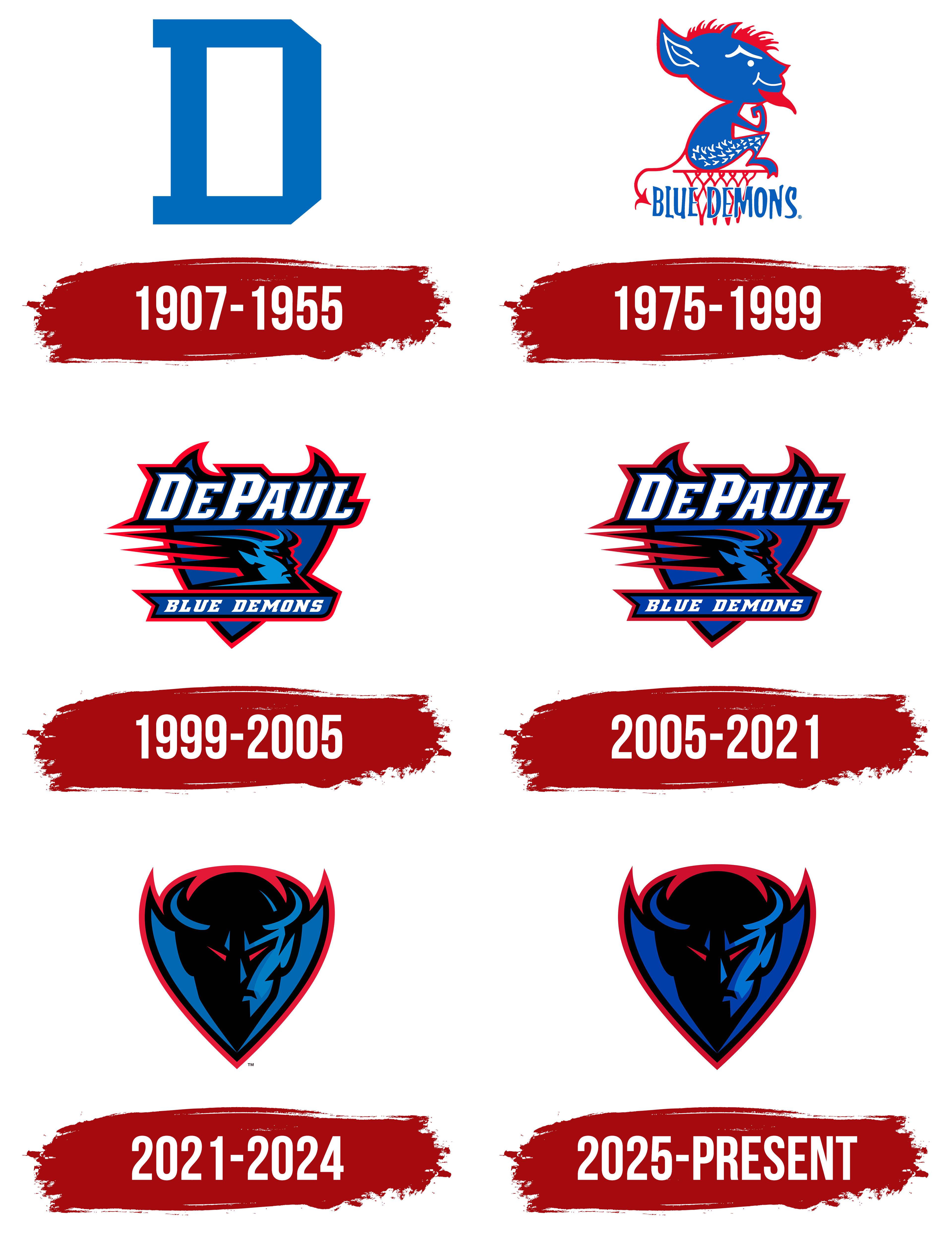
1907 – 1955

The “D” in DePaul’s early imagery gave rise to the Blue Demons nickname. After the letter appeared on uniforms, players became known as D-men. The similar sound led to “Demons,” connecting the team name to the university’s initial.
The DePaul Blue Demons represent DePaul University, a Catholic institution in Chicago. The Vincentians founded it in 1898 as St. Vincent’s College. In 1907, it was renamed DePaul University in honor of St. Vincent de Paul, the 17th-century French priest who founded the Congregation of the Mission. A large “D” replaced the St. V. initials on athletic uniforms.
The teams initially went by several names. Issues of the student newspaper The DePaulia from 1924 and 1925 used D-Men, Demons, and Blue Devils. Blue and red were already part of the athletic tradition. University teams wore red uniforms with blue lettering. At the same time, the affiliated DePaul Academy reversed the combination, placing red letters on blue.
The early emblem consisted of a standalone blue “D.” Heavy rectangular slab serifs extended from the left side. At the same time, the outer corners on the right were clipped. The interior opening was rectangular, and the strokes were nearly uniform in thickness, giving the letter a heavy appearance. The initial identified DePaul.
1975 – 1999

Billy Blue Demon introduced a cartoon mascot to DePaul’s letter-based imagery. The university credits alumnus Joe Wozniak and appearances in The DePaulia during the 1970s with the little demon’s creation. By the middle of the decade, Billy was depicted sitting on a basketball rim. The hoop connected the emblem to the sport, bringing recognition to the university’s teams.
Billy sits sideways, smiling and resting his chin on one hand. His oversized head has pointed ears, short horns, and a small beard. A long tail ends in an arrowhead. The figure is filled in blue. Red defines the outlines, hair, beard, tail, and basketball net, while white openings separate small facial and body details.
Only the team nickname, BLUE DEMONS, appears beneath the hoop. The tall, narrow letters vary in shape and sit along a slightly uneven baseline, complementing the hand-drawn illustration.
In the summer of 1978, artist and instructor Mark Elder painted Billy on the court at Alumni Hall. The image accompanied the Ray Meyer basketball era, appearing on pennants, fan apparel, and television broadcasts of games.
1999 – 2005

DePaul’s late-1990s branding update began with a debate over the future of the team name and mascot. In August 1998, during the university’s centennial, President John Minogue proposed reconsidering both. The discussion included whether a demonic figure suited a Catholic institution. Students and alumni supported Blue Demons. Across various surveys, supporters of the existing name outnumbered opponents by ratios ranging from 4 to 1 to 8 to 1.
In September, the university announced it would retain the name and develop a new image. The debate even took an unusual turn when NASA Administrator Daniel Goldin suggested calling the teams the DePaul Supersymmetric 11-dimensional Cosmologists.
The university commissioned New York agency SME Power Branding. James Doyle, vice president for student affairs, oversaw the yearlong project for DePaul. SME’s Christopher Marchiani discussed the proposed mascot with students, faculty, staff, alumni, and fans. The designers produced about 80 initial concepts. University leaders considered the seated Billy too passive and good-natured. His successor was intended to convey strength, speed, and readiness to compete while representing the university’s various teams.
The first unveiling was scheduled for October 14, 1999, at a preseason basketball luncheon. The following day, students and parents saw the updated mascot at Midnight Madness. The primary logo was part of a set of 17 marks. Black joined the traditional royal blue and scarlet, and custom lettering was developed for DePaul and Blue Demons.
The primary emblem centers on a shield resembling the university’s coat of arms. Inside is a demon in profile, with an angular face and long, pointed horns. The head faces right, with sharply tapered streaks extending to the left. Light blue areas define the face, black creates shadows, and red traces the profile and surrounding shapes.
White DePaul lettering sits above the shield, leaning to the right, with enlarged “D” and “P” initials and sharply pointed stroke endings. Horns project from either side of the name. A blue ribbon bearing white BLUE DEMONS lettering fills the lower portion. A shared red outline joins the text, shield, and head into one silhouette.
The set offered several versions of the demon. The profile could be paired with a “D,” a front-facing head appeared inside a shield, and another version showed the full figure. Wordmarks and portions of the primary illustration were available for standalone use. A smiling little demon flexing his muscles was intended for children. The shared mascot connected the various sports, while the basketball hoop became optional.
2005 – 2021

DePaul made slight color adjustments to the Blue Demons emblems in the mid-2000s. Blue and scarlet became darker, and the background and outer border were revised.
The shield’s arrangement remained intact. The demon’s profile, the streaks behind the head, the horns above the name, and the lower ribbon stayed in place. Differences between successive versions were mostly color changes, with minimal changes to the drawing.
2021 – 2024
In 2021, the front-facing demon head, previously a secondary mark, became DePaul’s primary emblem. The compact head replaced the shield containing the profile and two lines of lettering. The update reassigned the roles of existing marks.
Narrow, angled red eyes stand out against the nearly black face. Blue and light blue areas define the horns, cheekbone, nose, and chin. Pointed edges rise along the sides of the head, and the silhouette tapers to a point at the bottom. A red line surrounds the entire image.
Guidelines effective July 1, 2022, established uses for two primary versions. Primary 1A consisted of the standalone head. It was used when the university’s identity was evident from the context or when its name appeared elsewhere in the design. Primary 1B paired the head with DePaul and was intended for applications requiring the university’s name within the emblem.
The secondary set retained a stylized “D” and a DePaul Blue Demons wordmark. Athletic lettering used the Blue Demon typeface, reserved exclusively for the university’s athletic identity.
2025 – today
DePaul’s July 2, 2025, update retained the front-facing demon head as the primary emblem. The drawing received minor revisions during an eight-month effort to establish shared branding guidelines for the teams. Athletic department staff, an outside agency, and university branding specialists worked to align the athletic marks with DePaul’s standards. Some earlier marks were retired from general use.
The head’s edges were refined, and the color contrast was increased. A separate highlight on the forehead was removed, and the shapes framing the sides of the face were changed to dark blue. The red eyes, horns, and pointed base remained intact. Slight color adjustments preserved the demon’s familiar appearance.
DePaul Blue, Pantone 293 C, was designated the primary color. Scarlet, light Billy Blue, and black became supporting colors used to distinguish areas of the artwork and create contrast.
The vintage Billy Blue Demon collection was expanded, retaining the mascot for merchandise and other approved uses. Sports versions featuring a basketball, tennis racket, golf club, and softball bat joined the seated figure. The set gained a running demon, soccer and volleyball players, and a musician playing a trumpet. Different fills for the body, hair, and beard were prepared for light and dark backgrounds, so Billy’s facial features would remain visible against either.