


 Dia Logo PNG
Scale and breadth are embedded in the Dia logo. The emblem’s symbols suggest a large international network where purchases are profitable. The owners are passionate about what they do, ensuring delicious, fresh products on the shelves.
DIA, short for Distribuidora Internacional de Alimentación, began in 1979 with its first store on Valderrodrigo Street in Madrid’s Saconia district. The brand was built around the hard-discount model, with small neighborhood stores, limited assortments, and low prices. In 1984, it introduced private-label products in red-striped packaging, and in 1989, it launched a franchising program to accelerate expansion.
In the 1990s, DIA moved abroad. It entered Portugal in 1993 by acquiring Minipreço, then expanded into Greece in 1995, Argentina in 1997, and Turkey in 1999. A major shift occurred in 2000, when Carrefour Group took control of DIA following its merger with Promodès. Under Carrefour, DIA entered Brazil in 2001 and China in 2003 through a joint venture with Lianhua Supermarket Holdings. In 2007, it bought 251 Plus stores in Spain from Kaiser’s Tengelmann for 200 million euros.
In 2011, Carrefour spun DIA off as an independent company. Its shares were listed in Madrid at 3.5 euros on July 5, and on January 2, 2012, DIA joined the IBEX 35. Expansion continued with the 2013 purchase of 1,127 Schlecker stores, later rebranded as Clarel, and the 2014 acquisition of El Árbol for 1 euro, followed by the acquisition of 160 Eroski stores for 146 million euros.
The rapid growth created overlap and weak locations. From 2015 to 2019, DIA closed about 700 Spanish stores, and it sold its China business to Suning in 2018. After DIA left the IBEX 35 in late 2018, LetterOne acquired it in 2019. A 2021 share issue raised 1.028 billion euros, and in August 2022, Martín Tolcachir became CEO.
Meaning and History
The Dia chain comprises several supermarkets, including the 24-hour DIA & Go, the large DIA Maxi with parking, and the standard DIA Market, which sells perishable products. Regardless of the format, their overall concept is to maximize savings that keep prices down. To cut costs, the company relies on bulk purchasing, avoids unnecessary finishes and furniture, simplifies logistics, reduces advertising spend, and sells a limited range of European brands.
In such circumstances, its logo is a key marketing tool because it should attract customers’ attention. The bright red sign above the store entrances is associated with the range, which is selected based on quality and safety principles. Its design has changed several times, but we cannot say that these changes were drastic.
What is Dia?
Dia is a large-scale supermarket chain that distributes food, personal care, and household products. It is a Spanish company, but many of its stores are located outside of Spain; among the 6,000 stores it owns are those in Argentina, Brazil, and Portugal. Among them, more than 2,500 outlets are franchised.
1979 – 2009
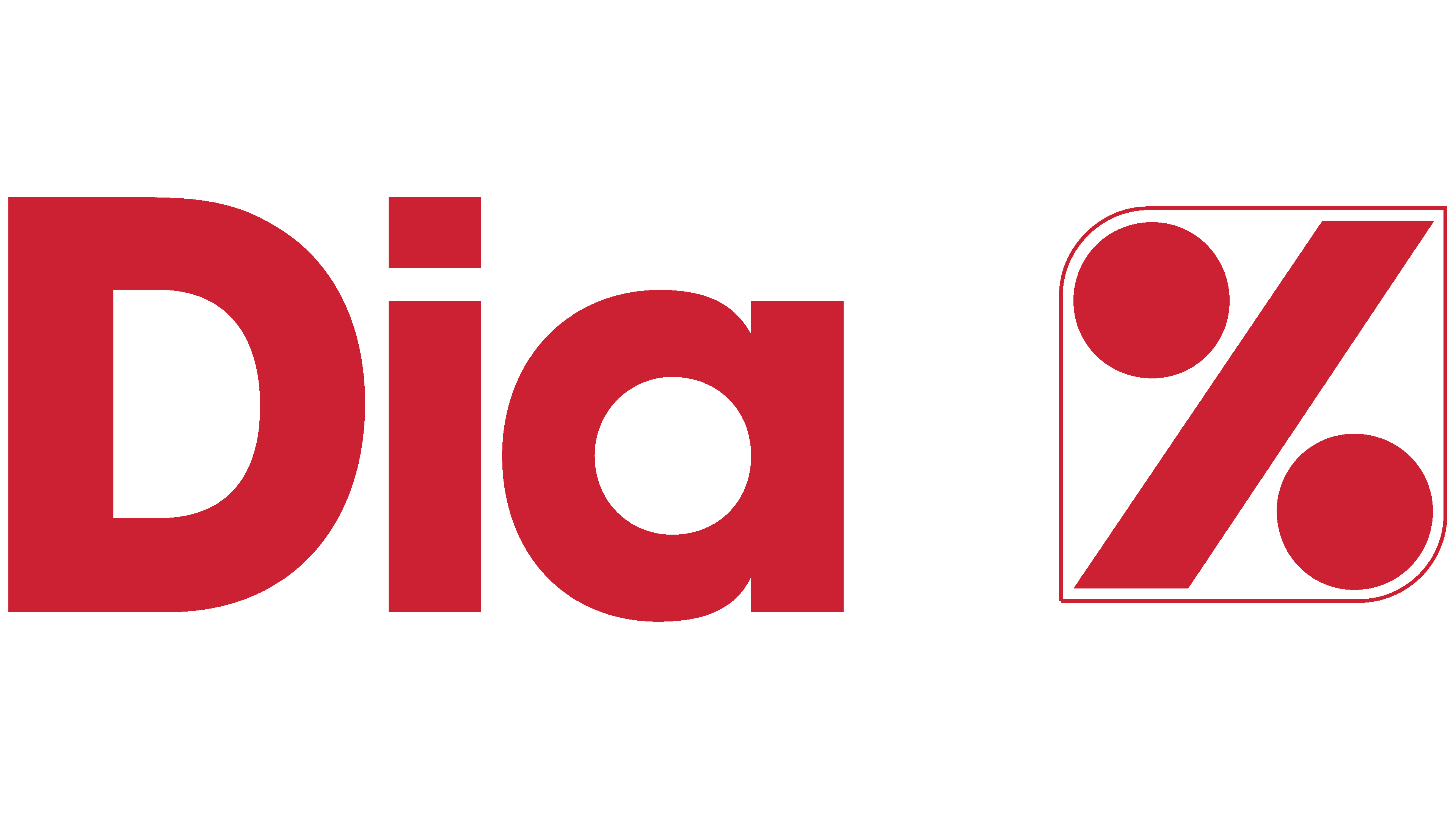
In 1979, the first discount store opened in Spain, giving rise to an entire retail chain. But the corporate image was finally formed by 1984, when the first own-brand Dia goods went on sale. The company logo featured its name in three letters. The first “D” was lowercase, while the “i” and “a” were lowercase. The lettering used a bold sans-serif, similar to Avalon Bold by FontSite Inc. or Galano Grotesque Bold Demo by Rene Bieder.
The main discount symbol, the percent sign, was to the right of the word. It contained a diagonally elongated parallelogram with two circles above and below. The designers placed it in a thin, square-shaped red frame with two rounded corners (opposite the circles).
2009 – 2020
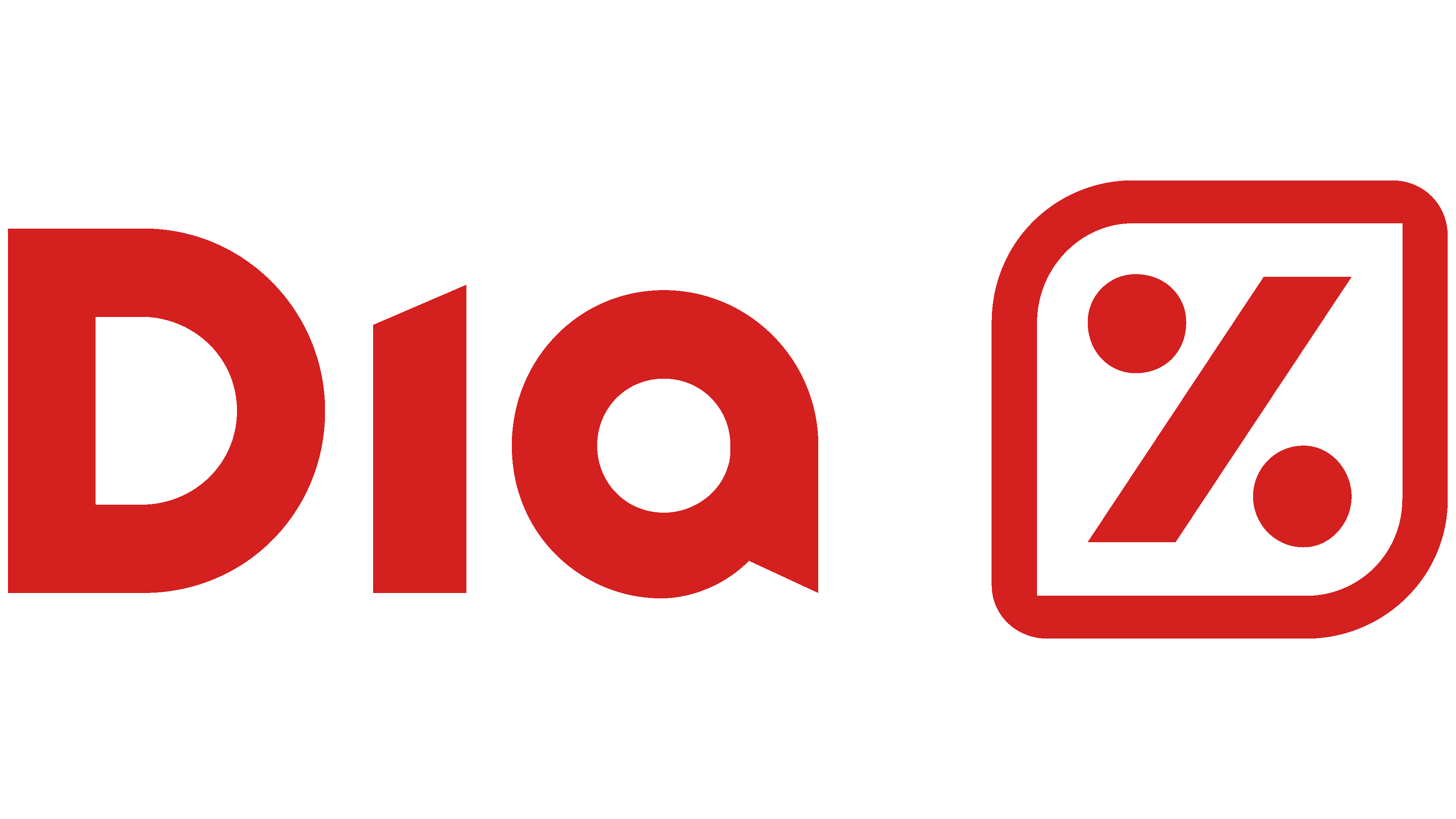
By the end of the 2000s, the retail chain had expanded beyond Spain and introduced innovative store formats. Therefore, it needed a new, more modern logo to reflect its growth. But the company did not want to experiment with style: it was completely satisfied with the previous concept. So they kept the red lettering; the developers only slightly changed the font, giving the “a” a round ring shape with a triangular ledge at the bottom and removing the square dot above the “i.” In doing so, they cut off the top corner of the vertical “i” stroke, reduced the percent sign, and made its border bold.
2020 – today
In 2019, LetterOne became the majority shareholder of DIA Group. It gained full control of the chain by buying 69.76% of the shares. Under her leadership, the stores have a new logo, a simplified version of the previous one. The designers removed only the percentage sign from the frame, leaving the brand name unchanged. The hint of discounting is gone, as it was assumed that customers already know the benefits of discount supermarkets.
Font and Colors
Although the current Dia trademark consists only of an inscription, it can be considered symbolic from a linguistic perspective. The company name is an acronym for the phrase Distribuidora Internacional de Alimentación and also a metaphor, as the word “dia” translates from Spanish as “day.” It alludes to the daily (and in some cases, 24-hour) availability of stores. Moreover, a day is associated with the beginning of something new, with prospects and the possibility of development.
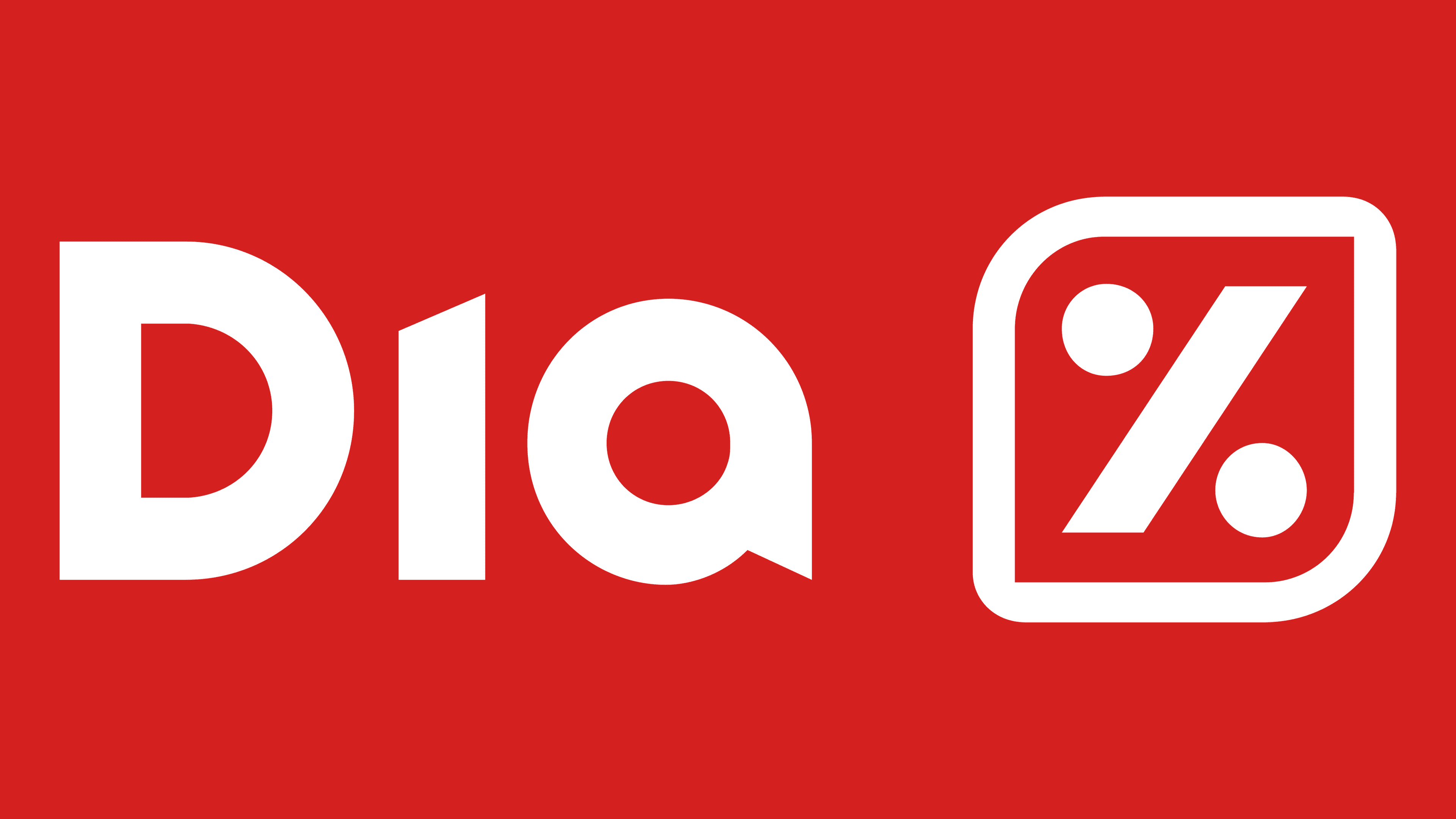
The designers used a set of individual glyphs rather than the standard font to make the logo distinctive. Only the uppercase “D” looks like a bold, sans-serif letter, and it hasn’t been changed since 1979. You can find analogs in many typefaces, including Strenuous Heavy from Typodermic Fonts Inc., SF Espresso Shack Bold from ShyFoundry, Noyh Geometric Black from Typesketchbook, Vedo Extra Bold from Wiescher-Design, and Adequate Black from K-Type. The lettering color has always remained red, although the developers have experimented with shades. Now, the palette is based on Fiery Red (#d51a19).