


 DirecTV Logo PNG
The DirecTV logo demonstrates how advances in space technology can create a strong, large television and radio company. The emblem conveys flight and the dissemination of information through waves and wires.
DirecTV’s roots go back to Hughes Aircraft, founded by Howard Hughes in 1932. After General Motors bought Hughes Aircraft in 1985, it combined it with Delco Electronics to form Hughes Electronics Corporation.
In 1990, Hughes Electronics created DirecTV as part of Hughes Communications. The plan was to deliver digital satellite TV directly to homes through a small 46-centimeter dish, replacing the large analog antennas common at the time.
Hughes partnered with United States Satellite Broadcasting, or USSB, to build the first high-power direct-broadcast satellite system. The first DirecTV satellite launched on December 17, 1993, and official service began on June 17, 1994.
DirecTV and USSB offered more than 75 digital channels, with subscriptions starting at $21.95 per month. A second satellite in August 1994 expanded the channel lineup. By the end of the first year, DirecTV had passed 1 million subscribers. In 1996, Dish Network, a subsidiary of EchoStar, became its main satellite rival. DirecTV answered through acquisitions, buying USSB for $1.3 billion in 1998 and PrimeStar in 1999. By the end of 1999, it had 7.8 million subscribers.
In 2003, Rupert Murdoch’s News Corporation acquired a 34% controlling stake in Hughes Electronics. In 2004, the company became The DirecTV Group. AT&T bought DirecTV for $67.1 billion in 2015. By 2017, DirecTV had 21 million subscribers, far ahead of Dish Network. Streaming later weakened the model, and in 2021, AT&T sold a 30% stake to TPG Capital. On July 2, 2025, TPG completed the purchase of the remaining 70% for $7.6 billion.
Meaning and History
The firm that became the basis for the satellite service was manufacturing rockets, airplanes, and helicopters. What’s left of Hughes Electronics now represents the broadcasting industry and competes with cable TV providers.
Naturally, the sharp change in priorities and many rebrandings affected the visual identity. Another factor that influenced the identity was DirecTV’s transfer to the international conglomerate AT&T in mid-2015.
What is DirecTV?
This company provides satellite broadcasting services in the United States and other American countries. It was launched under its current name in mid-1994. Its predecessor is the Hughes Electronics Corporation.
1985 – 1990

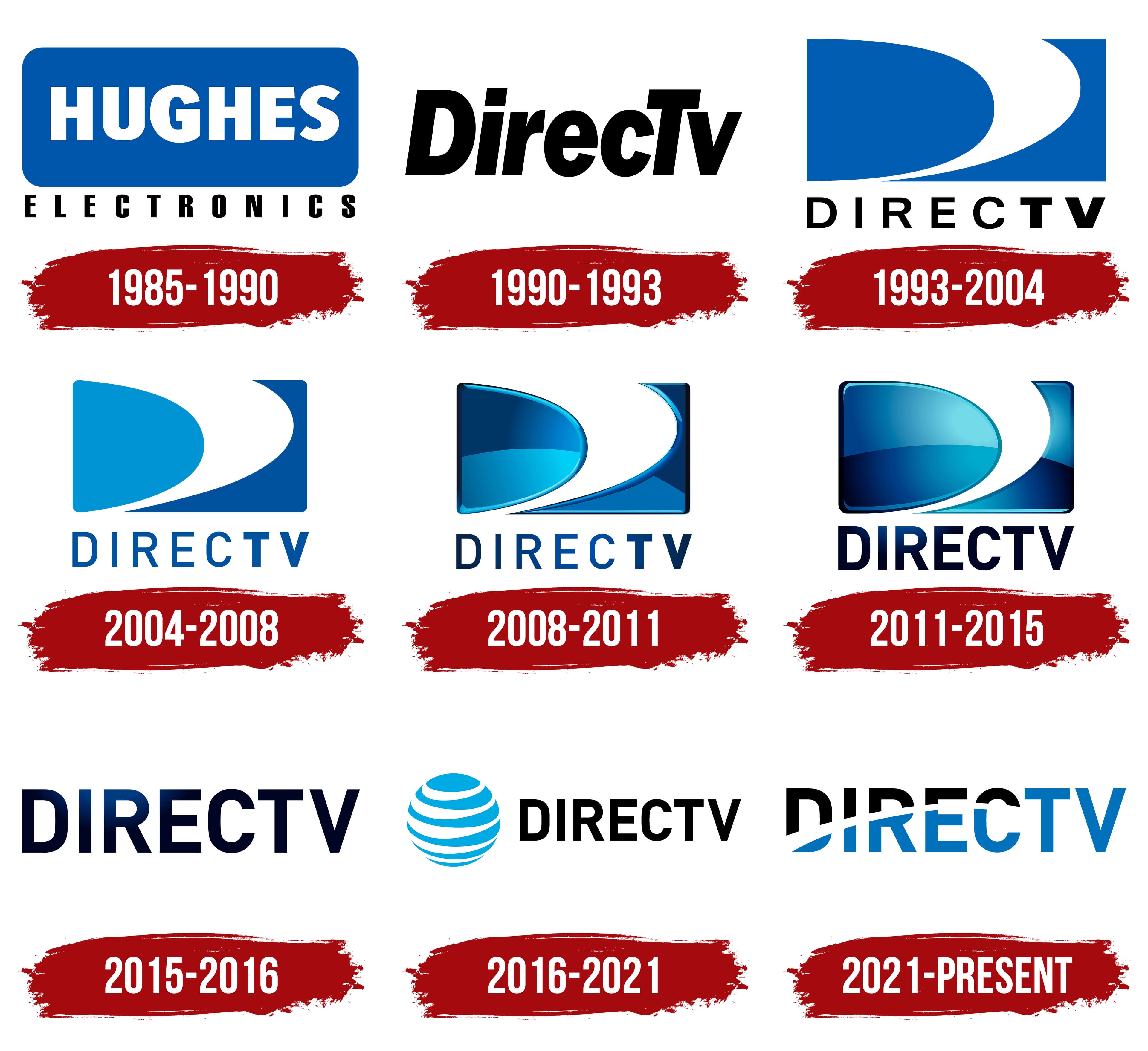
DirecTV’s first predecessor was the Hughes Electronics division, created in 1985 and based in General Motors. Its logo resembled its parent company’s: a blue rectangle with white lettering inside. Only the subsidiary brand used a rounded rectangle, complemented by a gray bar at the bottom. The word “HUGHES” appeared in white on a blue background, and “ELECTRONICS” in black on gray.
1990 – 1993
Hughes Electronics launched satellite broadcasting services under the DirecTV brand in the early 1990s. Initially, the channel had a simple black-and-white logo with one letter. The typeface was unremarkable: a standard oblique sans serif with tight letter spacing.
1993 – 2004
In 1993, the first version of the famous swirl emblem appeared, resembling the letter “D.” The designers combined a blue rectangle borrowed from Hughes Electronics with a curved white line that widens at the top into a funnel. The image was followed by a black sans-serif, “DIRECTV.”
2004 – 2008
News Corporation carried out the next rebranding. It bought out the remnants of Hughes Electronics, including the DirecTV brand, and named the combined company DirecTV Group. But this barely affected the logo: the new owner only rounded the rectangle’s sides, repainted the left part of the figure in blue, and made the inscription blue. The font changes were minor and only concerned letter heights.
2008 – 2011
When Photoshop effects arose, the designers added shadows, highlights, and gradients to the emblem. As a result, the image has acquired a three-dimensional appearance. The inscription also featured color transitions, but it remained flat because the letters lacked well-defined edges.
2011 – 2015
In 2011, another transformation occurred, altering the shape of the D-shaped vortex within the rectangle. The logo became more voluminous as the developers experimented with the color arrangement, darkened the edges, and increased the gradient.
2015 – 2016
In mid-2015, telecommunications conglomerate AT&T acquired DirecTV from its former owner to expand its content range. In terms of identity, it was a transition period between the classic blue-and-white letter “D” and the new design introduced in 2016. The brand used the inscription from the old logo, abandoning the classic swirl in the rectangle.
2016 – 2021
A few months after the purchase, AT&T donated its globe-shaped brand name to DirecTV. The changes came into effect on January 1, 2016. The striped globe symbolizes the broadcasting corporation’s global nature. It sits to the left of the caption, which remains unchanged except for the loss of the gradient. Now, the word is completely black.
The classic DirecTV emblem resembles the letter “D” but is a mini-tornado. Perhaps the designers wanted the drawing to symbolize expansion, or it happened by accident due to the similarity to “D.” Be that as it may, the iconic icon ceased to exist – an equally abstract globe replaced it. A white ribbon wraps around the globe, representing worldwide telecommunications. The same element, unofficially named “Death Star,” is depicted on the AT&T logo. Artist Soul Bass invented it in 1982.
The inscription is based on the DIN Pro Bold font, developed by the typographer Albert-Jan Pool in 2005 and owned by FontShop International GmbH. Its characteristic features are bold lettering, uniform line thickness, no serifs, and many corners. The company chose this typeface for its crispness and legibility.
Next to the black inscription is a white-and-blue globe. Blue is the main color, and white only complements it. DirecTV’s current parent company, AT&T, uses the same palette.
2021 – today

After the contract ended, the broadcaster redesigned the visual identity mark. She removed the AT&T globe from the logo and enlarged the text portion. The developers kept the same font but stylized the inscription. Now, the name “DIRECTV” is color-separated: the abbreviation “TV” is fully blue, and the word “DIREC” is blue and black. This effect was created by transferring the line from the globe, which was previously present on the emblem; it had similar tapering stripes. The update has made the logo simpler and easier to read.
Font and Colors
The emblem’s redesign did not affect the typeface; it remained the same. The only change is the inscription’s appearance, which now has a curved line resembling a semi-arch. A narrow white stripe divides the letters into blue (bottom) and black (top).
FAQ
What is the DirecTV symbol?
The symbol is a “D” logo introduced in 1993. This emblem, used in various forms until 2015, became iconic. The brand launched its satellite television service on June 17, 1994, and quickly became well known.
The “D” logo represents DirecTV’s commitment to delivering high-quality satellite television. It has been updated several times to stay modern and relevant, reflecting changes in brand strategy and visual uniqueness. The simple and elegant “D” design helps it stand out in a competitive market and become familiar to millions of viewers.
Does DirecTV have a logo?
The company introduced its “D” logo in 1993. This symbol quickly became a key part of the brand’s identity and was used in various forms until 2015, reflecting changes in its branding strategy.
The “D” logo represents the brand’s commitment to delivering high-quality satellite television service. Over the years, it has been updated to stay modern and relevant.
Its simple and elegant design helps it stand out in a competitive market and become familiar to millions of viewers. The logo’s different forms over the years show the brand’s adaptability and efforts to evolve.
Does AT&T own DirecTV?
Yes, AT&T bought a majority stake in DirecTV in 2015. AT&T now owns 70% of the shares. Since 2021, the investment company TPG Capital has held the remaining 30%.
This acquisition helped AT&T expand its portfolio and integrate DirecTV’s satellite television services. The partnership with TPG Capital brings extra resources and expertise to manage and grow the brand.
Is DirecTV and AT&T TV the same?
No, they are not. DirecTV is a satellite TV brand that operates under its original name. AT&T TV, now rebranded as DIRECTV STREAM, is a streaming service.
DirecTV provides satellite television services with a wide range of channels and packages, delivered to customers’ locations via satellite dishes. This is ideal for those who prefer traditional satellite TV or live in areas where streaming is unreliable.
DIRECTV STREAM offers live TV and on-demand content over the internet. Users can stream channels and shows without needing a satellite dish. This service is perfect for those who prefer the flexibility of streaming and want to access content on various devices.
Who started DirecTV?
Eddy W. Hartenstein, a businessman with a strong background in the media industry, founded the brand. He aimed to create a service that delivered a wide range of TV programming via satellite, providing an alternative to cable TV. Hartenstein played a key role in developing and launching the brand, establishing it as a major player in the television industry.
With his engineering and business expertise, Hartenstein navigated the technical and commercial challenges of starting a satellite TV company. He ensured the company offered high-quality service and a broad selection of channels, quickly attracting many customers.