


 Dollar General Logo PNG
The Dollar General logo promises no-frills and plenty of pleasant emotions. After all, everything costs no more than a dollar. The emblem is simple and captures the general mood of shopping at a retailer. Buy what you need without spending too much; that’s the sign’s motto.
Dollar General began with James Luther “J.L.” Turner, a Kentucky farmer’s son who left school in fourth grade after his father died. During the Great Depression, he found work in liquidation, buying inventory from bankrupt general stores and reselling it at low prices. His son Cal often traveled with him, learning to buy, price, and manage supplier relationships from the ground up.
In October 1939, J.L. and Cal each invested $5,000 to open J.L. Turner and Son Wholesale in Scottsville, Kentucky. The company first sold dry goods to small retailers, but after World War II, that trade weakened. The Turners shifted toward their own stores, and by the early 1950s, they operated 35 department stores in Kentucky and Tennessee, with annual sales above $2 million.
The major change came on June 1, 1955, when Cal converted a Springfield, Kentucky, store into the first Dollar General. The idea came from “Dollar Day” promotions at larger department stores: every item would cost $1 or less. The format worked quickly. By 1957, 29 Dollar General stores were generating $5 million in annual sales.
J.L. Turner died in 1964. In 1968, Dollar General Corporation was listed on the New York Stock Exchange, with annual sales exceeding $40 million. Cal Turner Jr. later expanded the chain to 6,000 stores before retiring in 2002. The company launched literacy programs in 1987, moved its headquarters to Nashville in 1989, and entered the Fortune 500 in 1999. KKR bought Dollar General for $7.3 billion in 2007, and the company returned to public trading in 2009. By 2020, it had about 17,000 stores in 47 states, competing with Family Dollar and Dollar Tree.
Meaning and History
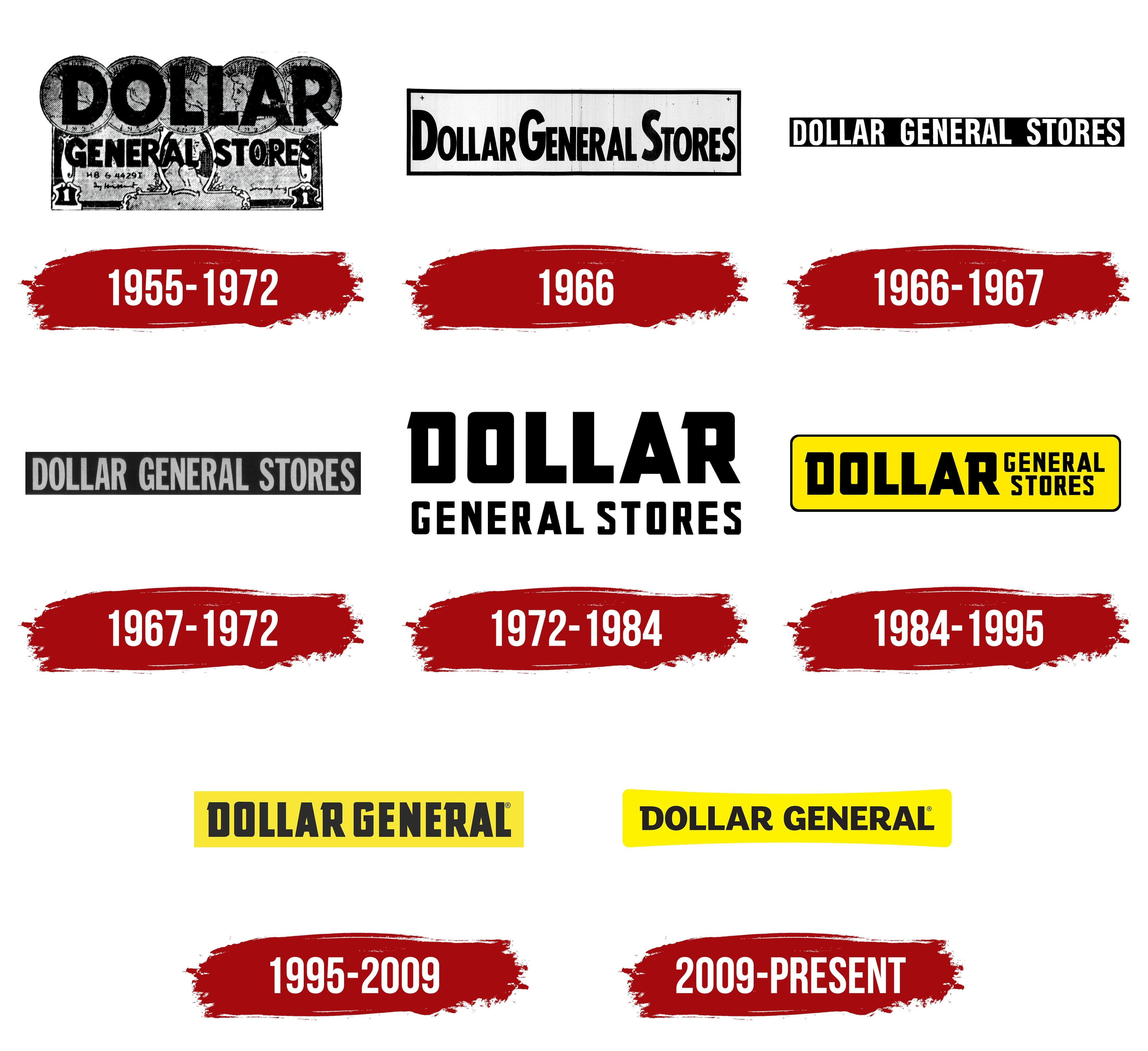
Dollar General got its name from a new concept that set all prices at $1. The idea was inspired by Dollar Days, a popular marketing technique used by other department stores to attract customers.
Dollar General remains recognizable thanks to an identity system that hasn’t changed much since 1984. All of its logos necessarily feature massive, bold lettering. The arrangement of the words and the background is variable. More recently, the text is inside a yellow rectangle, distinguishing the retail chain from its competitors.
1955 – 1972

In 1955, the owners of JL Turner and Son renamed their family business Dollar General and finally established it as a department store retailer. The emblem reflected the new concept, as the artists depicted a dollar bill, identifiable by its portrait of George Washington and the numbers in the lower corners. The bill had a serial number and signature for realism. Across it was the word “GENERAL STORES” in a geometric sans serif font. The word “DOLLAR” was on five coins with the corresponding denomination at the top.
1966
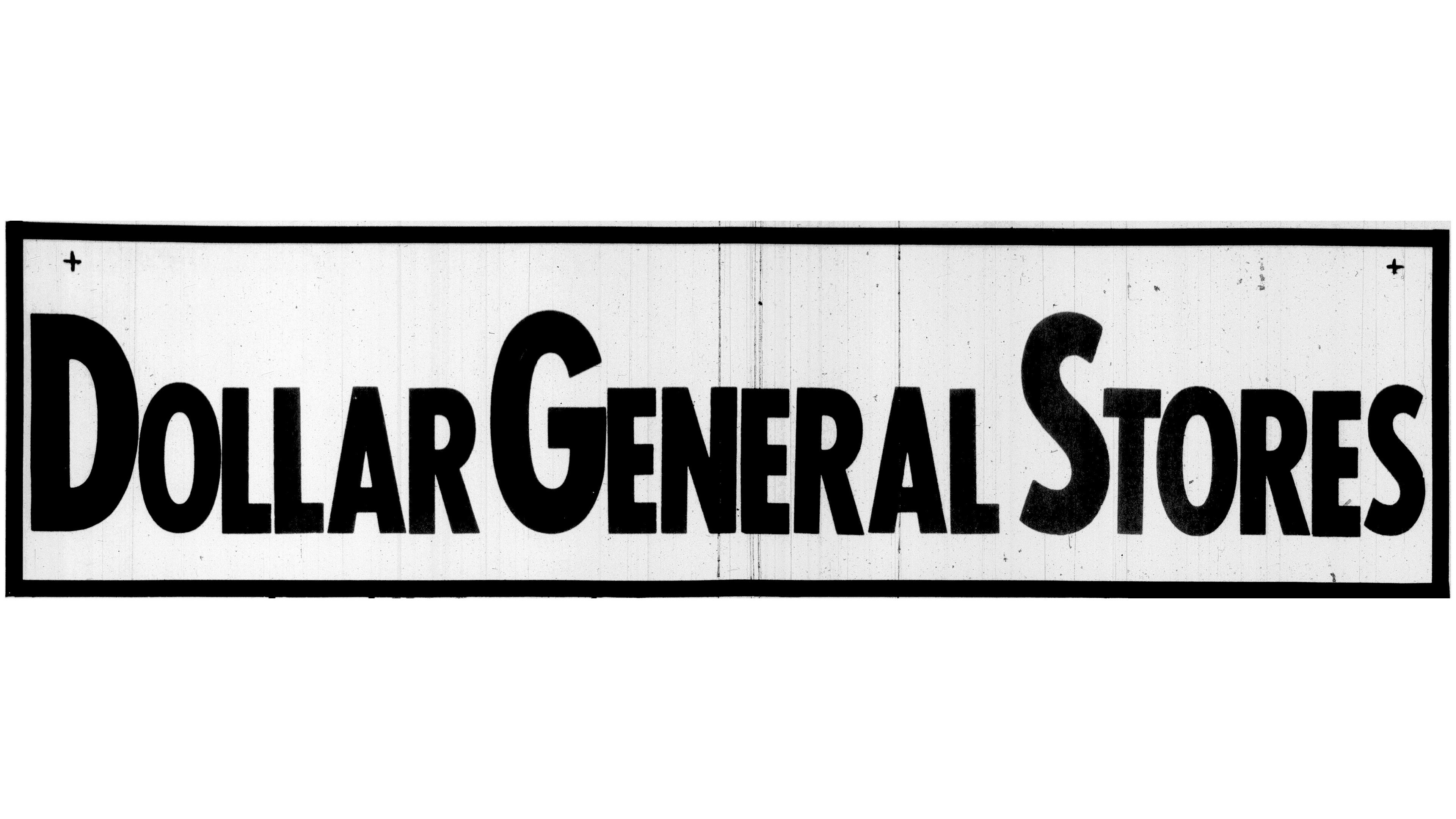
In 1966, another trademark appeared. It contained the inscription “DOLLAR GENERAL STORES” in uppercase. Although all the letters were capitalized, the first “D,” “G,” and “S” were almost half the size of the other characters. Black text filled a gray rectangle with a border. Small crosses in the two corners made the logo look like a sign fixed around the edges.
1966 – 1967

The letters were aligned in height and repainted white in the same year. The background rectangle became black and very narrow, leaving no free space around the lettering.
1967 – 1972
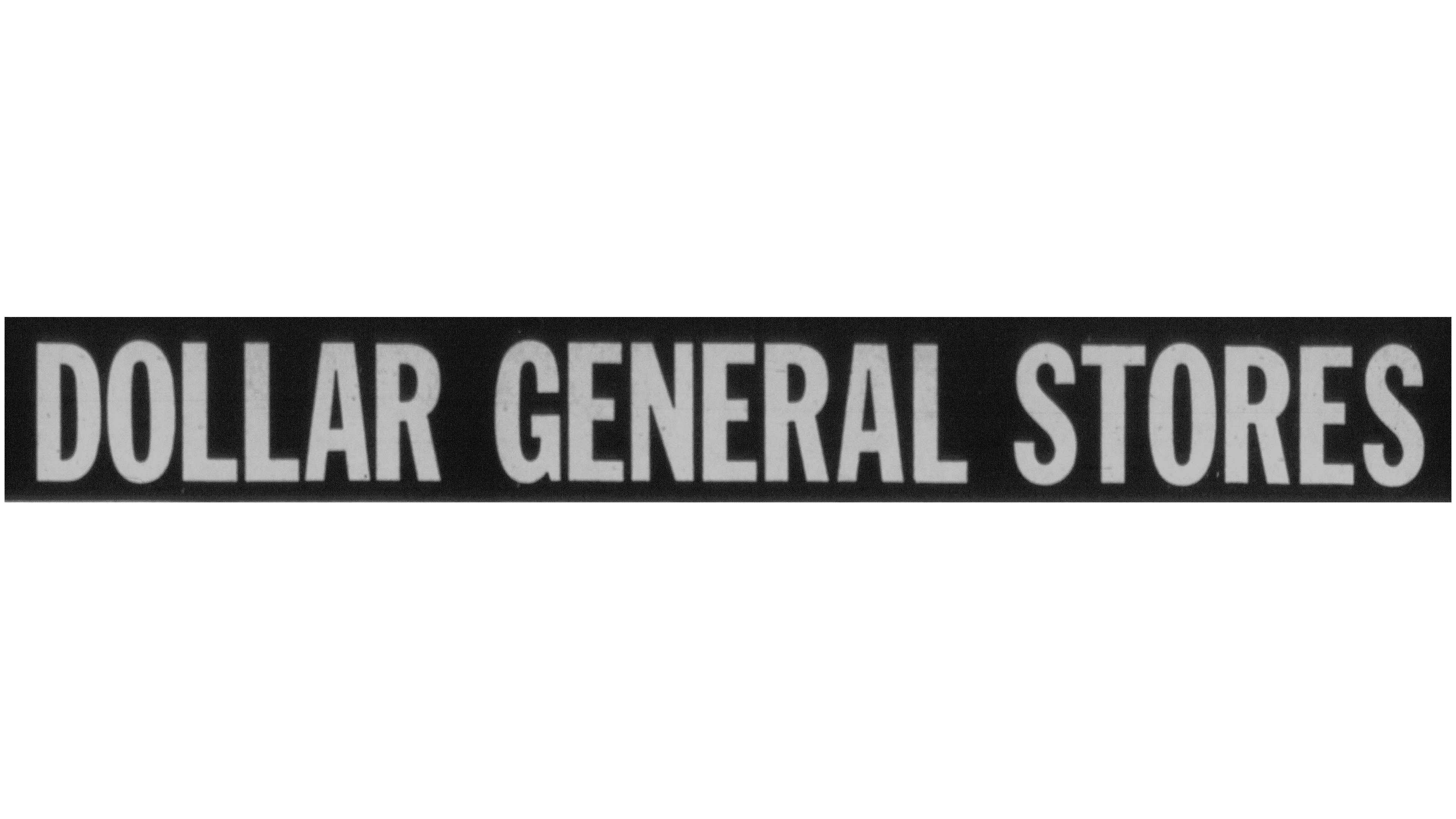
The designers set the background to dark gray and the text to light gray. They also slightly changed the typeface, stretching the letters vertically and adding an extra stroke to the “G ” at the bottom.
1972 – 1984

In 1972, the rectangle disappeared, so the compact inscription was no longer needed. The word “DOLLAR” was enlarged and moved up, and the phrase “GENERAL STORES” took the second line. The letters “D” and “R” were decorated with small triangular serifs. The curves of both “S’s” on the right side formed a right angle.
1984 – 1995
Again, the retail name had a rectangular base with rounded corners, so the words were regrouped. “DOLLAR” was moved to the left, and “GENERAL” and “STORES” to the right, one under the other to save space. The background became yellow with a thin black frame.
1995 – 2009

After a small rebranding, the logo was simplified. The words “STORE” were removed, allowing “DOLLAR GENERAL” to fit on one line. The black inscription turned gray. Seeking a minimalist look, the designers removed the dark outline and rounded the base corners.
2009 – today
In 2009, Dollar General entered a new era. A redesign gave the logo a modern look. First, it changed the font: the letters’ proportions became symmetrical, which they had not been before. The designers kept the traditional “D” serif, though it is now rectangular rather than triangular. The yellow base is now uneven: it has rounded corners and a concave middle.
Font and Colors

Dollar General’s wordmark resembles a sign, so it’s perfect for a chain store. Over the years, it has evolved into an unusual shape that only remotely resembles the original rectangle. This was all done for marketing purposes because rounded corners evoke subconscious consumer confidence.
The font currently used for the Dollar General logo is called FS Lola Bold. Its developer, Phil Garnham, tried to create a sans-serif grotesque, but in the process, he realized he was getting a kind of “semi-Antiqua” lettering with half-serifs. The typographer went even further, combining contrasting elements with soft, rounded corners and angular edges.

The retail chain’s traditional color has been yellow since 1984. Dollar General’s corporate identity pairs this bright hue with its gloomy antagonist, black, the color in which the company’s name is written.