


 Dota Logo PNG
The Dota logo unfolds before the viewer a picture of an extraordinary fantasy world where courage, bravery, and strength are essential attributes of life. The emblem hints at strategy, calculating moves, and mission execution.
Dota began in 2003 in the Warcraft III modding scene, when developer Eul created Defense of the Ancients for Blizzard Entertainment’s Warcraft III: Reign of Chaos. The idea grew from “Aeon of Strife”, a StarCraft mod in which two teams fought through lanes to destroy an enemy base. After The Frozen Throne expansion, Eul stopped updating the map and released its source code, leading to several competing versions.
The key version became DotA Allstars by Steve “Guinsoo” Feak, who combined heroes from earlier builds and added new content. With Steve “Pendragon” Mescon, he created DotA-Allstars, LLC and the site dota-allstars.com, which had over 1.5 million registered users by 2009. Around 2005, Feak left development to Neichus, and later to IceFrog, whose patches turned the map into a major competitive PC project.
In 2009, Mescon joined Riot Games, developer of League of Legends, and the old DotA-Allstars site was closed. IceFrog moved the community to playdota.com. In October 2009, Valve hired him to build a standalone sequel for Steam, while agreements were also made with Eul and other figures from the original project. In 2010, the company filed for the Dota trademark.
The trademark dispute involved DotA-Allstars, LLC and Blizzard Entertainment, which had acquired the company from Riot Games. A 2012 settlement gave the Steam developer commercial rights to the Dota name, while noncommercial use remained allowed. Dota 2 launched in July 2013 on Source. The International grew from a $2.8 million prize pool in 2013 to $34 million in 2019. Later releases included Artifact i(018), Dota Underlords i(020), and Netflix’s Dota: Dragon’s Blood i(021).
Meaning and History
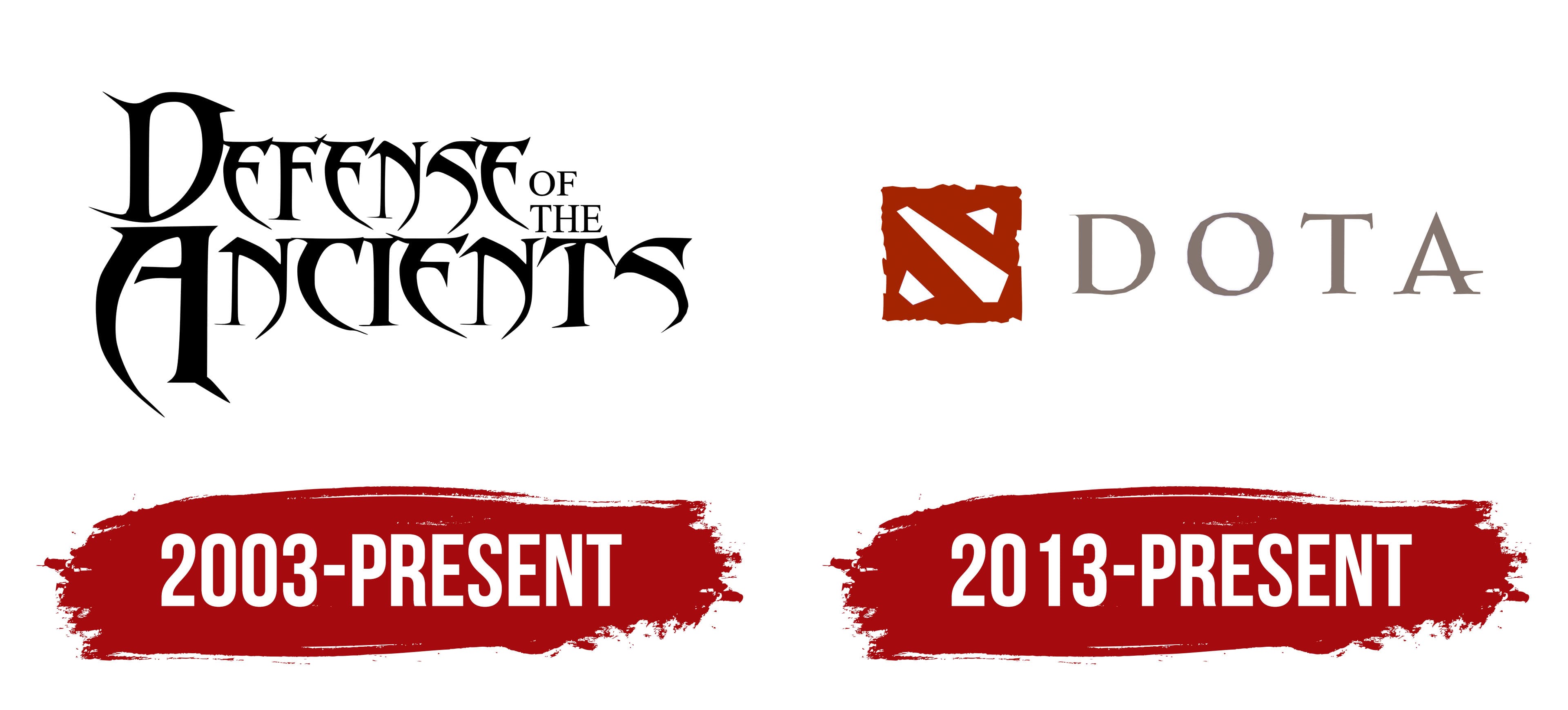
The game has two versions. Fans call them “Dota” and “Dota 2”. Their logos are entirely different because, despite the similar name, different companies developed and own the versions. The first Dota is not quite a separate game. It is a map created in Blizzard Entertainment’s Warcraft III World Editor. The map has many variations, but the most famous are by the designers Eul, IceFrog, and Guinsoo. The fantasy-style emblem fits perfectly within the World of Warcraft universe. Dota 2 is a separate game based on the Defense of the Ancients map, but with different content and participants. Hence, the logo emphasizes the game world’s modifications and features.
What is Dota?
A strategy game in which two teams of five players must destroy an ancient structure in each other’s base. Teams comprise various races with different abilities, powers, and health. Each player controls one of the five characters. Team competitions are part of esports tournaments. The prize pool for the International Dota 2 tournament ranges from $1.6 million to $40 million.
2003 – today

The first emblem is a fantasy-style inscription with modified letters, proposed by developer Eul in 2003. Each symbol has sharp edges and bends that remind:
- In Warcraft III, players use blades, axes, swords, and knives with interesting blade bends, notches, and decorations.
- In the game world, the confrontation has four sides, three of which are non-human: the undead, the horde, and the elves. Their distinguishing features are claws and fangs.
The title “Defense of the Ancients” is arranged in two levels in the logo, with the prepositions downsized and stacked one on top of the other next to “Defense.” Originally, the word ‘ancient’ referred to the tree-house of the night orcs in Warcraft, but later in the game it came to refer to the primary objectives: the World Tree and the Frozen Throne. If either is destroyed, the game ends. Therefore, the gameplay is focused on protecting and attacking these structures. The towers are very ancient, hence the game’s name.
Most of the characters in the emblem are not fully outlined. Their lower parts are transformed into a handle, emphasizing battles, fights, and resource gathering. Small notches on top of the letters cross over one another like swords, creating a sense of confrontation.
The inscription’s overall appearance suggests confusion, intertwined roots and branches, and a thick scrub that participants must navigate. The fog of war initially obscures much of the map.
2013 – today

The game’s emblem was developed to announce Dota 2 in 2010. The logo consists of a drawing and a name. Dota’s main figure is a red cube with three holes. The two side holes are smaller, and the middle one is longer and wider.
The square symbolizes the gaming space. The player’s screen shows a square map of the terrain. The uneven edges convey a world without borders. The version features a specific area of land. Real mountains, hills, and valleys don’t have smooth edges.
The slits symbolize the lines of combat: lower, upper, and center. Each team has five characters. One team member controls each character. Upon encountering an enemy, they fight 5v5, with two players on the upper and lower sidelines and one in the center. The participant’s position is determined beforehand, before the match starts.
Along the lines, creep creatures move, either controlled by the team or hostile, with predetermined parameters. Every 30 seconds, new batches of warriors emerge from the barracks. They fight alongside the main players and contribute to the outcome. Killing creeps provides experience or gold.
Therefore, the lines on the logo’s square depict the main battle scheme that characterizes Dota 2.
The abbreviated name from Defense of the Ancients is used in the second emblem. Valve previously used the abbreviation for map modifications until it registered Dota as the game’s trademark in 2009. Therefore, only the second version is now referred to as such.
Font and Colors
The rusty red and gray-red shades of the Dota 2 logo hint at bloody battles. In the game, each character has a health reserve, damage points they can inflict, and armor. Players fight in teams, and battle is the main focus.
The gray color embodies the missions and the constant repetition of actions required to master the world. Consistency and repetition are important features of the game. Characters can increase their experience and abilities through hard work and task completion.
The inscription’s font is unique, with uneven letter edges and the sharp protrusion of the A’s crossbar. The letters embody a world with plains, mountains, and rivers. Sharp details resemble heroes’ swords, arrows, and blades.