


 Dunder Mifflin Logo PNG
The company’s name is shrouded in darkness because it does not exist. The Dunder Mifflin logo evokes white printing paper and suggests that the writers intended the firm’s office to streamline how business is conducted in client offices.
Dunder Mifflin is a fictional brand that has become a real pop-culture icon. In The Office, the company was founded in 1949 by Robert Dunder and Robert Mifflin, who met while visiting Dartmouth College. It first sold construction staples, then shifted into office paper and supplies. By the time the series begins, it is a regional paper company headquartered in New York, with its best-known branch in Scranton, Pennsylvania, at the fictional 1725 Slough Avenue.
The brand’s true origin dates back to the British version of The Office, created by Ricky Gervais and Stephen Merchant for the BBC in 2001. After its success, producer Ben Silverman bought adaptation rights. He brought the project to Greg Daniels, known for The Simpsons and King of the Hill. Daniels moved the story to Scranton and rebuilt the characters for American television.
NBC premiered the U.S. pilot on March 24, 2005. Steve Carell took the lead as Michael Scott after Bob Odenkirk had been considered. The first episode drew 11.2 million viewers, and the second season turned the show into a major comedy hit. In 2006, it won the Emmy for Outstanding Comedy Series. The single-camera mockumentary style, awkward pauses, and talking-head interviews made Dunder Mifflin feel oddly believable.
NBC later sold Dunder Mifflin shirts, mugs, calendars, and office goods. In 2011, Staples sold real Dunder Mifflin paper through Quill.com under a license from NBCUniversal. The series ended on May 16, 2013, after nine seasons and 201 episodes. In 2025, Greg Daniels returned with The Paper on Peacock, where Dunder Mifflin had been absorbed by Enervate in 2019.
Meaning and History
Dunder Mifflin is not exactly a fictional firm. At least its logo exists in reality and appears on souvenir merchandise, including T-shirts, office paper, and office supplies. The brand sign also appears at the intersection of Penn Avenue and Vine Street and at two locations in Scranton (three, if you count the elevator at The Marketplace at Steamtown). In addition, the company has two websites: an intranet and a publicly available site.
In episodes of the American sitcom, Dunder Mifflin tries to compete with larger players in the market, such as Office Depot and Staples. Employees repeatedly emphasize that their main advantage is quality customer service and customer focus. But the logo spoils the impression. It has an outdated design and looks too corporate.
It is a visual sign containing the company’s full name: “DUNDER MIFFLIN PAPER COMPANY, INC .” The first two words are in large, bold letters, stacked one above the other. At the end of the second line, the abbreviation “INC” is inverted vertically, reading from top to bottom. And below it, just behind “MIFFLIN,” is a comma. The phrase “PAPER COMPANY” occupies the lowest row. It uses a smaller font and wider letter spacing so the third line matches the second.
In The Office, the Dunder Mifflin logo rarely appears in the frame. But fans recognize it because it appears in the real world on store windows, banners, and souvenirs. The brand has only a laconic text mark with no unusual elements. It has no memorable symbols and bright colors, perhaps because Dunder Mifflin is trying to position itself as a serious stationery manufacturer and adheres to a strict office style. That is what makes the fictional company’s logo so recognizable.
Font and Colors
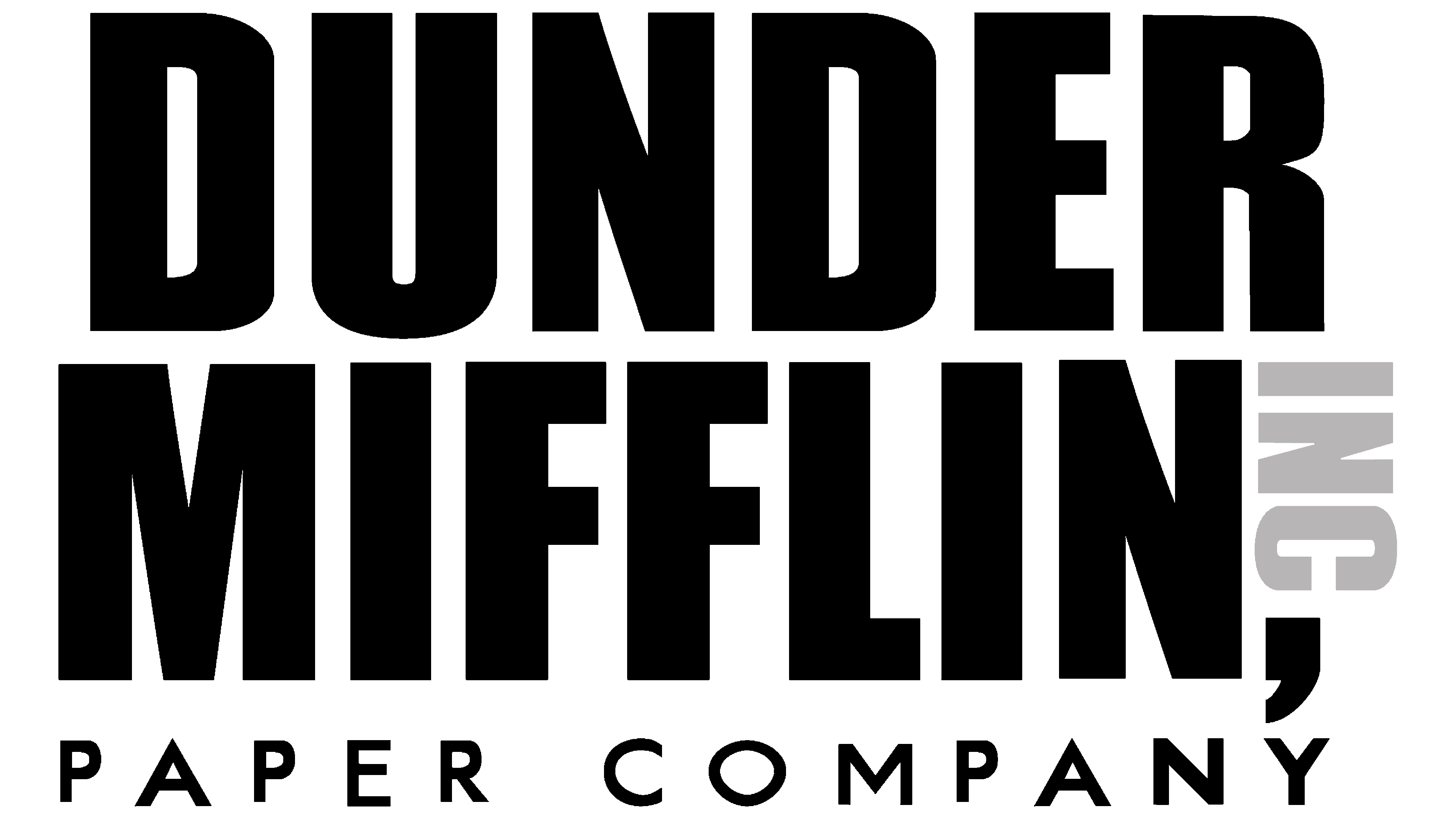
Experts have established that two different fonts were used for the company name. The consensus is that the words “DUNDER MIFFLIN” and “INC” are set in a fat grotesque from the Impact family. This typeface first appeared in 1965 and was based on old posters. It is distinguished by narrow letter spacing and massive strokes.
As for the second typeface, it is less clear. Some people think the phrase “PAPER COMPANY” uses the neo-grotesque Helvetica (or its analog), designed in 1957. Others think the thin sans serif letters resemble the humanist typeface Tahoma, created specifically for Microsoft and debuted in 1994.
The basic version of the logo uses very simple colors. Most of the text is white, except for the light gray word “INC .”The background looks like a big black rectangle.