


 Eastern Illinois Panthers Logo PNG
Eastern Illinois Middle School’s sports emblem features a beastly appearance with deep symbolic meaning. Chosen as a mascot back in 1930, the panther immediately and confidently led to victory. The modern Eastern Illinois Panthers logo shows a close connection between the brand’s history and the present day.
Eastern Illinois University in Charleston began its athletic history in 1899, when students formed a football team weeks after the campus opened. Early competition took place in the Interstate Intercollegiate Athletic Conference. In 1930, the Panthers adopted the mascot Billy the Panther.
The program gained momentum in the late 1970s under coach Darrell Mudra. In 1978, Eastern Illinois won the NCAA Division II national title with a 12–2 record. Running back Pug Cobb earned All-American honors, and the team reached the Division II final again in 1980, losing to Cal Poly.
In 1981, the program moved to Division I FCS. Future NFL coaches Sean Payton and Mike Shanahan played at Eastern Illinois, and both later won Super Bowl titles.
Bob Spoo led the team from 1987 to 2011, recording 144 wins. Quarterback Tony Romo played from 1999 to 2002, set a program record with 85 touchdown passes, and won the Walter Payton Award in 2002. The team won conference titles in 2001 and 2002. Romo later joined the Dallas Cowboys and earned multiple Pro Bowl selections.
Jimmy Garoppolo followed from 2010 to 2013, leading the team to a 12–2 season and earning the Walter Payton Award. The New England Patriots drafted him, and he later became the San Francisco 49ers’ starting quarterback.
Outside football, Eastern Illinois won NCAA titles in cross-country in 1968, 1969, and 1977; in track in 1974; and in soccer in 1969. Wrestler Matt Hughes later became a UFC champion.
Meaning and History
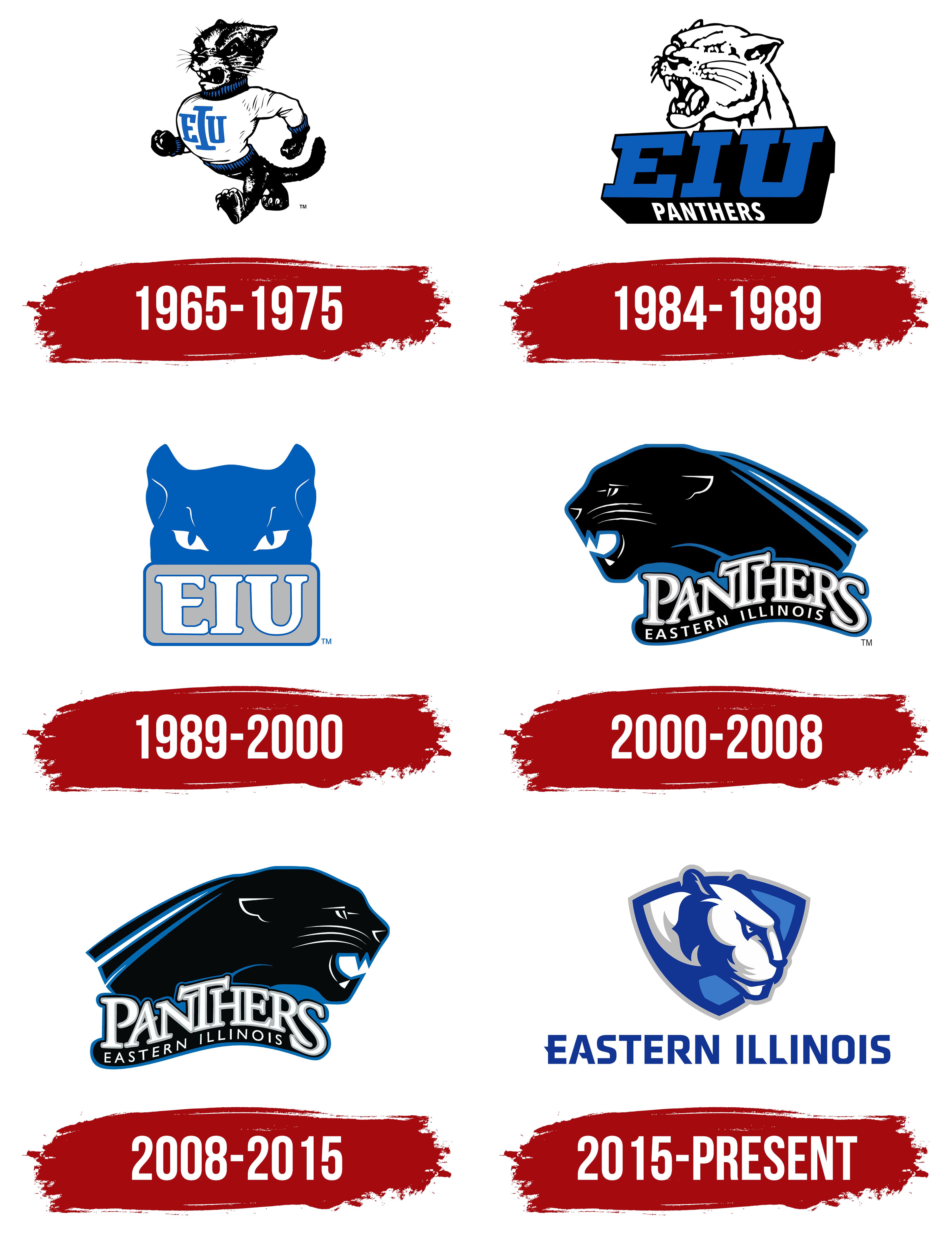
Like all intercollegiate teams, Eastern Illinois Panthers wear an emblem featuring their mascot. Over the years, the panther has appeared in different forms.
What are the Eastern Illinois Panthers?
The Eastern Illinois Panthers are a sports division that unites 21 student teams at Eastern Illinois University. Based in Charleston, they compete in the Ohio Valley Conference, Horizon League (tennis), and Summit League (swimming and soccer). The athletes compete in NCAA Division I (FCS) and have won five championships. Additionally, they won the NAIA men’s soccer championship in 1969.
1965 – 1975
Eastern Illinois University’s athletic teams in Charleston adopted the Panthers name through a student contest. Previously, they competed as the Blue and Gray, a nickname drawn from the school colors. In 1930, the Teachers College News and Fox Lincoln Theatre invited suggestions for a new name. The prize was $5 worth of movie tickets.
Athletic director and football coach Charles “Pop” Lantz, football captain Gene Kintz, and sports editor Irvin Singler reviewed the entries. Three participants proposed Panthers: Harland Baird, Paul Burtisell, and Thelma Brooks. The results were published on October 16, 1930, and the winners shared the prize.
The Eastern Illinois portion of the name traces to Eastern Illinois State Normal School, a teacher-training institution established in 1895. Status changes brought new names. It became Eastern Illinois State Teachers College in 1921, Eastern Illinois State College in 1947, and Eastern Illinois University in 1957. The abbreviation EIU later appeared in several athletic emblems, including a panther wearing a university sweater.
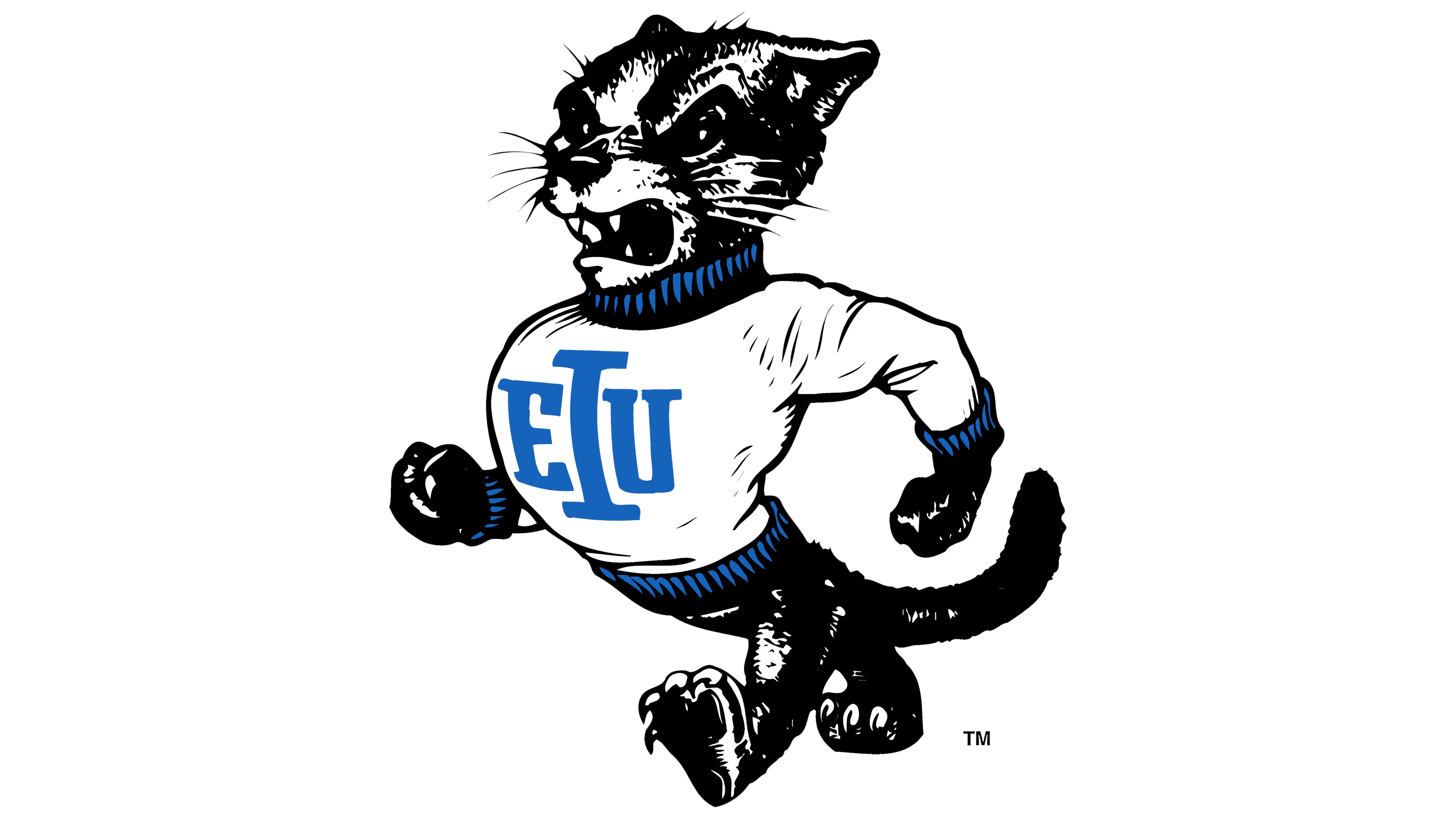
In the early panther logo, blue EIU lettering on the chest identified the character with the university. The middle “I” stood taller than the neighboring “E” and “U.” Blue also appeared on the collar, cuffs, and lower edge of the sweater. Black-and-white hatching defined the fur, clothing folds, and facial contours.
The panther walked on its hind legs with its front legs bent and paws clenched into fists. Its nearly human body and clothing contrasted with its predatory features. Fangs projected from an open mouth, and furrowed brows hung over the eyes. The head faced left, while the long tail curved right. The university initials and animal brought both parts of the Eastern Illinois Panthers name into a single emblem.
1984 – 1989
In the next Eastern Illinois Panthers logo, EIU moved from the panther’s sweater to the foundation of the emblem. Large initials dominated the design, while a head replaced the full animal.
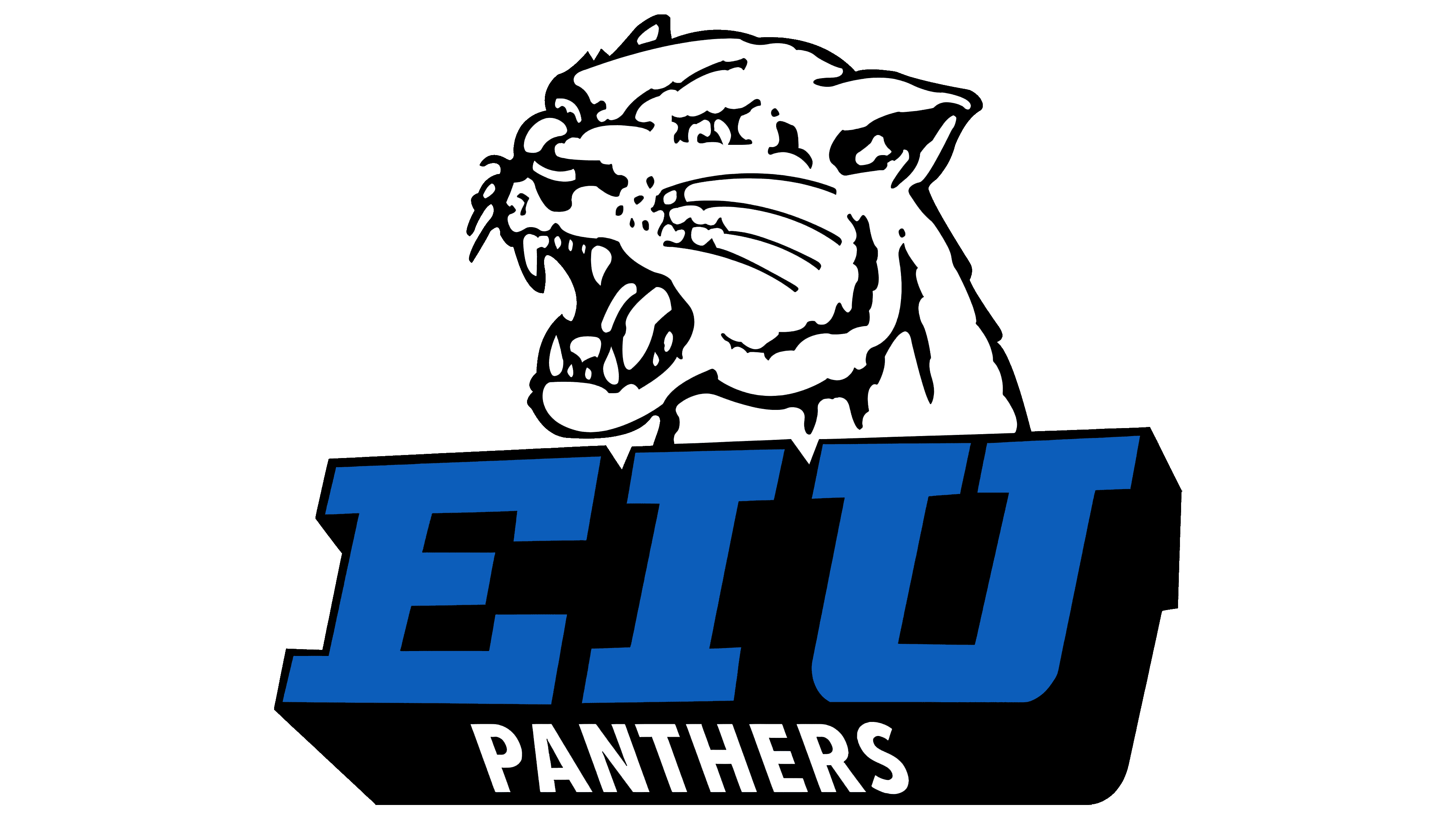
The blue letters slant right and feature heavy rectangular serifs. A black shadow offset down and to the right creates a dimensional base beneath them. White PANTHERS lettering sits within its lower portion, combining the university abbreviation and team name into one block.
A white panther head with black outlines appears above EIU. Its face points left, with long fangs extending from the open mouth. The animal remained in the logo but yielded the dominant role to the university initials.
1989 – 2000
A panther peering over a panel bearing the university initials formed the Eastern Illinois Panthers emblem from 1989 to 2000. The head now faced forward, and large areas of color replaced detailed linework. The combination of the head and an EIU panel replaced the dimensional shadow and PANTHERS lettering.
A gray rectangular panel with rounded corners covered the panther’s nose, mouth, and lower jaw. White EIU letters with blue outlines and rounded serifs filled the panel. Part of the blue face remained visible above it. White eyes looked toward the viewer, while thin white lines defined the inner ears and folds above the eyes. A black-headed version accompanied the blue one.
2000 – 2008
The updated Eastern Illinois Panthers emblem introduced in 2000 placed large PANTHERS lettering beneath the animal’s head. EASTERN ILLINOIS appeared below on a black base in small, widely spaced uppercase sans-serif letters. The difference in scale emphasized the team nickname, with the university name in a supporting role.
The letters in PANTHERS varied in height and slant. The upper edge rose around the “T,” while the lower edge formed an arc. Long serifs and extended terminals on the outer “P” and “S” widened the word’s silhouette. Gray outlines bordered the white letters, with black spaces between them. A blue outer border connected the text to the panther.
An elongated black profile, facing left in the primary version, replaced the previous forward-facing head. The new angle revealed the entire muzzle and open mouth. A blue line followed the forehead, nose, mouth, and neck, while white strokes defined the eye, ear, whiskers, and fangs. Long, pointed bands extended from the back of the head.
2008 – 2015
In 2008, a right-facing panther became the primary Eastern Illinois Panthers logo. The illustration had served as a secondary version since 2000 and remained the primary emblem until 2015. The lettering retained its placement and form. The black head, blue outline, white facial details, and gray letter outlines remained unchanged.
In 2008, the university also officially named its mascot Billy. Fans had known the name since the late 1980s. Billy the Panther debuted on September 13 before the football game against Indiana State, replacing Prowler. Athletic director Barbara Burke attributed the update to the worn condition of the previous costume and a desire to restore a name familiar to alumni.
Billy’s clothing changed with the season. In fall, he wore a No. 90 football jersey, switching to a basketball uniform in winter. His personal name and the Panthers team nickname originated at different points in university history. Billy’s official return in 2008 continued a fan tradition.
2015 – today
By spring 2015, Eastern Illinois teams were wearing several versions of the athletic emblems, and the department needed a consistent identity. Vice president Bob Martin, assistant vice president Steve Rich, and athletic director Tom Michael discussed an update. University administration, athletics, the campus store, and the student community joined the project. Atlanta-based Collegiate Licensing Company, or CLC, was commissioned to develop it.
The new emblem centered on a panther’s head against a shield with an arched top and pointed base. A right-facing three-quarter view replaced the elongated profile. The head extends beyond the shield, with an ear projecting above the upper edge and the nose and chin crossing the right edge. A closed mouth replaced the open jaws and fangs. A narrow eye, heavy brow, and angular tufts of fur define the expression.
Navy areas replaced the black fill, adjoining white sections of the forehead, muzzle, and neck. Gray shadows add detail, while light blue sections appear in the background. The outer border varies by background color. A gray outline surrounds the emblem on white, while a white outline is used on blue.
The lettering was redesigned along with the image. Horizontal lines of tightly spaced uppercase letters with nearly uniform stroke widths replaced the curved PANTHERS wordmark and its long serifs. Triangular projections and angled cuts became part of the letterforms. A projection crosses the left vertical stroke of the “E,” the crossbar of the “A” ends in a point, and the lower stroke of the “L” is cut diagonally. The collection included one-line and two-line EASTERN ILLINOIS wordmarks, standalone PANTHERS and EIU marks, and an EIU PANTHERS combination. All could appear independently of the shield and head. A secondary paw emblem and revised color standards were included.
The same treatment extended to sport and department names. A gray, slanted FOOTBALL, BASKETBALL, BASEBALL, or TRACK & FIELD line appeared beneath EASTERN ILLINOIS. ATHLETICS and PANTHER CLUB followed the same format. The university name remained on top, with the lower line identifying the team or unit.
The public unveiling took place on October 7, 2015, in the Buzzard Hall auditorium. Bob Martin opened the ceremony, student trustee Katie Witt revealed the emblem, and participants modeled apparel featuring the new designs. CLC’s director of corporate communications, Tammy Tully, participated in the project. Her connection to the university was personal. She was born in Charleston, and her father played football for EIU.
The new emblem made its competitive debut on October 10, 2015, on players’ helmets during the home football game against Southeast Missouri. Across campus, earlier images were replaced as facilities were updated.