


 Egyptian Air Force Logo PNG
The Egyptian Air Force emblem is a compelling blend of symbolism and authority, embodying the values and aspirations of the military establishment. The emblem speaks to both domestic and international audiences, emphasizing the Air Force’s role as the guardian of sovereignty. It represents pride and unity, implying an organic fusion of past heritage and modern capabilities. The symbolism radiates strength, discipline, and dignity.
The Egyptian Air Force traces its origins to 1932, when Egypt, with British support, established its first aviation school. Early development relied on British training systems, aircraft standards, and instructors, reflecting Egypt’s political and military alignment with the United Kingdom during the interwar period.
Its first major combat experience came in the 1948 Arab-Israeli war, when Egypt joined a coalition of Arab states against the newly formed State of Israel. At that stage, the air force remained limited in scale and equipment compared to European air forces and the emerging Israeli Air Force, which affected its operational performance in the conflict.
A major turning point followed during the 1956 Suez Crisis, when British, French, and Israeli forces launched strikes on Egyptian airfields, destroying aircraft on the ground before they could take off. Despite these losses, the conflict ended with the withdrawal of the invading forces under international pressure from the United States and the Soviet Union, strengthening Egypt’s political position in the region.
After 1956, Egypt expanded its military cooperation with the Soviet Union, which supplied aircraft such as the MiG-15, MiG-17, MiG-19, and later the MiG-21. Much of this fleet was destroyed in the 1967 Six-Day War during Israeli preemptive strikes on Egyptian bases. In the 1973 Yom Kippur War, Egyptian air forces operated in coordination with ground forces during the crossing of the Suez Canal. After the 1979 peace treaty with Israel, Egypt shifted toward Western suppliers, introducing F-4 Phantom and F-16 Fighting Falcon aircraft, later adding Mirage 2000, MiG-29M/M2, Su-35, and Rafale fighters. The main regional rival throughout its history remained the Israeli Air Force.
Meaning and History
What is the Egyptian Air Force?
Established as the aviation branch of the Egyptian Armed Forces, the Egyptian Air Force (EAF) has played an important role in the country’s defense system since its inception. Responsible for all air defense tasks, the EAF employs all military aircraft supporting Egypt’s armed forces. This important defense institution was established to protect Egypt’s airspace from potential threats, ensuring a safe environment for the nation’s growth and prosperity.
1932 – today
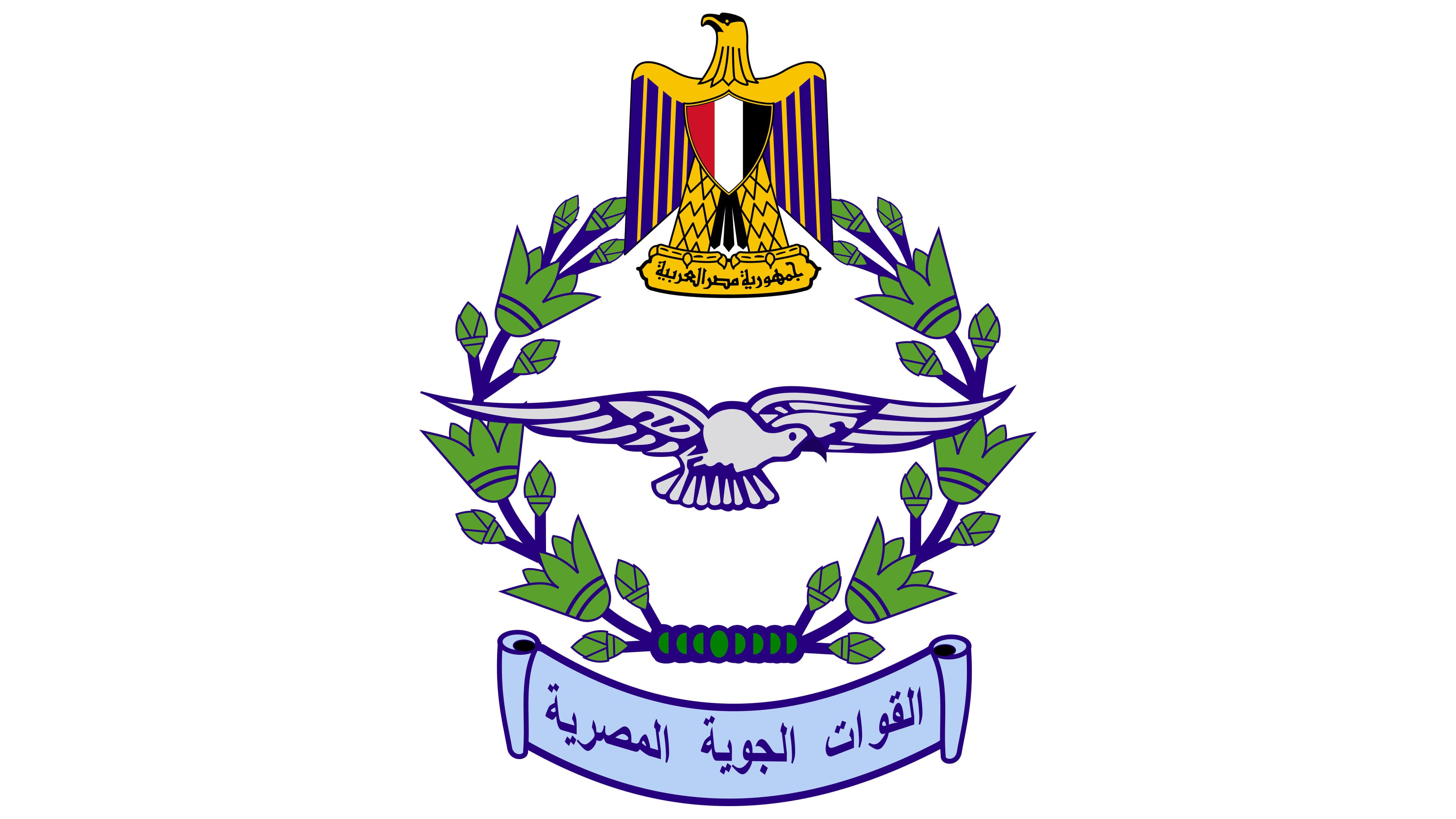
The large yellow-and-blue bird on the Egyptian Air Force emblem is Saladin’s eagle. This symbol of Arab nationalism is used on Egypt’s coat of arms and represents three qualities: sovereignty, beauty, and strength. On its chest is a heraldic shield divided into vertical stripes of red, white, and black. In its claws, the eagle holds a plate bearing the state’s name in Arabic. In the center of the coat of arms is a flying white bird surrounded by a green wreath of patterned plants. At the bottom, the name of the aviation unit is written on a blue scroll.
The eagle of Saladin is a historically significant symbol that reinforces the Egyptian Air Force’s connection to national identity. The heraldic shield echoes the colors of the Egyptian flag, reinforcing the emblem’s connection to the state. The flying white bird in the center can signify freedom, agility, or vigilance, qualities often associated with the Air Force. The green wreath, symbolizing honor and valor, gives the emblem a decorative yet dignified appearance. The blue scroll clearly identifies the unit, completing the emblem’s composition.