


 Epic Games Logo PNG
“Follow the sign, and you will enter a special gaming world,” the Epic Games logo invites. The emblem holds a sense of mystery and a touch of fantasy. Players never know what lies behind the plot twist or which direction the game will take them.
Fans and computer game enthusiasts know the products of Tim Sweeney’s company, Epic Games, Inc., formerly known as Potomac Computer Systems. The company develops and publishes video games and related software. Its founder created and released the first commercial video game, ZZT, in 1991 at his parents’ home in Potomac, Maryland, which was a hit with gamers at the time. Within a year, that success contributed to the company’s expansion and a name change to a more resonant one: Epic MegaGames, Inc. At the same time, the staff expanded, with Mark Raine from id Software appointed Vice President. After moving to Cary in 1999, the company shortened its name to Epic Games. In 2014, Guinness World Records called the Unreal Engine the studio developed “the best engine at the moment.”
Meaning and History
After starting his business as a computer consultancy in his parents’ home in 1991, Sweeney gave up on that option when he realized it would take substantial investment and labor to develop. However, without self-promotion, the successful launch of the first game by an unknown company gave him a new direction for developing his ideas, reformatting the business to focus on creating video games.
In early 1992, Sweeney realized the game world was already crowded with big, world-renowned studios such as Apogee Software and id Software. To somehow enter this market, and even more to make a loud statement right away, it was not enough to make 1-2 popular games. It required in-depth marketing, a well-thought-out image, an attractive name, and an original company logo. The renaming to Epic MegaGames seemed impressive and original to him. It sounded like a large, solid organization, even though its founder, manager, and employee were all one person.
Mark Raine, who became Sweeney’s partner that same year, helped organize the company’s promotion. His experience at ID Software proved valuable for business development. Having connections and handling marketing, sales, and publishing issues made a significant contribution to the new company’s successful growth. During one season, the studio’s development required the services of a wide range of specialists – programmers, designers, composers, and artists. Twenty employees were invited to work and formed the studio’s core team.
The company became widely known among video game developers for Unreal Engine. As it developed the engine, the studio also launched video games, including Fortnite, Gears of War, and Infinity Blade, all of which use Unreal Engine. Its application demonstrated excellent results. Subsequent refinements have enabled its successful use in video games developed by other developers. But this followed years of hard work and struggle to secure a place in this type of business. The next year, we expanded to 30 employees.
In 1996, the Polish studio Chaos Works approached the company for help releasing its shooter, Fire Fight. In 1997, the staff increased to 50 people worldwide. The following year, its new Unreal Engine opened many possibilities for further unique developments. That same year, the Unreal series launched with Digital Extremes, a three-dimensional first-person shooter that quickly became popular with gamers. This fame made the engine in demand among other developers, allowing the studio to pursue a new direction: implementing a unique but already licensed engine.
The company underwent significant changes in 1999. As the number of employees and the volume of tasks grew, the company had to revise its approach to collaboration. Previously, many of them worked in their own country. However, developing Unreal required all its creators to work together under one roof. The company moved to Cary, North Carolina, and occupies an impressive facility that meets current needs. At the same time, the company removed “Mega” from its name, as it no longer needed to convey the appearance of a large organization. Since then, Epic Games has become a “big” company, known far beyond the United States.
In 2019, the studio won the British Academy of Film and Television and was awarded the Engineering Excellence Award from the Hollywood Professional Association. Organizing contests, cybersport events, and investing have increased the project scale and the company’s profitability.
The right marketing approach has also played a major role in the company’s development, enabling it to respond quickly and effectively to change, update the studio’s image, and align with the spirit of the time. Its emblem has changed several times, each time showing the new logo’s success in fulfilling its purpose.
1991 – 1993
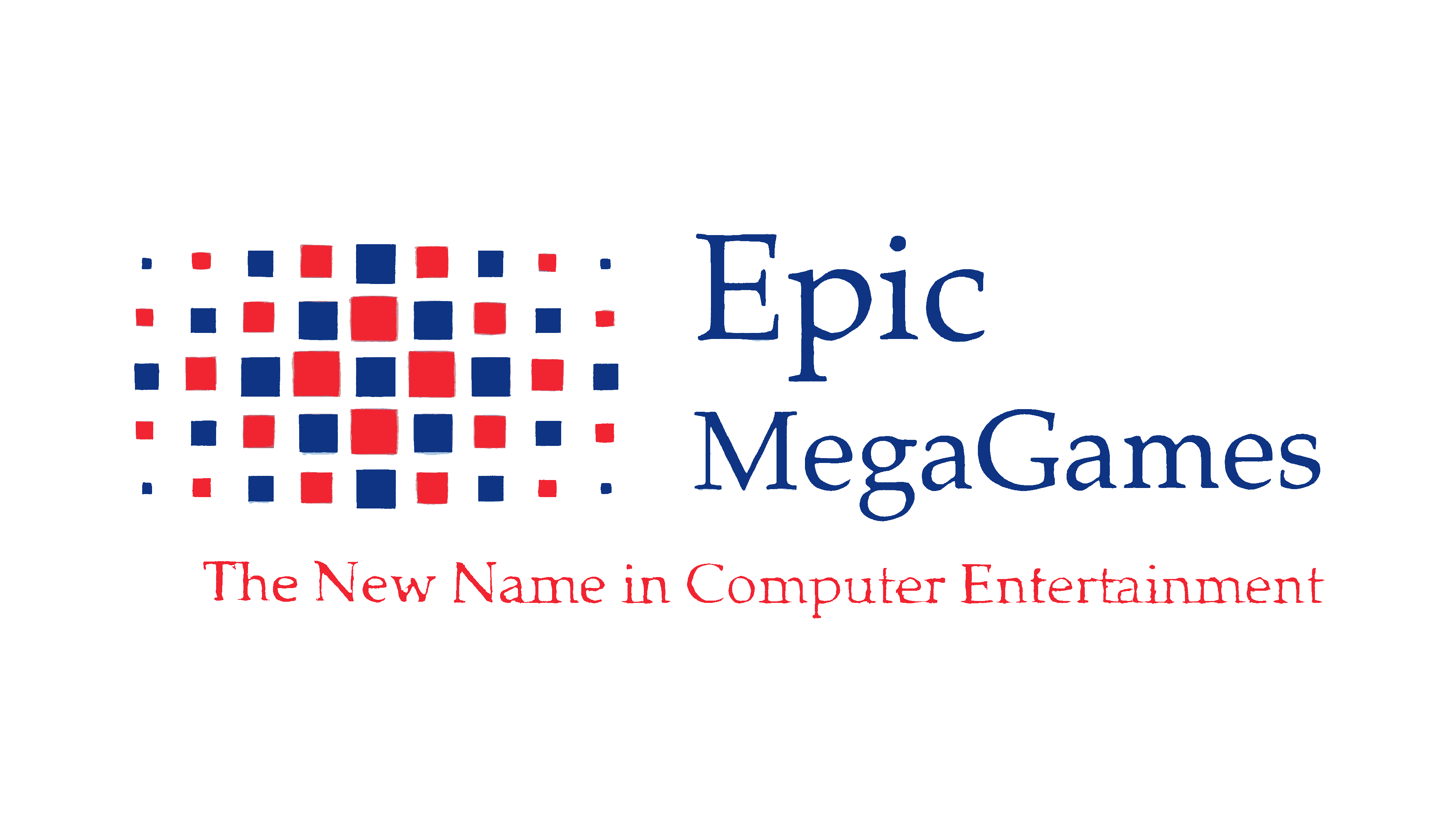
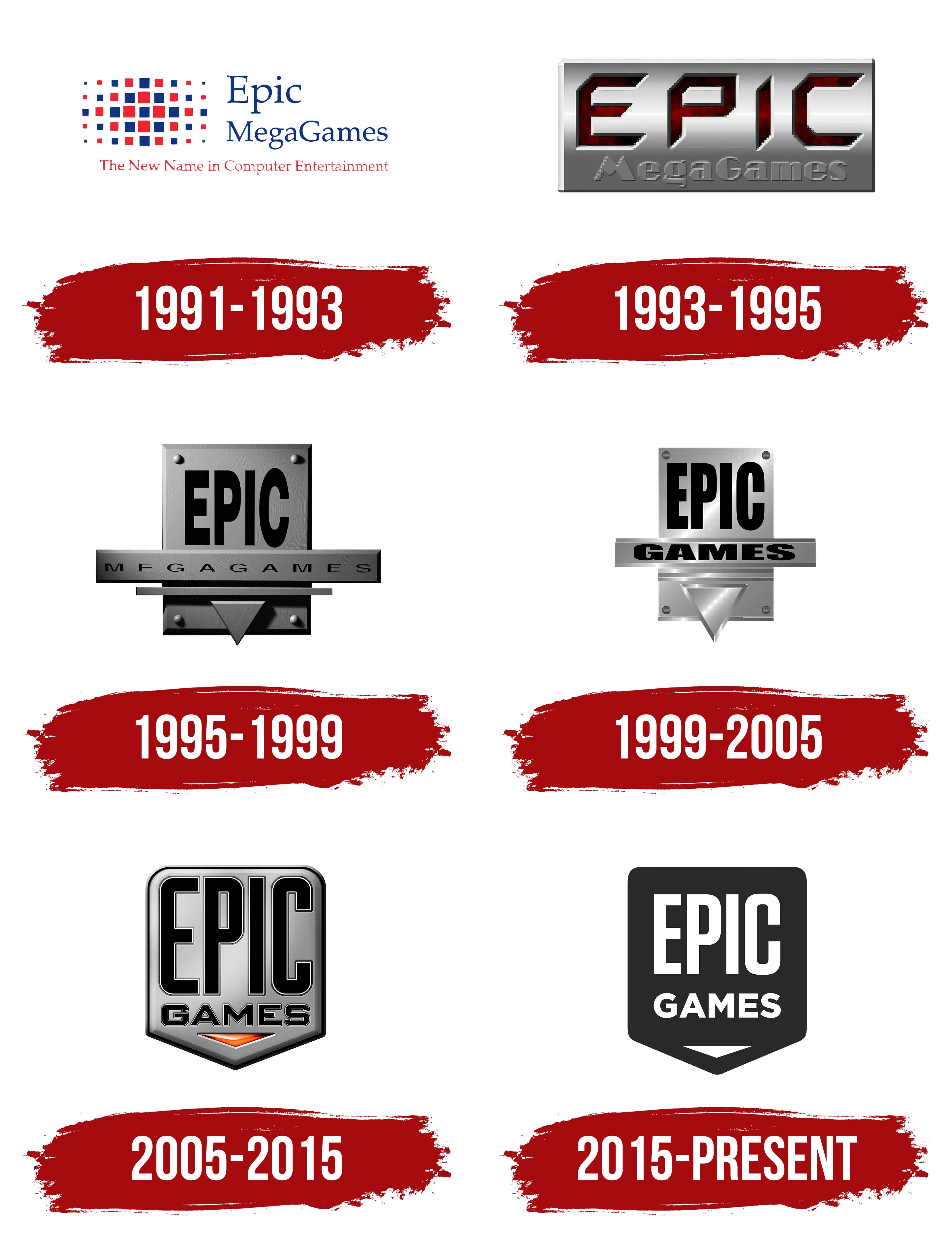
The first logo was designed under the first name change when Sweeney made his first risky move, hoping to raise his company’s profile. The composition reflected the state-of-the-art computer technology at the time. It was well suited to establishing him as a major player in video game development and distribution.
1993 – 1995

The company’s rapid development, its use of computer technology, and its focus on new game technologies and game systems led to a rethink of its logo and image. The new logo became three-dimensional, in the form of a metalized plate and a label, with the first word of the name in convex text and the second in convex text. The color solution created the required perception of the plate’s steel material, and the letters of the first word were set in a blood-red gradient.
1995 – 1999
This version lasted until 2005 and carried forward only technical changes.
1999 – 2005
In 1999, the logo gained clarity and sharper image quality thanks to computer technology and graphics. It would no longer contain the word “Mega .”It would become the company’s demo logo for the first time at the release of Unreal Tournament (1999)
2005 – 2015
In May 2005, the company unveiled a new emblem that retained the general idea of the previous version while simplifying it. It is a downward-pointing vertical pointer in the traditional steel design, with text throughout its free space and a small isosceles triangle pointing down at the apex. The text is black, and the visually voluminous triangle is filled in red with a gradient from lightest to darkest.
2015 – today
The desire for concreteness and brevity, which are today’s trends, led to a revision of its emblem. As a result, the modern company logo, preserving the general contours of the previous one, has become a simple label. The company’s fame has grown to the point that its brand is easy to visualize. Today’s simple version is quite enough for the company. Since November 2015, it has served as Epic Games’ official emblem.
Font and Colors
Most gamers and fans of the company’s game consoles helped develop the new sign at Epic Games’ request. By a majority vote, they chose the logo that appears on all company products, the portal, and social networks. Its color scheme is simple, laconic, and contrasting, using only white and black. No gradients, full colors, rainbow colors, or shades. The pointer is black, with a white triangular arrow at the bottom; the font is white, and the company name sits in its field.
The text is in capital letters. The first word, “EPIC,” occupies almost 3/4 of the pointer area. Under it is “GAMES,” in a smaller typeface that matches the width of the first word’s borders. The small arrow-triangle under the second word of the company’s name is symmetrically repeated at the tip of the pointer. This is ensured by the parallelism of its sides with the pointer’s sides, forming a downward-pointing wedge.