Erie SeaWolves Logo PNG
The Erie SeaWolves baseball club logo symbolizes the team’s spirit and the region’s characteristics. Its design emphasizes the team’s athletic nature and its connection to the local community.
The Erie SeaWolves trace their history to 1989, when the franchise began in Welland, Ontario, as the Welland Pirates, affiliated with the Pittsburgh Pirates. In 1995, the team moved to Erie, Pennsylvania. It adopted the SeaWolves name, combining the city’s location on Lake Erie with the pirate theme inherited from its parent organization in the Minor Leagues.
A new home, Jerry Uht Park, opened in 1995, and José Guillén delivered the decisive hit in the first game there. In 1999, Erie moved up to Double-A and joined the Eastern League, while its affiliation changed to the Anaheim Angels. Two years later, the club entered a long-term partnership with the Detroit Tigers, whose system sent numerous prospects through Erie, including future star pitcher Justin Verlander.
The ballpark was renovated in 2006 with new premium seating and fan areas, then renamed UPMC Park in 2016. Erie also became known for unusual promotions, including the 2017 “Alternative Facts Night,” a politically themed event that received national media coverage. The club also competed regularly with regional opponents such as the Harrisburg Senators.
The strongest on-field period came much later. Under manager Gabe Alvarez, the SeaWolves won their first Eastern League championship in 2023. Erie repeated the feat in 2024, securing back-to-back titles and marking the franchise’s most successful two-season stretch.
Meaning and History
What is Erie SeaWolves?
It is a Double-A baseball club based in Erie, Pennsylvania, competing in the Eastern League as the Detroit Tigers’ farm team. The team’s name refers to legendary creatures said to inhabit Lake Erie. Established after relocating from Welland, the club has long been a partner of the Tigers. Home games take place at UPMC Park. Notable alumni include Justin Verlander.
1995 – 1998
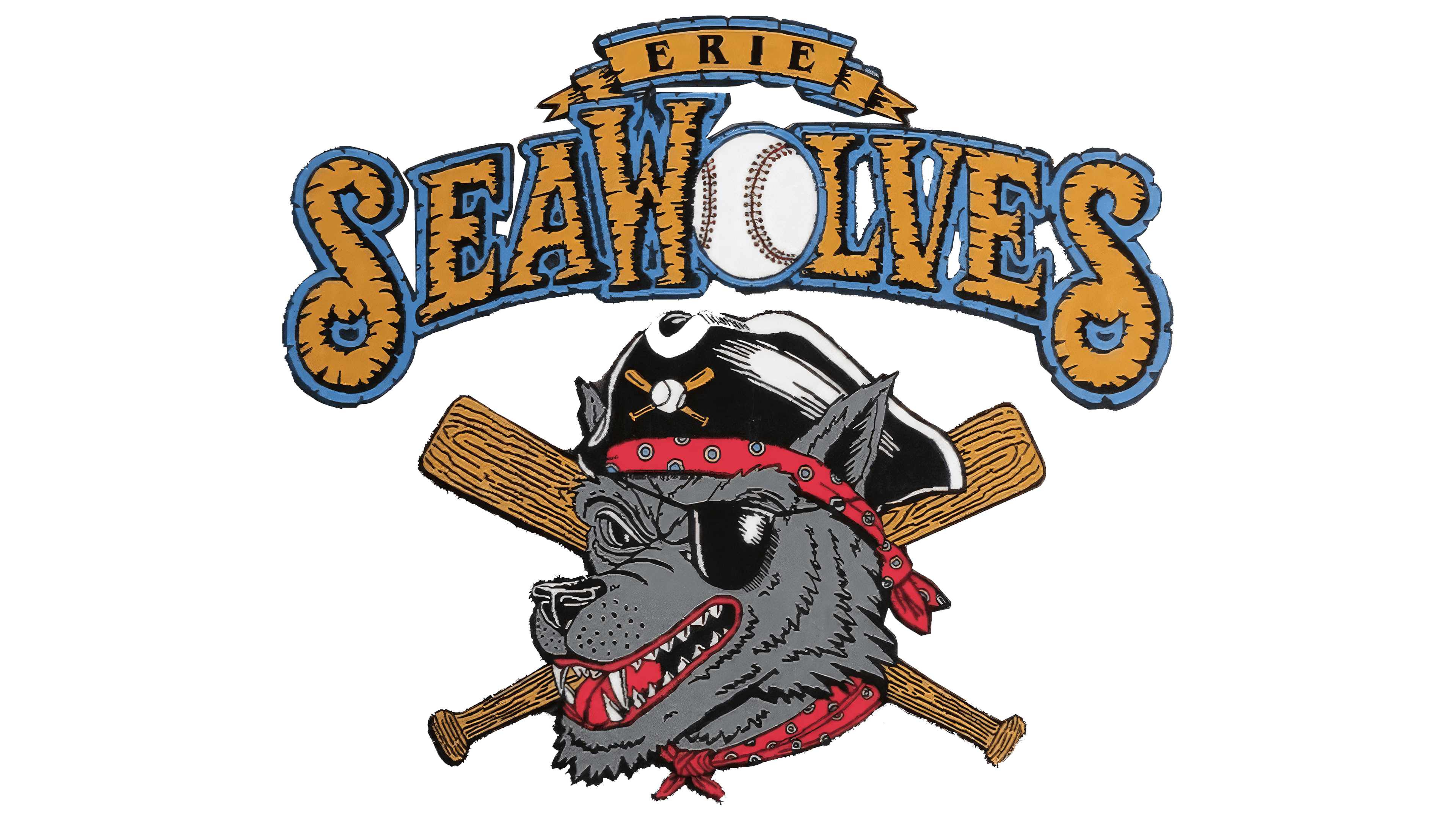
The first official emblem of the Erie SeaWolves baseball club was created specifically for the team’s debut in the New York-Penn League. The visual composition reflects the cartoon-like style characteristic of 1990s baseball aesthetics, with rich detail and bold contrasts.
The main figure of the emblem is a stylized wolf’s head depicted as a pirate. The wolf is depicted in profile, its mouth agape in an aggressive snarl, revealing fangs and sharp teeth to underscore the team’s fighting spirit and determination. The wolf wears pirate attire: a black tricorn hat featuring a baseball with crossed bats, a red bandana with white accents on the head and neck, and a black eyepatch covering the left eye. Expressive facial details and an intense gaze create a strong visual association with aggressiveness and energy.
Behind the wolf’s head are crossed light wooden baseball bats, referencing the traditional pirate “Jolly Roger” symbol. This reinforces the double meaning of the name SeaWolves, which combines maritime pirate themes with the club’s baseball identity.
The upper part of the composition features the large word “SEAWOLVES” in a decorative serif font with a texture reminiscent of weathered wood or the planks of a pirate ship. The central letter “O” is stylized as a white baseball with characteristic stitching, adding a clear sports reference. Above the main text is a gold banner with the black word “ERIE,” indicating the club’s home city.
The color palette includes bright, saturated shades: gold-orange for the lettering, blue outlines around the letters, red for the bandana and the wolf’s mouth, gray and black for the wolf’s head, and the natural wood color of the bats. This combination was typical of baseball teams of the era and helped draw attention by emphasizing dynamism and aggression.
The choice of a pirate theme was intentional, as it is a popular metaphor associated with competition, energy, and adventure, perfectly matching the competitive spirit of a baseball club. The wolf in a pirate role became the team’s symbol, reflecting its fighting attitude and determination.
Overall, the design of the first Erie SeaWolves emblem is a vivid example of 1990s baseball identity, expressing energy, boldness, and character through an abundance of details and strong imagery.
1999 – 2000
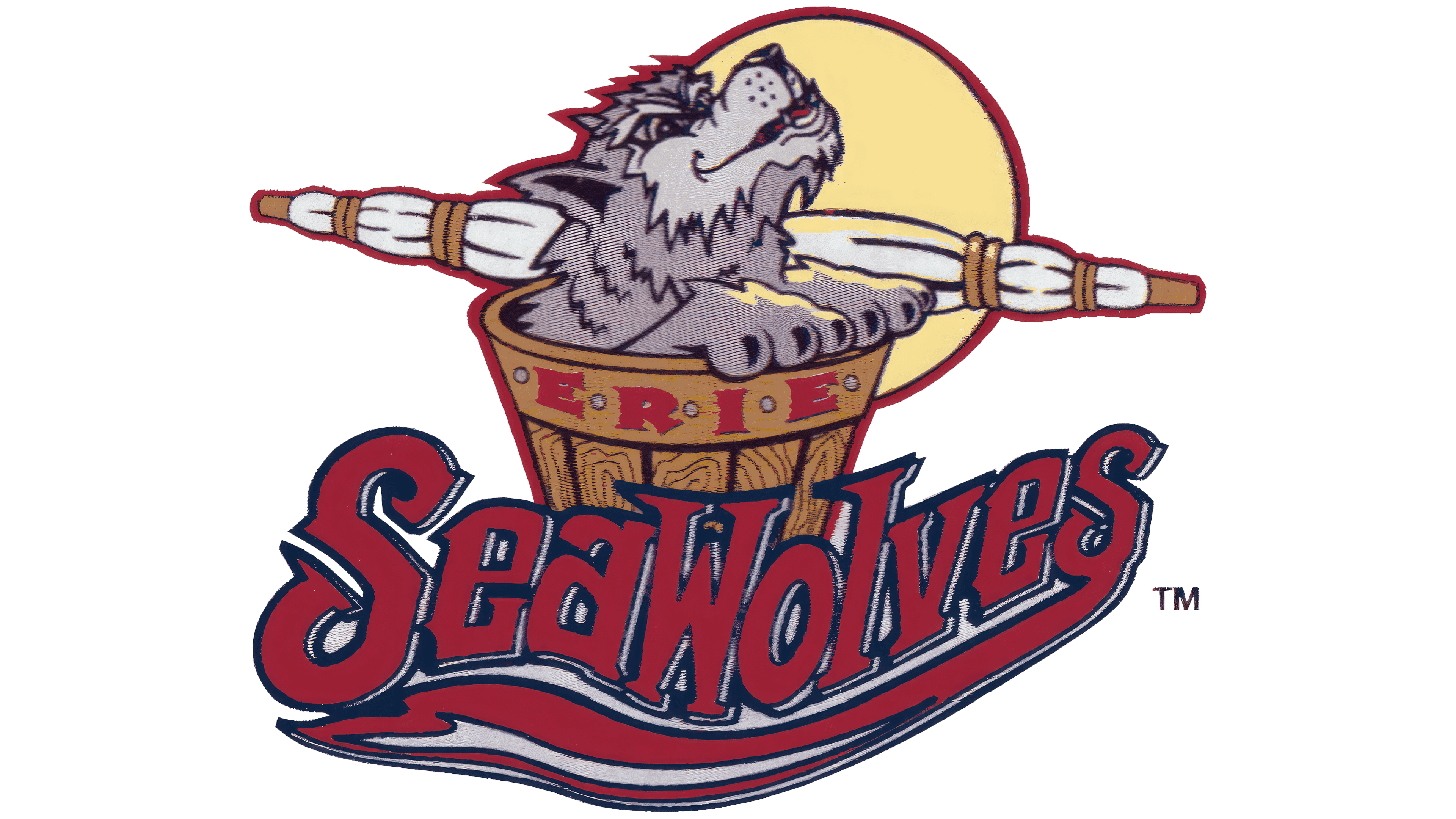
The new Erie SeaWolves emblem marked the team’s transition to the next level in Minor League Baseball. It was accompanied by a shift in visual style toward a friendlier, brighter cartoon-like image that retained the maritime theme and wolf symbolism.
The composition features a wolf in light gray tones peeking out from inside a wooden barrel styled as a ship’s container. The wolf is depicted in a three-quarter profile, with one paw raised, emphasizing its liveliness and personality. The facial expression conveys confidence and a sense of challenge, but without the aggression seen in the team’s previous logo.
The wooden barrel holding the wolf displays the word “ERIE” in red decorative capital letters with small serifs, styled to resemble old wooden carvings. The barrel’s wooden texture and lettering tie into maritime themes and pirate fleet traditions.
Behind the wolf is a large yellow circle with a red outline, symbolizing either the sun or a full moon, adding extra meaning and color contrast to the design. Horizontally placed behind the barrel are two white oars with wooden handles, referencing seafaring and adventure in a lighter, less direct way than in earlier emblems.
The lower part of the logo contains the large word “SeaWolves” in a custom decorative font with smooth yet pointed lines and varying letter heights. The main text is a rich red, with a double outline in white and dark blue that visually mimics waves, giving the lettering a sense of movement and energy.
The color palette combines light gray, red, blue, white, and yellow. These shades create a bright and memorable image that captures fans’ attention and reflects the team’s energetic spirit.
The use of this stylized, cartoon approach stemmed from the club’s aim to create an image that appeals to a broad audience, including families and children. The emblem from this period stands apart from earlier versions with its lighter style, reduced emphasis on aggression, and greater focus on a playful game-day atmosphere and the entertainment side of baseball.
2001 – 2012

The Erie SeaWolves’ emblem was introduced as part of a broader rebrand during a period of growing popularity for the team in Minor League Baseball. This update helped the franchise establish itself as a recognizable brand in the eastern United States sports scene while maintaining ties to the tradition and bold style of early-2000s baseball iconography.
The composition centers on the image of a pirate wolf illustrated in a cartoonishly aggressive style. The wolf is depicted in profile, with its detailed facial features accentuated by sharp fur lines, prominent fangs, and a protruding tongue. A black pirate patch covers one eye, and the other is red, giving the character a menacing, battle-ready expression. The wolf’s head is topped with a black tricorn hat with a white outline, decorated with a baseball and two miniature bats, and an orange bandana with a white polka-dot pattern. A matching scarf is tied around the neck.
In the background are two crossed wooden baseball bats in a natural wood tone with visible texture, referencing the pirate “Jolly Roger” symbol. The combination of baseball gear and pirate iconography reinforces the SeaWolves’ name, merging sports and maritime themes in a unified, expressive mark.
The team name appears below the wolf in large letters. The “SeaWolves” wordmark is bold, with tall letterforms and thin light-colored outlines that add depth and dimension. The central letter “O” is replaced by a white baseball with red stitching, seamlessly integrated into the text and emphasizing the sport. A smaller “Erie” sits above the start of the wordmark in a simpler sans-serif font to indicate the team’s location.
The palette combines black, gray, bright orange, red, and white. Gray shades form the primary color of the wolf’s fur, black highlights the details and text, and bright orange adds energy and contrast to elements such as the bandanas and small shadows. The saturated, contrasting colors heighten the sense of intensity and reinforce the design’s aggressive, dynamic nature.
2013 – today

The current Erie SeaWolves logo was developed by the design agency Brandiose. The goal was to reinterpret the club’s classic identity elements, giving them a modern, striking, and more refined style suited to professional baseball standards.
The design centers on a front-facing wolf with an expression of pride and calculated defiance. Sharp facial lines, an asymmetrical eye squint, and a black pirate patch add boldness, tying the theme to pirates. Above the wolf’s head is a black tricorn hat featuring a red letter “E” representing Erie, anchoring the club’s geographic identity. The wolf’s graphic execution leans toward simplicity, with a focus on geometric precision and minimal extraneous detail.
Behind the wolf’s head are baseball bats visually resembling crossed sabers. The handles are styled like weapons, featuring red accents and curves that enhance the pirate motif, giving the composition a symbolic similarity to maritime pirate emblems. The bats’ wooden texture and golden-yellow color integrate naturally into the logo’s overall structure.
The word “SeaWolves” is placed along an arc at the top of the composition. The font is large and bold, featuring short serifs and straight, carefully balanced proportions, which ensure strong readability across all media. A compact “ERIE” is set above the main arc in a simple, upright font, reinforcing the hierarchy of the main name.
The color palette includes black, gray, white, red, and yellow-orange. Black and gray form the base of the wolf and text elements, red highlights the bat handles and the letter “E,” while yellow-orange is used in the circular elements and bats, adding contrast that gives the emblem its dynamic quality.
The Erie SeaWolves have successfully refreshed their visual identity, making it distinctive, professional, and relevant within the baseball industry.