


 Estonian Air Logo PNG
Estonian Air’s logo reflects the airline’s mission to provide comfortable and reliable travel. It is a unifying symbol that resonates with Estonian nationalism and the broader concepts of aviation safety and quality of service. The emblem stands for trust, setting a high standard of what to expect from a flight.
Estonian Air was founded in 1991, soon after Estonia restored independence and the Soviet Union collapsed. The government created the airline as a national carrier to give the young state its own direct air links with the rest of Europe and nearby markets. At the start, Estonian Air was fully state-owned, and Tallinn Airport became its main operating base.
The company inherited part of the former Soviet aviation structure and had to adjust to commercial conditions in a newly independent economy. In 1996, the Estonian government partly privatized the airline, selling about 66% to a foreign investor consortium that included Denmark’s Maersk Air and the American investment firm Cresco LLC. The state kept a minority stake while private owners took control of the business.
In the early 2000s, SAS acquired a stake in Estonian Air. It later increased its holding to about 49%, making it the largest private shareholder. The partnership connected the airline to a broader Scandinavian network of bookings and routes. Still, it did not resolve deeper financial problems. Competition from low-cost airlines and other Baltic carriers continued to intensify, and by 2010, Estonian Air was close to bankruptcy. The government then bought back the SAS stake, effectively renationalizing the carrier.
The final crisis followed a European Commission ruling that earlier state financial support had violated European Union competition rules. Estonian Air was ordered to repay the aid, but the company could not do so. On November 7, 2015, it stopped operations and entered liquidation. During its history, the airline competed with airBaltic, which built a strong hub in Riga. After Estonian Air ceased operations, Estonia established Nordica to preserve part of the country’s air connectivity.
Meaning and History
What is Estonian Air?
This was Estonia’s former national airline, based at Tallinn Airport, serving essential air connections between the Baltic countries and key European destinations. With a fleet of small aircraft tailored to the local market’s needs, the airline was Estonia’s primary carrier, playing a significant role in linking the country with European hubs. Its route network covered popular business and tourist destinations such as Stockholm, Copenhagen, and Amsterdam, and its blue-and-white livery, reflecting the national colors, became a familiar symbol in the skies of Northern Europe.
1991 – 2015
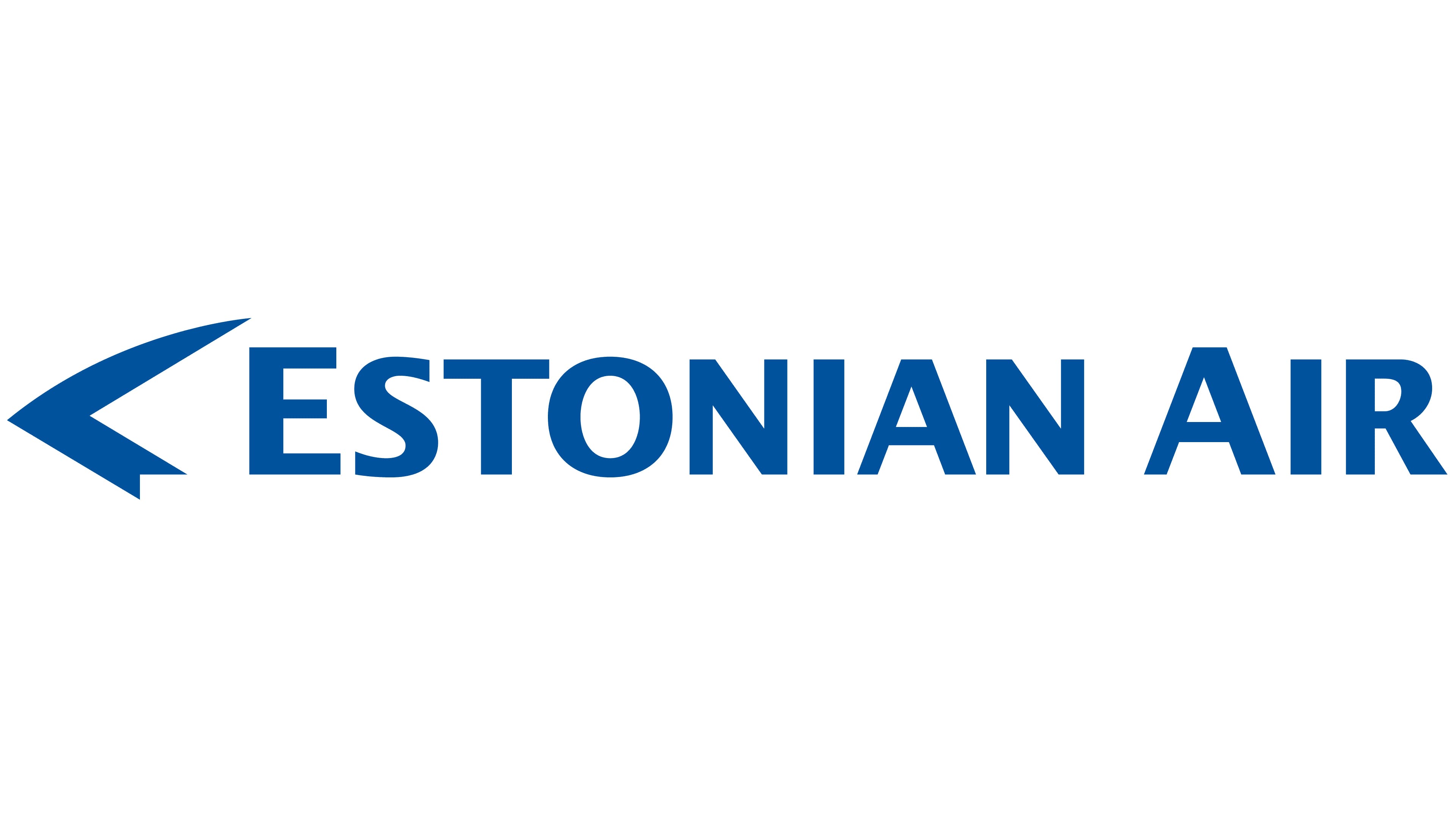
The Estonian Air logo is simple, yet this simplicity is its strength and precision. It is designed in a clean blue color, symbolizing the sky, flight, and reliability. The main graphic element on the left is a stylized silhouette of an airplane’s nose section. The sharply angled line resembles a climbing fuselage, emphasizing its connection to aviation and evoking a sense of upward movement.
The element is minimalist: a single smooth, curved stroke with a sharp tip. This stroke seamlessly complements the text, integrating the graphic with the name. The simple yet expressive symbol indicates that this airline is focused on clarity and efficiency.
The name is written in a strict, modern uppercase typeface. The capital letters are large, bold, and sans-serif, making the text readable and visually solid. The minimal spacing between the letters creates a sense of unity as if the text forms a single shape reminiscent of a streamlined airplane fuselage.
The deep blue color reinforces this, conveying professionalism and stability. The color connects to Estonia’s national identity, evoking associations with the country’s flag. The logo is free from unnecessary details, but each element is carefully designed. The airplane graphic and the typography convey a sense of reliability, while the blue adds a lightness evoking the sky.
The company’s name highlights its geographic origin and professional approach to its mission. The emblem reflects its connection to aviation, standing out through its simplicity and elegance.