


 ETSU Buccaneers Logo PNG
The letter emblem serves as recognition and a vivid representation of East Tennessee’s sports department, which was founded in 2002. The contrast and graphics strengthen the pirate nickname, making the ETSU Buccaneers logo particularly informative.
The ETSU Buccaneers trace their roots to 1920, when East Tennessee State Normal School fielded its first football team in Johnson City. The pirate nickname came from a local story about a hidden river and caves beneath campus, linked in legend to buried treasure.
The program grew gradually. In 1978, ETSU joined the Southern Conference after time in the Ohio Valley Conference, setting the stage for its strongest results.
Men’s basketball reached the Sweet Sixteen in 1968, then peaked from 1989 to 1992 with four straight conference titles and 99 wins under Les Robinson and Alan LeForce. That stretch included wins over Arizona, NC State, Wake Forest, Cincinnati, BYU, Xavier, Tennessee, and Memphis. In 1991, the team ranked in the top ten nationally. In 1992, it eliminated Arizona before losing to Michigan.
Football reached the Division I-AA playoffs in 1996, defeating Villanova before losing to Montana. Financial issues led to the program’s shutdown in 2004 and its return in 2015, followed by a new stadium in 2017.
Basketball returned to the NCAA Tournament in 2003 and 2004, with close losses to Wake Forest and Cincinnati. Another rise came from 2015 to 2020 under Steve Forbes, with five seasons of 24+ wins and a 30-win season in 2019–20.
Golf produced PGA Tour players such as J.C. Snead and Garrett Willis. Women’s basketball reached the NCAA tournaments from 2008 to 2010. Baseball won the Atlantic Sun Conference in 2013 against Kennesaw State.
Meaning and History
What is ETSU Buccaneers?
ETSU Buccaneers (more precisely, East Tennessee State Buccaneers) is the sports division of East Tennessee State University in Johnson City. It includes 16 student teams competing in NCAA Division I as members of the Southern Conference.
2001 – 2007

In 2001, the ETSU Buccaneers updated their athletic identity to refresh the teams’ appearance and expand logo use on merchandise. Kevin Montgomery of Ohio-based Montgomery Graphics developed six logos featuring a pirate, lettering, and crossed blades. A stern, scowling character replaced the earlier cartoon buccaneer. The nautical theme remained part of the identity of East Tennessee State University’s teams in Johnson City.
Buccaneers refers to pirates and is commonly shortened to Bucs on campus. ETSU stands for East Tennessee State University. The early teams were called the Teachers, reflecting the institution’s teacher-training mission when it opened in 1911. Buccaneers emerged in 1935. The university credits coach Gene McMurray and the college’s athletic culture of the 1930s with its origins.
A university legend about Jean Paul LeBuc explained the presence of a pirate in the Appalachian Mountains, far from the coast. According to the tale, the buccaneer was searching for a hiding place for his treasure and reached the Johnson City area through an underground river called Pirate Creek. His route passed through caves connecting the mountains to the Atlantic Ocean. A later shift in the earth’s crust blocked the passage. In ETSU folklore, LeBuc belongs to the mascot’s story, while the athletic nickname traces to McMurray.
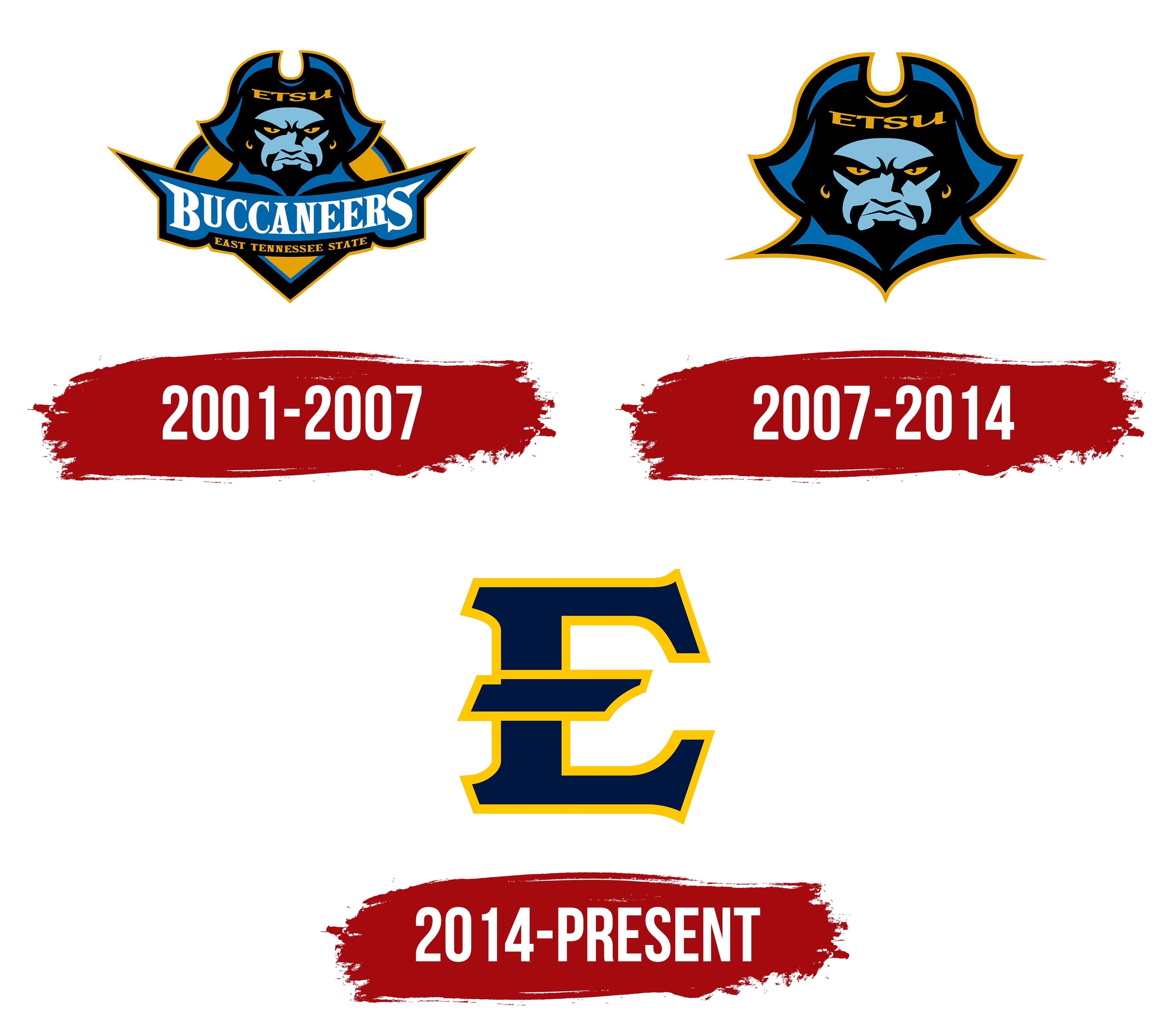
The primary emblem used from 2001 to 2007 arranged the university and team names on three levels. Gold ETSU initials appeared on a black tricorn hat with blue sections. Large BUCCANEERS lettering filled a blue ribbon with raised, pointed ends. Narrow white serif letters varied in height to follow the ribbon’s curve. At the bottom, gold EAST TENNESSEE STATE lettering on a black base spelled out the geographic portion of the university’s name.
A bust of a forward-facing pirate rose above the ribbon. His light blue face contrasted with gold eyes and earrings. Black eyebrows, a mustache, and a beard had sharply angular contours. A rounded gold background ending in a point sat behind him. Blue, black, and gold outer lines united the portrait and text. The collection included a standalone pirate head and versions with ETSU or BUCS, allowing different amounts of text while retaining a consistent appearance.
The new pirate differed from the preceding Running Bucky in pose and proportions. Until 2001, the official athletic emblem had been a full-body running pirate with an oversized head, short legs, and rounded forms. He wore a tricorn hat with a skull and crossbones, an eye patch, a BUCS shirt, and tall boots. A curved saber rested in his raised hand, and a pistol hung from his lowered hand. A navy outline framed the white areas of his face and muted gold clothing.
The university’s live mascot tradition began in 1950 with a goat named Captain Kidd. Captain Kidd II replaced him in 1957. Costumed Bucky pirates followed, wearing tricorn hats and carrying sabers and other pirate accessories. Pepper the Parrot joined them at Homecoming in 1980. The names, costumes, and companion characters maintained the nautical theme long before the modern lettermarks.
After updating its printed identity, the university turned to the mascot’s appearance. In February 2003, the athletic department announced that a costume based on the new logo was in development. Mascot program representative Aaron Fielden explained that the costumed character should resemble the redesigned pirate. Students were invited to enter a naming contest, with Bucky remaining an option. The character would appear at games, visit children’s hospitals, and participate in parades and university gatherings.
2007 – 2014
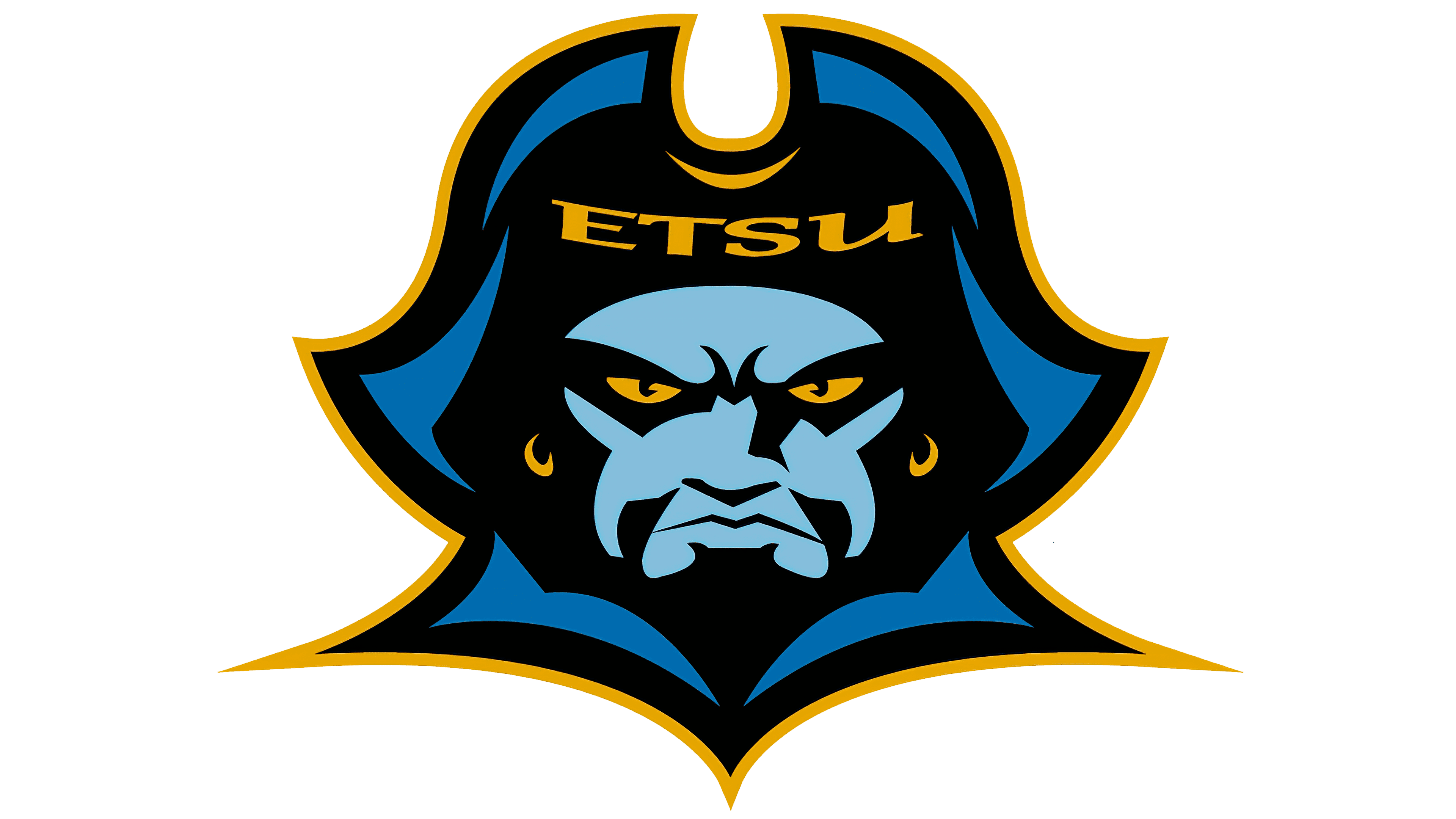
In 2007, BucHead, the standalone Bucky head from the existing collection, became ETSU’s shared athletic emblem. During the 2007–08 season, the athletic department replaced its assortment of logos with a common mark and agreed with Nike to coordinate uniforms and equipment. BucHead remained the primary emblem from 2007 to 2014.
The face remained unchanged, while the BUCCANEERS ribbon, EAST TENNESSEE STATE line, and background disappeared. Gold ETSU letters on the tricorn identified the university. Two outward-spreading blue collar sections completed the lower edge.
With the framing removed, the pirate portrait filled the emblem. Pale blue skin, yellow eyes, and narrow pupils gave Bucky a sinister appearance. The earrings and pointed beard carried over from the previous illustration. New usage guidelines helped maintain a consistent identity across the teams.
2014 – today

In 2014, an “E” replaced the pirate portrait as ETSU’s primary athletic emblem. The change was part of a university-wide identity update. That spring, president Brian Noland described a system with three main images and approximately 120 additional marks for departments, clubs, and other groups. Their colors ranged from blue and gold to light blue, yellow, and gray. Following focus-group discussions, the university began coordinating its identity. The university-wide shield-and-“E” emblem debuted on April 30, followed by the athletic collection on July 23.
Torch Creative worked on both parts of the project, developing lettermarks, a pirate profile, and mascot imagery. The primary athletic “E” used navy with a gold outline, heavy strokes, and flared terminals with slightly curved outer edges. A silhouette of Tennessee replaced its middle bar. The elongated shape, with its irregular eastern edge, resembled a separate form laid over the letter. Incorporating the state into the initial of East connected the emblem to the university’s name. When paired with text, the “E” appeared above it.
The pirate portrait remained a secondary mark. The new head faced right in profile. Navy hair and a long, pointed beard framed a gold face, while the tricorn used the same dark color. The ends of a bandanna streamed behind the head, and an earring remained in the ear. This profile replaced BucHead’s symmetrical, forward-facing blue face. Torch Creative also explored a three-quarter view during development. The university preferred the profile, and the studio later shared the rejected illustration in a series about unused designs.
The pirate head appeared alone or beside ETSU in large letters with angular serifs. The abbreviation provided a letter-based alternative to the primary “E.” Athletics, Buccaneers, Bucs, and sport names could appear beneath the marks in Sling’s Light, Normal, or Bold weights. A separate restriction applied to the “E.” It was to be used only as an approved emblem, rather than substituted for ordinary letters within words.
The color standards specified Pantone 282 navy and Pantone 123 gold. This pairing replaced the black, blue, light blue, and gold of the earlier portrait. The shared colors united the primary “E,” ETSU wordmark, and secondary pirate image.
A historic character returned to the athletic identity on October 7, 2023. At the Homecoming football game against Mercer, the university introduced Running Bucky 2.0. The project responded to students and alumni who wanted the running pirate back. Licensing director Barb Mason described the effort as a way to connect the university’s past with its current identity. By then, the original Running Bucky remained in the archive collection for throwback merchandise. The updated version retained his earlier pose.
Bucky now ran with a gold BUCS flag, his free hand clenched into a fist. The saber and pistol were removed. Both eyes replaced the eye patch, and a beard covered the previously clean-shaven face. BUCS moved from the chest to the flag, making room for ETSU on the white shirt. The university’s “E” replaced the skull and crossbones on the tricorn and appeared again on the belt buckle. Gold accents highlighted the navy pants and boots, and a white outline surrounded the figure. Running Bucky 2.0 received a bronze Collegiate Advertising Award in the logos, trademarks, and mascots category.